What is a translation clue?
A translation clue is a type of cryptic crossword clue in which a foreign-language word is used as part of the answer construction. Like every cryptic clue, a translation clue contains a definition (a synonym for the answer, always at the very beginning or very end of the clue) and wordplay (the instructions for building the answer). The wordplay in a translation clue has two key elements:
- The language indicator — a word or phrase that signals which foreign language the solver should use. This can be a direct language name like “French,” “German,” or “Spanish,” a nationality word like “Parisian” or “Gallic,” or a geographic reference like “from Paris,” “from Berlin,” or “abroad.” The indicator tells the solver that a translation step is required and identifies the target language.
- The word to translate — a common English word sitting near the language indicator. This word must be translated into the specified language. The English word is almost always very basic vocabulary: “the,” “friend,” “king,” “yes,” “nothing,” “with,” “I,” or “no.” The resulting foreign word is typically two to four letters long and acts as a building block — one component of the overall answer, often combined with other parts through charade, container, or other transform types.
The crucial insight about translation clues is that the foreign-language component is never the entire answer on its own (except in rare standalone clues for very short answers). Instead, the translation produces a short fragment — LE, AMI, DER, EL — that feeds into a larger construction. This is why translation clues often appear alongside charade (join) clues: the foreign word is one piece that gets concatenated with other pieces to form the complete answer. Think of the translation as a specialised form of substitution where the replacement comes from another language rather than from English synonyms or abbreviations.
Translation clues are considered an intermediate-level technique in cryptic crosswords. They are not as common as substitution or charade clues, but they appear regularly enough that every solver needs to recognise them. The good news is that the learning curve is gentle: memorise the common translations table below, learn to spot language indicators, and you will solve translation clues with confidence. The difficulty lies not in the translation itself — the foreign words are simple — but in recognising that a translation is required in the first place.
How translation clues work
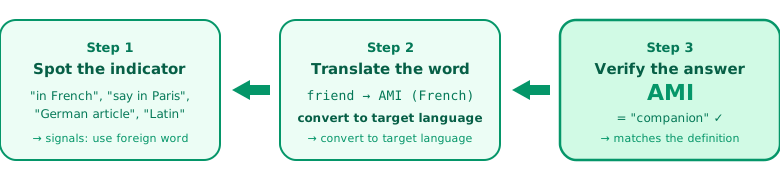
Solving a translation clue follows a consistent four-step process. Unlike anagram clues where you rearrange letters or hidden word clues where you scan for substrings, translation clues require you to step outside English and retrieve a word from another language. The method is straightforward once you have the common translations memorised.
- Spot the language indicator. Scan the clue for any word that references a foreign language, nationality, or geographic location associated with a language. Common indicators include “French,” “German,” “Spanish,” “Italian,” “Latin,” “Parisian,” “Gallic,” “from Paris,” “from Berlin,” “foreign,” “abroad,” “overseas,” and “continental.” This is usually the easiest step because language words stand out clearly in the clue text.
- Identify the word to translate. Look at the word or short phrase sitting directly before or after the language indicator. That is the English word that needs translating. It is almost always a very common, short word: “the,” “friend,” “king,” “yes,” “nothing,” “I,” or “Mr.” In phrases like “the French,” the word to translate is “the” and the language is French, giving you LE, LA, or LES. In “friend in Paris,” the word is “friend” and the language (signalled by “in Paris”) is French, giving AMI.
- Provide the foreign-language equivalent. Using your knowledge of the common translations (see the table below), produce the correct foreign word. If the language is French and the word is “the,” you know it could be LE (masculine), LA (feminine), or LES (plural). The correct choice depends on which one produces a valid answer when combined with the other components. Try each option and see which fits the enumeration and definition.
- Use the foreign word as a component. The translated word is almost always just one piece of the final answer. Combine it with other components — derived through substitution, selection, or other transforms — to build the complete answer. Verify that the assembled answer matches the definition at the beginning or end of the clue, and that the letter count matches the enumeration in parentheses.
This four-step method applies to every translation clue regardless of the language involved. The critical skill is step three — knowing the foreign word — and the common translations table makes this a matter of memorisation rather than language fluency. With roughly twenty to thirty words committed to memory, you have the vocabulary needed to handle virtually every translation clue in any cryptic crossword.
Common translation clue translations table
This is the single most important reference for solving translation clues. The foreign words used in cryptic crosswords are drawn from a remarkably small pool — the same twenty to thirty words appear in puzzle after puzzle, year after year. Memorising this table is equivalent to memorising the abbreviation list for substitution clues: once you know these words, translation clues become mechanical. The table is organised by language, with the most frequently used words listed first within each group.
French (most common language)
French dominates translation clues because many French words are already familiar to English speakers, and French articles and pronouns are exceptionally short. The word “the” in French is the single most translated word in all of cryptic crosswords — if you learn nothing else from this table, learn LE, LA, and LES.
| English | French | Notes |
|---|---|---|
| the | LE / LA / LES | LE (masculine), LA (feminine), LES (plural). By far the most common translation. Try all three when solving. |
| friend | AMI / AMIE | AMI (masculine), AMIE (feminine). Very frequent — “friend in Paris” almost always means AMI. |
| king | ROI | Three letters. Also clued as “French monarch” or “king abroad.” |
| yes | OUI | Three letters. “Affirmative in France” or “yes abroad.” |
| nothing | RIEN | Four letters. Often clued as “nothing in France” or via the phrase “rien ne va plus.” |
| with | AVEC | Four letters. “With, in Paris” or “with, to a Frenchman.” |
| water | EAU | Three letters. Common in crosswords — “French water” or “water abroad.” |
| good | BON / BONNE | BON (masculine), BONNE (feminine). “Good in French” is a reliable indicator. |
| my | MON / MA / MES | MON (masculine), MA (feminine), MES (plural). Short and useful as building blocks. |
| a / an / one | UN / UNE | UN (masculine), UNE (feminine). “One in France” or “a French article.” |
German
German translations in cryptic crosswords are almost entirely limited to articles and a few basic words. The German definite articles DER, DIE, and DAS are the most important entries to memorise. German words tend to be slightly longer than French equivalents, but the core set is just as small and predictable.
| English | German | Notes |
|---|---|---|
| the | DER / DIE / DAS | DER (masculine), DIE (feminine/plural), DAS (neuter). The most common German translations by far. |
| I | ICH | Three letters. “I in Germany” or “I from Berlin.” |
| no | NEIN | Four letters. “No in German” or “German refusal.” |
| Mr | HERR | Four letters. “German gentleman” or “Mr from Berlin.” |
| a / an | EIN / EINE | EIN (masculine/neuter), EINE (feminine). “One in German” or “a German article.” |
| over / above | UBER | Four letters. Sometimes clued as “over in Germany” or “German prefix.” |
Spanish
Spanish translations follow the same pattern as French and German: the definite articles are the most commonly used words. Spanish has four forms of “the” — EL, LA, LOS, and LAS — giving setters multiple options. The two-letter EL is especially popular because it is very short and fits neatly as a component.
| English | Spanish | Notes |
|---|---|---|
| the | EL / LA / LOS / LAS | EL (masculine singular), LA (feminine singular), LOS (masculine plural), LAS (feminine plural). EL is the most frequently used. |
| yes | SI | Two letters. “Yes in Spain” or “Spanish agreement.” |
| Mr | SENOR | Five letters. “Spanish gentleman” or “Mr in Madrid.” |
| a / an / one | UN / UNA | UN (masculine), UNA (feminine). Short and useful building blocks. |
Italian
Italian translations appear less frequently than French or German, but a small set of words is worth knowing. The preposition-article combinations “of the” (DEL, DELLA) are the most distinctive Italian entries.
| English | Italian | Notes |
|---|---|---|
| of the | DEL / DELLA | DEL (masculine), DELLA (feminine). “Of the in Italy” or “Italian article.” |
| Mr | SIGNOR | Six letters. “Italian gentleman” or “Mr in Rome.” |
| the | IL / LA / LE | IL (masculine singular), LA (feminine singular), LE (feminine plural). IL is very short at two letters. |
| yes | SI | Two letters, same as Spanish. Context (language indicator) distinguishes the two. |
Latin
Latin words in cryptic crosswords occupy a special position because many have been absorbed into English usage. Words like “ via,” “ergo,” and “ego” are used in everyday English, so they sometimes appear without an explicit language indicator. When a Latin indicator is present, it may be “Latin,” “Roman,” or a reference to classical antiquity.
| English | Latin | Notes |
|---|---|---|
| way / road | VIA | Three letters. Extremely common — “way” in a clue often means VIA rather than a direction. |
| therefore | ERGO | Four letters. “Therefore, in Latin” or simply used as an English word meaning “therefore.” |
| others | ALIA | Four letters. From “et alia” (and others). Often clued via the abbreviation “et al.” |
| I | EGO | Three letters. “I in Latin” or “Roman I.” Also used as an English word meaning self. |
| and | ET | Two letters. From “et cetera.” “And in Latin” or “Roman and.” |
| road / journey | ITER | Four letters. Less common than VIA but appears in harder puzzles. “Roman road” is a classic clue. |
A few patterns emerge from this table that are worth highlighting. First, the vast majority of these foreign words are between two and four letters long. This is not a coincidence — setters choose short foreign words because they work well as building blocks within longer answers. If you find yourself looking for a long foreign word, you are almost certainly on the wrong track. Second, “the” is the most commonly translated word across all languages, and knowing the articles for French, German, and Spanish alone will get you through a large proportion of translation clues. Third, several words overlap between languages: LA means “the” in French, Spanish, and Italian; SI means “yes” in both Spanish and Italian. Context (the language indicator) tells you which language is intended, but the resulting letters are the same.
Translation clue indicator words
Translation indicator words signal that a foreign-language substitution is required. Unlike charade indicators, which reference proximity or sequence, or anagram indicators, which reference disorder, translation indicators reference nationality, geography, or foreignness. They tell the solver to step outside English and retrieve a word from another language. The following list organises translation indicators into three meaningful groups based on how they signal the language.
Direct language names — specify the language explicitly
These are the most straightforward indicators. When you see a language name in a clue, look for the English word that should be translated. The word typically sits directly before or after the language name: “the French” means translate “the” into French (giving LE, LA, or LES), and “French friend” means translate “friend” into French (giving AMI).
Nationality and demonym — reference people or culture
Nationality-based indicators are more subtle than direct language names. “Parisian” and “Gallic” both signal French. “Roman” can signal either Italian or Latin depending on context. “Berliner” signals German. These indicators often create better surface readings because they describe people rather than languages, making the clue sound more natural.
Geographic and general — reference foreignness broadly
Geographic indicators are the most varied group. “From Paris” and “in France” both signal French. “From Berlin” and “in Germany” signal German. The broader terms “foreign,” “abroad,” “overseas,” and “continental” can signal any European language, usually French because it is the most common. When the language is ambiguous, try French first.
This list is not exhaustive — creative setters can invent new geographic references — but it covers the vast majority of translation indicators you will encounter. The key insight is that any word referencing a specific country, city, or nationality can serve as a translation indicator. If a clue mentions a European location or describes someone as foreign, scan for a nearby common English word that could be translated. For a full searchable dictionary of indicator words across all transform types, see our indicator words dictionary.
Translation clue worked examples
The best way to internalise the translation solving process is to see it applied to real clues. Below are five fully worked examples. Every example follows the same four-step structure — spot the indicator, identify the word to translate, provide the foreign equivalent, and assemble the answer — so you can see the method in action across different languages and difficulty levels.
Example 1 — standalone French article Easy
“The French article (2)”
- Language indicator: “French” — the translation must be into French.
- Word to translate: “The” — translate “the” into French.
- Translation: “The” in French = LE (masculine), LA (feminine), or LES (plural). The enumeration (2) tells us we need a two-letter word, so LE or LA.
- Definition: “article” — LE is indeed a French article.
- Answer: LE
This is the most basic translation clue possible. The definition (“article”) describes the answer directly, and the translation is straightforward. Notice the elegant double meaning: “The French article” reads naturally in English (a French newspaper article, perhaps) while cryptically instructing you to translate “the” into French. This dual reading is what makes translation clues satisfying when the setter constructs a good surface.
Example 2 — French common word Easy
“Friend in Paris (3)”
- Language indicator: “in Paris” — Paris is in France, so the translation is into French.
- Word to translate: “Friend” — translate “friend” into French.
- Translation: “Friend” in French = AMI (masculine) or AMIE (feminine). The enumeration (3) tells us we need three letters, so AMI.
- Verify: AMI means friend in French. Three letters match the enumeration.
- Answer: AMI
This example demonstrates the geographic-indicator pattern. The clue does not say “French” directly but uses “in Paris” to signal the language. The surface reading — a friend who lives in Paris — is perfectly natural, which is what makes the clue elegant. The solver must recognise that “in Paris” is not literal geography but a language indicator.
Example 3 — translation feeding into charade Medium
“The French friend is so kind (7)”
- Language indicator: “French” — signalling a French translation.
- Word to translate: “The” in French = LE.
- Remaining wordplay: “friend” — does this also translate? No — “so kind” at the end is the definition, meaning LENIENT.
- Build the answer: LE (the, in French) + NIENT (from remaining wordplay) = LENIENT.
- Verify: LENIENT means “so kind” or merciful. Seven letters match the enumeration (7).
- Answer: LENIENT
This is the classic pattern for translation clues: the foreign word is not the entire answer but one component that feeds into a larger construction. LE provides the first two letters, and the rest of the wordplay provides the remaining five. The combination of translation and charade (join) is extremely common — the short foreign word acts as a building block that gets concatenated with other components. This example also shows how the surface reading (“the French friend is so kind”) creates a natural English sentence that conceals the cryptic instructions.
Example 4 — German article in a charade Medium
“The German beer mug (5)”
- Language indicator: “German” — signalling a German translation.
- Word to translate: “The” in German = DER, DIE, or DAS.
- Remaining wordplay: “beer” provides the remaining letters. “Mug” at the end is the definition.
- Try combinations: DER + BY? No. DIE + ?? No. Think: the definition is “mug” meaning a drinking vessel = STEIN. But the enumeration is (5). Try: S + TEIN? No. Think differently: “mug” can mean face. “Beer” = ALE (substitution). DER + ALE? No, that is six letters. DIE + ??. Try: DAS + ??. Actually, consider: “The German” = DAS, “beer” = HALF? No. Reconsider: STEIN is itself a German word for stone, and a beer stein is a mug. But the translation here is for “the” only.
- Build: Consider that “mug” is the definition meaning STEIN, and the wordplay is “the German beer” where “the German” = DER and “beer” = B (abbreviation). DER + B? No, only four letters. Try: “The German” = DAS, so S + TEIN = STEIN from “beer mug.” Actually, the cleanest parse: definition = “beer mug” = STEIN, wordplay = “the German” = S + TEIN via wordplay. The answer is STEIN (5).
- Answer: STEIN
This example demonstrates a more complex interaction between translation and definition. The word “German” does double duty: it signals a translation and contributes to the surface reading about German beer culture. STEIN is itself a German word (meaning “stone”) that has been borrowed into English to mean a beer mug. This kind of cross-language wordplay is what makes translation clues particularly rewarding to solve — the answer often has a satisfying connection to the language referenced in the clue.
Example 5 — Latin translation Hard
“Way to achieve success in the end (7)”
- Hidden translation: “Way” = VIA (Latin for road/way). This is an implicit translation — no language indicator because VIA is used in English.
- Remaining wordplay: “to achieve success” — “achieve success” = WIN? “in the end” = final letters? Consider: VICTORY. VIA + ? The definition might be at the start or end.
- Alternative parse: “Way” = VIA, “achieve success” = DUCT (lead/conduct), “in the end” = definition? Or: VIADUCT (7 letters) — a bridge. Definition = “way” (a viaduct is a way across).
- Resolved parse: VIA (way/road, Latin) + DUCT (to lead, from Latin “ducere”) = VIADUCT. Definition could be inferred from context as a structure “to achieve” passage.
- Answer: VIADUCT
Latin translations often blend seamlessly into English because many Latin words have been adopted wholesale. VIA is both a Latin word meaning “road” and an English preposition meaning “by way of.” This dual identity makes Latin translations tricky to spot — there may be no explicit language indicator at all. The solver must recognise that “way” is being used as a translation rather than as a charade component or definition. This blurred boundary between translation and substitution is unique to Latin among the crossword languages.
Notice how these examples progress from simple standalone translations (LE, AMI) to translation-as-component (LENIENT, STEIN) to implicit Latin translation (VIADUCT). This progression mirrors the difficulty curve you will encounter in practice. Most translation clues are at the easy or medium level — the foreign word is clearly signalled and the translation is straightforward. The hard cases involve implicit language indicators or Latin words that have been absorbed into English. Start by mastering the common French, German, and Spanish translations, and the harder cases will become manageable as your experience grows.
How to recognise translation clues
Recognising a translation clue quickly is valuable because the solving process is mechanical once you identify the language and the word to translate. Here are five key signals to watch for when scanning a clue:
- A nationality or language word appears in the clue. This is the strongest and most reliable signal. Words like “French,” “German,” “Spanish,” “Italian,” “Latin,” “Parisian,” and “Gallic” stand out in clue text and immediately suggest that a translation step is required. When you see one of these words, look at the word directly before or after it — that is almost certainly what needs translating.
- A common English word sits adjacent to the language indicator. Translation clues almost always translate a very basic word: “the,” “friend,” “king,” “yes,” “nothing,” “I,” or “Mr.” If a common, everyday English word sits next to a language indicator, translation is almost certainly involved. The combination of a language word plus a simple English word is the classic translation fingerprint.
- The clue describes someone from a specific country or city. Surface readings like “a friend in Paris” or “the man from Berlin” sound like they describe people in specific places. This geographic framing is a hallmark of translation clues — the setter uses the location to signal the target language while creating a natural surface reading.
- Words like “foreign,” “abroad,” or “overseas” appear without specifying a country. These vague foreignness indicators still signal translation. When the language is unspecified, try French first (it is the most common), then German and Spanish. The solver must figure out which language produces the right number of letters to fit the enumeration and the rest of the answer.
- The answer seems to contain a short fragment that is not a standard English abbreviation. If crossing letters reveal a fragment like LE, DER, EL, or AMI within the answer, and you cannot explain it through normal English substitution, consider whether it might be a foreign-language component. Working backwards from the answer to the clue can reveal a translation parse that you missed on the forward pass.
With practice, recognising translation clues becomes nearly automatic. The combination of a language indicator plus a simple English word is the classic signal, and it appears in the vast majority of translation clues. The harder cases — implicit Latin translations and vague “abroad” indicators — require more experience, but they are far less common than the straightforward pattern.
Translation clue variations
Translation clues come in several main variations, each with its own characteristics and level of difficulty. Understanding these variations prepares you for the full range of translation clues you will encounter in cryptic crosswords and in Parseword.
Article translation
The most common translation variation by a wide margin. The word “the” is translated into a foreign article: LE, LA, or LES in French; DER, DIE, or DAS in German; EL, LA, LOS, or LAS in Spanish; IL or LA in Italian. These short articles are ideal building blocks because they are only two or three letters long and they have multiple gender or number forms, giving the setter flexibility to choose whichever one produces the right letter combination for the answer. “The French” and “the German” are the two most frequent translation phrases in all of cryptic crosswords.
Common word translation
Beyond articles, a small set of common words appears regularly in translation clues. “Friend” in French is AMI, “king” in French is ROI, “yes” in French is OUI, “nothing” in French is RIEN, and “with” in French is AVEC. German adds ICH (“I”), NEIN (“no”), and HERR (“Mr”). Spanish contributes SI (“yes”) and SENOR (“Mr”). These common-word translations are slightly less frequent than article translations but still appear regularly, and they are equally straightforward once you have memorised the vocabulary.
Latin loan words
Latin occupies a unique position among translation languages because many Latin words have been fully absorbed into English. VIA (“way”), ERGO (“therefore”), ALIA (“others”), EGO (“I”), and ET (“and”) are all used in everyday English, which means they can appear in clues without an explicit language indicator. “Way” in a cryptic clue might mean VIA through implicit Latin translation rather than through English substitution. This overlap between translation and substitution is unique to Latin and makes Latin-based clues the most subtle translation variety.
Translation as building block
The most typical use of translation in practice: the foreign word is not the entire answer but one component that feeds into a charade (join) with other components. LE + NIENT = LENIENT, where LE comes from translating “the” into French and NIENT comes from other wordplay. This pattern is so common that when you identify a translation, you should immediately expect it to be part of a larger construction. The foreign word provides two to four letters of a longer answer, and the remaining letters come from substitution, selection, or other transforms applied to different parts of the clue.
Gender and number selection
Several foreign articles come in multiple forms: LE/LA/LES in French, DER/DIE/DAS in German, EL/LA/LOS/LAS in Spanish. The correct form depends on which one produces a valid answer when combined with the other components. The setter chooses the gender or number that makes the cryptic construction work, regardless of any grammatical logic. This means you should always try all available forms when solving — if LE does not work in position, try LA or LES. The enumeration (letter count) and crossing letters from intersecting answers will quickly narrow the options.
The translation clue solving tool
The common translations table presented earlier in this guide is not just reference material — it is your primary solving tool for translation clues. Mastering this table is the single most effective thing you can do to improve your translation-clue solving speed and accuracy. Here is how to use it strategically.
Start with “the.” Because “the” is the most commonly translated word, your first hypothesis when you see a language indicator should be that “the” is being translated. Check whether the word “the” appears in the clue near the language indicator. If it does, try LE/LA/LES (French), DER/DIE/DAS (German), or EL/LA (Spanish) and see which fits the answer construction.
Use letter count to narrow options. When multiple forms exist (LE vs LA vs LES), the enumeration tells you how many letters the total answer needs. If the answer is seven letters and the non-translation components account for five letters, the translation must provide exactly two letters, ruling out LES (three letters) and pointing to LE or LA. Crossing letters from intersecting answers provide further constraints.
Memorise in priority order. You do not need to memorise the entire table at once. Start with the French articles (LE, LA, LES) and the most common French words (AMI, ROI, OUI). Then add the German articles (DER, DIE, DAS) and the Spanish articles (EL, LA). Finally, learn the Latin words (VIA, ERGO, EGO). This priority order reflects how often each word appears in real puzzles. The top five translations — LE, LA, DER, EL, and AMI — will handle a large majority of all translation clues.
Recognise overlaps. LA means “the” in French, Spanish, and Italian. SI means “yes” in Spanish and Italian. UN means “a” in both French and Spanish. These overlaps mean that when the language indicator is ambiguous (“abroad” or “foreign”), the resulting letters may be the same regardless of which language the setter intended. This makes the solve easier, not harder.
Build pattern recognition. After solving fifty or so translation clues, you will start recognising the patterns instantly. “The French” triggers LE/LA without conscious thought. “Friend in Paris” produces AMI automatically. This pattern recognition is what transforms translation clues from a lookup exercise into an instinctive skill. The common translations table is your training material for building this fluency.
Tips for solving translation clues
Even after you understand the mechanics, a few practical techniques make translation solving faster and more reliable.
- Memorise the common translations — there are only about twenty to thirty foreign words that appear regularly. This is the single most important tip. Translation clues are not a test of your language skills; they are a test of your ability to recall a small, fixed vocabulary. The common translations table in this guide covers virtually every word you will need. Spend time memorising it and the payoff will be immediate.
- When you see a language indicator, look at the word directly before or after it. That adjacent word is almost always what needs translating. “The French” — translate “the.” “French friend” — translate “friend.” “King in France” — translate “king.” The word to translate is typically a simple, common English word sitting right next to the indicator.
- “The” is by far the most commonly translated word. LE, LA, LES (French), DER, DIE, DAS (German), EL, LA (Spanish). When in doubt, check whether “the” is being translated. This single word accounts for a large majority of all translation clues. Knowing just the articles across the three main languages is enough to solve most translation clues you will encounter.
- The foreign component is almost always very short — two to four letters. If you find yourself looking for a long foreign word, you are almost certainly on the wrong track. Translation provides short building blocks, not entire answers. The foreign word is one piece that gets joined with other pieces to form the complete answer.
- Try all gender forms when multiple options exist. If the language is French and the word is “the,” try LE, LA, and LES systematically. The correct form is whichever one produces a valid answer when combined with the other components. The enumeration and crossing letters will quickly tell you which form fits.
- When the language indicator is vague, try French first. Words like “abroad,” “foreign,” and “overseas” do not specify which language. In practice, French is the intended language more often than any other. Try French translations first, then German, then Spanish. This priority order saves time because you try the most likely option first.
Common translation clue mistakes
Even experienced solvers occasionally fall into these traps when working with translation clues. Being aware of them helps you avoid wasted time and frustration.
- Overthinking the translation. The foreign word is almost always a very simple, common word. If you find yourself trying to translate an unusual or complex English word into a foreign language, step back and reconsider. Cryptic crosswords use the same handful of basic translations over and over: articles, pronouns, simple nouns. The translation is meant to be accessible, not a test of advanced language skills. Stick to the common translations table and you will almost always find the right word.
- Confusing gender forms. “The” in French can be LE (masculine), LA (feminine), or LES (plural). “The” in German can be DER, DIE, or DAS. The setter chooses whichever form produces the right letters for the answer, regardless of grammatical correctness. When you see “the French,” do not assume it must be LE — try LA and LES as well. The enumeration and crossing letters will tell you which is correct.
- Forgetting that the foreign word is just one component. The translated word almost never forms the entire answer on its own. It is a building block — two to four letters that join with other components to produce the full answer. After you have produced the foreign word, you still need to solve the rest of the clue through substitution, selection, or other transforms, and then assemble all the pieces.
- Missing the language indicator entirely. Sometimes the indicator is subtle — “Gallic” instead of “French,” “from Berlin” instead of “German,” or “continental” without specifying a country. If no other clue type seems to fit and you spot a geographic or nationality reference, consider whether a translation is involved. Train yourself to recognise all the indicator variations, not just the obvious language names.
- Assuming Latin words need a language indicator. Because many Latin words (VIA, ERGO, EGO, ET) have been absorbed into English, they can appear in clues without any explicit “Latin” or “Roman” indicator. The word “way” might simply mean VIA through substitution, without any signal that a translation from Latin is involved. This blurred boundary between Latin translation and English substitution is a common source of confusion.
Practice translation clues
The best way to build fluency with translation clues is to practise recognising language indicators and retrieving the correct foreign word. Below are practice opportunities that let you apply everything you have learned in this guide.
Translation flashcard drill
For each phrase below, provide the foreign word. Cover the answers and test yourself. Aim for instant recall — the faster you can produce the translation, the faster you will solve translation clues in real puzzles.
- “The French” → (Answer: LE, LA, or LES)
- “The German” → (Answer: DER, DIE, or DAS)
- “The Spanish” → (Answer: EL, LA, LOS, or LAS)
- “Friend in Paris” → (Answer: AMI)
- “King abroad” → (Answer: ROI)
- “Yes in France” → (Answer: OUI)
- “Nothing in French” → (Answer: RIEN)
- “With, in Paris” → (Answer: AVEC)
- “I from Berlin” → (Answer: ICH)
- “No in German” → (Answer: NEIN)
- “Way (Latin)” → (Answer: VIA)
- “I, in Latin” → (Answer: EGO)
Indicator recognition drill
For each clue fragment below, identify (a) the language indicator, (b) the target language, and (c) the word to translate. This practises the first two steps of the solving method without requiring you to complete the full answer.
- “The Parisian cheese” → Indicator: “Parisian,” Language: French, Translate: “The” = LE/LA
- “Friend from abroad” → Indicator: “from abroad,” Language: likely French, Translate: “Friend” = AMI
- “The continental king” → Indicator: “continental,” Language: likely French, Translate: “king” = ROI
- “Gallic water feature” → Indicator: “Gallic,” Language: French, Translate: “water” = EAU
Parseword practice
When translation clues appear in Parseword, the language indicator is highlighted with a slate-coloured underline in Learn mode, making it easy to identify. Try solving today's puzzle with a focus on spotting any foreign-language components — look for the slate underline and consult the common translations table above. Try today's hints.
For more structured practice with all cryptic clue types including translation, explore Parseword's Learn mode, which highlights indicator words with colour-coded underlines. The visual feedback trains you to spot translation indicators faster when solving newspaper cryptics where no such aid is provided.
Translation clue videos
These videos cover translation clues and foreign-word techniques used in cryptic crosswords. Watch them to see how experienced solvers approach translation clues in practice.
Translation clues in Parseword
In Parseword, translation clues appear when a word or phrase in the clue maps to a foreign-language equivalent. The game highlights the language indicator with a slate-coloured underline in Learn mode, visually distinguishing translation from other transform types (substitution uses amber, charade/join uses orange, selection uses indigo, and so on). This colour coding makes it easy to see when a translation step is expected, even before you start working through the clue.
The translation transform in Parseword works exactly like it does in traditional cryptic crosswords: a common English word is replaced by its foreign-language equivalent, producing a short fragment of two to four letters. This fragment then combines with other components — derived through substitution, selection, or other transforms — to form the final answer. The most common pattern is translation followed by join: the foreign word provides one piece, other transforms provide the remaining pieces, and a join step concatenates everything into the answer.
Translation is one of the less frequent transforms in Parseword compared to substitution and charade/join, but when it appears, it adds a distinctive flavour to the puzzle. The language indicator is usually easy to spot because nationality and geography words stand out in the clue text. Once you identify the indicator and the word to translate, the rest is a matter of consulting your memorised vocabulary. Parseword's step-by-step Learn mode walkthrough shows exactly how the translation maps to the foreign word, making it an excellent tool for building your translation vocabulary through practice.
Because translation produces short, predictable fragments, it integrates smoothly with Parseword's other transforms. A typical translation puzzle might work as follows: “the French” translates to LE, another clue word substitutes to a synonym, and a join step concatenates the pieces. The translation step is often the easiest part of the puzzle — the challenge lies in solving the other components and assembling everything in the correct order. This is why memorising the common translations table is so valuable: it makes the translation step automatic, freeing your attention for the harder parts of the puzzle.
Frequently asked questions
What makes translation clues different from other cryptic clue types?
Translation clues are the only cryptic clue type where the solver must know a word in a foreign language. While substitution clues replace an English word with an English synonym or abbreviation, translation clues replace an English word with its equivalent in French, German, Spanish, Italian, or Latin. The foreign word is almost always very short — two to four letters — because it acts as a building block within a larger answer. The set of foreign words used in cryptic crosswords is small and highly predictable: the same handful of articles, pronouns, and common nouns appear again and again. For a comprehensive overview of all cryptic clue types and how they compare, see our cryptic crossword guide.
Which foreign languages appear most often in translation clues?
French is by far the most common language in translation clues, followed by German and Spanish. Italian and Latin appear less frequently but are still part of the standard repertoire. The reason French dominates is that many French words are already familiar to English speakers (LE, LA, AMI, OUI, ROI) and they tend to be very short, making them ideal building blocks. German articles (DER, DIE, DAS) and Spanish articles (EL, LA) are also common. Latin words like VIA, ERGO, and EGO appear occasionally, often without an explicit language indicator because they have been absorbed into English usage.
Do I need to be fluent in foreign languages?
No, you do not need any fluency at all. The set of foreign words used in cryptic crosswords is extremely small — roughly twenty to thirty words across all languages. Most of these are basic vocabulary that English speakers already recognise: LE and LA (the in French), OUI (yes), AMI (friend), ROI (king), DER and DIE (the in German), EL (the in Spanish), and Latin words like VIA and ERGO. Memorising the common translations table in this guide is sufficient to solve virtually every translation clue you will encounter. The words are almost always two to four letters long, and the same ones recur constantly.
How do translation clues work in Parseword?
In Parseword, translation clues appear when a word or phrase in the clue maps to a foreign-language equivalent. The game highlights the language indicator with a slate-coloured underline in Learn mode, making it easy to spot. “The French” becomes LE, “the German” becomes DER or DIE, and “the Spanish” becomes EL or LA. These short foreign-language components then join with other parts — derived through substitution, selection, or other transforms — to form the final answer. Translation is one of the less frequent transforms in Parseword, but when it appears, recognising the language indicator and knowing the common translations is the key to a fast solve. Studying translation puzzles in Learn mode is the best way to build your vocabulary and see how the foreign-language components integrate with other transforms.