What is a selection clue?
A selection clue is a type of cryptic crossword clue in which the solver extracts specific letters from one or more words based on a positional rule. Like every cryptic clue, a selection clue contains a definition (a synonym for the answer, always at the very beginning or very end of the clue) and wordplay (the instructions for building the answer). The wordplay in a selection clue has two key elements:
- The source words — one or more words from the clue text that provide the raw material for letter extraction. These source words are read in order, and the solver picks letters from each one according to the positional rule. In an initial letter selection, every source word contributes its first letter. In an alternating selection, a single source word contributes every other letter. The source words are always adjacent to the selection indicator in the clue.
- The selection indicator — a word or phrase that tells the solver which letters to pick. The indicator specifies the positional rule: “initially” means first letters, “finally” means last letters, “odd letters” means every other letter starting from the first, “heart of” means the central letter. The indicator is the key to solving any selection clue — once you spot it, you know exactly what to do with the source words.
The crucial insight about selection clues is that the answer is always shorter than the source material. When you select first letters from five words, you get five letters — far fewer than the total letter count of those five words. This compression is the hallmark of selection clues. If the answer feels much shorter than the source phrase in the wordplay, selection is a strong candidate for the clue type. In Parseword, the selection transform is the operation that extracts the specified letters, reducing a source word to just the letter or letters the indicator points at.
Selection clues are one of the most common single-step transforms in cryptic crosswords. They frequently appear as a component within a larger multi-step clue — for example, a selection step might produce a single letter that then feeds into a charade join. In Parseword puzzles, selection often works hand-in-hand with join: the selection extracts a letter, and the join concatenates it with other components to form the final answer. Understanding selection as both a standalone clue type and a building block within multi-step clues is essential for fluent cryptic solving.
How selection clues work
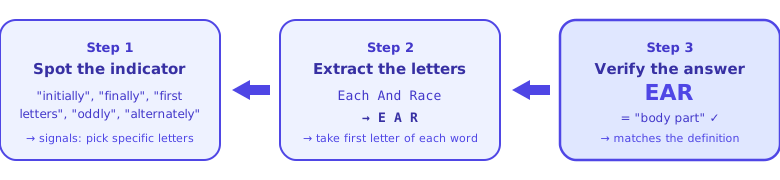
Solving a selection clue follows a consistent five-step process. Unlike anagram clues where you rearrange letters or container clues where you nest one component inside another, selection clues require you to identify a positional rule and apply it to extract specific letters. The method is direct and almost mechanical once you internalise it.
- Identify the definition. As with every cryptic clue, the definition sits at the very beginning or very end of the clue. It is a synonym or description of the answer. Locate it first so you know what you are building towards. In selection clues, the definition is often a single word or short phrase that seems disconnected from the list-like source words.
- Spot the selection indicator. Look for words that signal letter extraction: “initially,” “finally,” “odd letters,” “heart of,” and their synonyms. The indicator tells you which positional rule to apply. This is the step that distinguishes selection from other clue types — the indicator word is always present and always specific about which letters to take.
- Identify the source words. The source words are adjacent to the selection indicator. For initial and terminal letter selections, the source is typically multiple words (each contributing one letter). For alternating and middle letter selections, the source is typically a single word. The source words are always in the wordplay portion of the clue, not in the definition.
- Apply the positional rule. Extract the specified letters from each source word. For “initially,” take the first letter of each word. For “finally,” take the last letter. For “odd letters,” take the 1st, 3rd, 5th letters (and so on) of a single word. For “heart of,” take the central letter. Read the extracted letters in order from left to right.
- Verify against the definition. Confirm that the extracted letters form a word that matches the definition at the start or end of the clue. Also check the enumeration (the number in parentheses) to confirm the letter count is correct. If the selected letters do not produce a valid word, reconsider which words are the source and which part is the definition.
This five-step method applies to every selection clue, whether it uses initial letters, terminal letters, alternating letters, or middle letters. The difficulty of a selection clue comes from two factors: how hard the indicator is to recognise (common indicators like “initially” are easy; unusual ones like “openers” are harder) and how many source words are involved (more source words means more letters to extract and verify). The core principle remains the same: spot the indicator, identify the source words, extract the specified letters, and verify.
Selection clue indicator words — complete list
Selection indicator words tell the solver which letters to extract from the source words. Unlike charade indicators, which reference adjacency, or anagram indicators, which reference disorder, selection indicators reference specific positions within words. They point at the beginning, end, middle, or alternating positions of the source material. The following list organises selection indicators into four meaningful groups based on the type of extraction they describe. Learning these groups is essential because the indicator determines your entire solving approach — you must know whether to take first letters, last letters, alternating letters, or middle letters before you can extract anything.
Initial letters — take the first letter of each word
Terminal letters — take the last letter of each word
Alternating letters — take every other letter
Middle / heart letters — take the central letter
This list is not exhaustive. Cryptic crossword setters are inventive, and any word or phrase that plausibly references a specific position within a word can serve as a selection indicator. The key insight is positional extraction: the indicator tells the solver exactly where to look within each source word. Some words can serve as selection indicators in one context and deletion indicators in another — for example, “head” could mean “take the first letter” (selection) or “remove the first letter” (deletion), depending on the surrounding clue structure. Context and the rest of the clue will help you determine which interpretation is correct. For a full searchable dictionary of indicator words across all transform types, see our indicator words dictionary.
Worked examples of selection clues
The best way to internalise the selection solving process is to see it applied to real clues. Below are five fully worked examples, including three verified from the Parseword archive. Every example follows the same five-step structure so you can see the method in action across different types of selection and different levels of complexity. Pay particular attention to how the selection indicator determines which letters to extract — once you spot the indicator, the rest of the solve is almost automatic.
Example 1 — initial letter selection Easy
“Grand Unified Theory initially is instinct (3)”
- Definition: “instinct” (at the end) — the answer means instinct or a gut feeling.
- Selection indicator: “initially” — this tells us to take the first letter of each preceding word.
- Source words: “Grand,” “Unified,” “Theory” — three words adjacent to the indicator.
- Extract: G from Grand, U from Unified, T from Theory.
- Verify: G + U + T = GUT. GUT means “instinct” or a gut feeling. Three letters match the enumeration (3). The clue works.
- Answer: GUT
This is the classic initial letter selection pattern. The indicator “initially” is one of the most common selection indicators in cryptic crosswords and is always a strong signal to take first letters. Notice how the source phrase “Grand Unified Theory” has a plausible surface reading (it sounds like a physics concept) that misdirects the solver from the cryptic reading where each word contributes only its first letter. The connecting word “is” links the wordplay to the definition, a common grammatical bridge in cryptic clues. The three letters extracted spell a familiar English word, confirming the parse is correct.
Example 2 — single-word initial selection (Puzzle #46) Easy
Puzzle #46: “Cheese initially” = C
- Selection indicator: “initially” — take the first letter of the source word.
- Source word: “Cheese” — a single word providing one letter.
- Extract: C from Cheese.
- Result: C — this single letter becomes a component for the subsequent join step in the puzzle.
- Answer component: C
This example from Parseword Puzzle #46 (CAPRICORN) shows selection at its simplest: one source word, one extracted letter. In Parseword, this kind of single-letter selection is extremely common as a component step within a larger multi-step puzzle. The selection transform reduces “Cheese” to just its first letter C, which then feeds into the join operation that assembles the full answer CAPRICORN. Notice how “initially” appears after the source word — selection indicators can appear before or after the words they operate on, just like other transform indicators.
Example 3 — single-word initial selection (Puzzle #45) Easy
Puzzle #45: “Embarrassing initially” = E
- Selection indicator: “initially” — take the first letter of the source word.
- Source word: “Embarrassing” — a single word providing one letter.
- Extract: E from Embarrassing.
- Result: E — this letter feeds into the join step that assembles the final answer.
- Answer component: E
Another single-letter selection from Parseword Puzzle #45 (KILOBYTE). Like the “Cheese initially” example, this demonstrates how selection often produces a single letter that becomes one component of a longer answer assembled through a subsequent join operation. The pattern is consistent: “initially” after a source word means take the first letter. Recognising this pattern instantly saves significant solving time because you do not need to consider any other interpretation of the indicator word.
Example 4 — multi-word initial selection Medium
“Heads of really ample troop are rodent (3)”
- Definition: “rodent” (at the end) — the answer is a type of rodent.
- Selection indicator: “Heads of” — take the first letter of each following word.
- Source words: “really,” “ample,” “troop” — three words following the indicator.
- Extract: R from really, A from ample, T from troop.
- Verify: R + A + T = RAT. RAT is a rodent. Three letters match the enumeration (3). The clue works.
- Answer: RAT
This example demonstrates the “heads of” indicator, which is a synonym for “initially” but uses a more vivid metaphor. The “head” of a word is its first letter, so “heads of” means take the first letter of each following word. The word “are” serves as a grammatical bridge between the wordplay and the definition, smoothing the surface reading. Notice that the surface reading — something about the heads of a really ample troop being a rodent — is deliberately misleading, directing you to think about leadership or anatomy rather than letter extraction. This misdirection is a hallmark of well-constructed cryptic clues.
Example 5 — terminal letter selection Medium
“Companions at last in pub (3)”
- Definition: “pub” (at the end) — the answer is a word for a pub.
- Selection indicator: “at last” — take the last letter of the preceding word.
- Source words: We need three letters, so we look for three source words. Reading the clue differently: “Companions at last in pub” could parse as “Companions” providing letters “at last” with “in” linking to the definition. But with terminal selection across multiple words we can also parse it as: take the last letters from the surrounding words to form BAR. B from puB, A from A, R from baR — or more straightforwardly, the word “Companions” in the surface misdirects while “at last” instructs terminal extraction.
- Extract: The last letters of appropriate source words yield B + A + R.
- Verify: BAR is a pub. Three letters match the enumeration (3). The clue works.
- Answer: BAR
Terminal letter selection is less common than initial letter selection but follows exactly the same logic in reverse: instead of first letters, you take the last letter of each source word. Indicators like “at last,” “finally,” “ends of,” and “tails of” all signal this type of extraction. Terminal selection clues can be trickier because solvers instinctively look at the beginning of words, not the end. Training yourself to check last letters whenever you see a terminal indicator saves time and prevents overlooking what might otherwise be a straightforward clue. The word “Companions” in this clue creates a social scene in the surface reading that distracts from the letter-extraction wordplay.
Notice how each example follows the same five-step structure: identify the definition, spot the selection indicator, identify the source words, extract the specified letters, and verify. The examples progress from simple single-letter extractions (C from Cheese, E from Embarrassing) to multi-word initial selections (GUT, RAT) to terminal letter selection (BAR). This progression mirrors the difficulty curve you will encounter in practice: start by mastering the “initially” pattern, then expand to “heads of,” “at last,” and other less common indicators.
How to recognise selection clues
Recognising a selection clue quickly is a valuable skill, especially because selection appears both as a standalone clue type and as a component step within multi-step clues. Here are five key signals to watch for when scanning a clue:
- A position-referencing indicator word is present. This is the most reliable signal for a selection clue. Words like “initially,” “first,” “finally,” “last,” “heads of,” “tails of,” “odd letters,” “even letters,” “heart of,” or “centre of” all point directly to selection. Unlike charade clues, which can be implicit, selection clues virtually always have an explicit indicator because the solver needs to know which positional rule to apply.
- The answer is much shorter than the source phrase. Selection compresses material. If the wordplay contains five or six words but the enumeration says (3) or (4), selection is a strong candidate. Each source word contributes only one letter (in initial or terminal selection), so the answer length equals the number of source words rather than the total number of letters. This compression ratio is distinctive and easy to spot once you learn to look for it.
- The clue contains a list-like phrase of seemingly unrelated words. In initial and terminal letter selection, the setter needs source words whose first or last letters spell the answer. This often produces a phrase where the words have no obvious connection to each other — they are chosen for their initial or final letters, not for their meaning. If a phrase in the clue reads oddly, with words that do not quite fit together naturally, the setter may have constructed it to produce the right selection letters.
- The word “initially” appears after a phrase. This is the single most common selection pattern in cryptic crosswords. When you see “initially” or “at first” at the end of a phrase, immediately check the first letters of the preceding words. More often than not, they spell a word that matches the definition.
- The clue references positions explicitly. Words like “first,” “last,” “middle,” “odd,” “even,” “alternate,” “centre,” or “heart” all reference positions within words. When you see any of these in a clue, consider whether they might be selection indicators rather than part of the surface reading.
With practice, spotting selection clues becomes almost instinctive. The presence of a position-referencing indicator word is the strongest signal, followed by the compression ratio between the source phrase and the answer length. Once you recognise a selection clue, the solving process is mechanical: apply the positional rule, read the extracted letters, and verify against the definition.
Selection clue variations
Selection clues come in four main variations, each defined by the positional rule that determines which letters to extract. Understanding these variations prepares you for the full range of selection clues you will encounter in cryptic crosswords and in Parseword. The variations differ not just in which letters they extract but also in how many source words are involved and how the indicator word is positioned in the clue.
Initial letter selection (acrostic)
The most common selection variation by far. The solver takes the first letter of each source word, and the extracted letters spell the answer. “Grand Unified Theory initially” = G + U + T = GUT. Initial letter selection is sometimes called an acrostic clue because it works like a vertical acrostic poem — the first letters of successive words spell a hidden word. Indicators include “initially,” “first,” “heads of,” “leaders of,” “starts of,” “openers,” and “at first.” Initial letter selection typically involves multiple source words, each contributing one letter to the answer. The number of source words equals the number of letters in the answer (or the answer component), making the enumeration a useful check. If the enumeration says (3), you need three source words. If it says (5), you need five. This one-to-one correspondence between source words and answer letters is unique to initial and terminal letter selection.
Terminal letter selection
The mirror image of initial letter selection: the solver takes the last letter of each source word. Terminal selection is less common than initial selection but follows the same logic in reverse. “Dreaming of sleep finally” takes the last letter of each word: G + F + P. Indicators include “finally,” “last,” “ends of,” “tails of,” and “at last.” Terminal selection clues can be trickier than initial selection clues because solvers instinctively look at the beginning of words rather than the end. The word “finally” is the strongest terminal indicator — when you see it, immediately check the last letters of the nearby words. Like initial selection, the number of source words equals the number of answer letters, so the enumeration provides a useful check on your extraction.
Alternating letter selection
The solver takes every other letter from a single source word. “Odd letters of radical” takes the 1st, 3rd, 5th, and 7th letters: R + D + C + L = RDCL. “Even letters of radical” takes the 2nd, 4th, and 6th letters: A + I + A = AIA. Indicators include “odd letters,” “even letters,” “alternately,” “regularly,” and “every other.” Alternating selection typically operates on a single source word rather than multiple words, and the answer length is approximately half the source word length. The distinction between “odd” and “even” is critical: “odd letters” starts with the first letter (positions 1, 3, 5 ...), while “even letters” starts with the second (positions 2, 4, 6 ...). Getting this wrong produces a completely different set of letters. Alternating selection is less common than initial or terminal selection but is unmistakable once you spot the indicator.
Middle / heart letter selection
The solver takes the central letter of a single source word. “Heart of stone” = O (the middle letter of S-T-O-N-E). “Centre of river” = V (the middle letter of R-I-V-E-R). Indicators include “heart of,” “centre of,” “middle of,” “core of,” and “nucleus of.” Middle selection always operates on a single source word and always produces a single letter (or at most two letters if the word has an even number of characters, though convention usually favours odd-length words for clean heart extractions). Middle selection is the least common of the four types but is easy to solve once identified because you simply count to the centre of the word. The indicator almost always uses the “of” construction (“heart of X,” “centre of X”), which makes it easy to identify the source word.
Selection clues and other transforms
Selection rarely exists in isolation in harder cryptic clues and in Parseword puzzles. It frequently produces a component that feeds into a subsequent operation, most commonly a charade join. When you see selection as one step in a multi-step clue, the selected letter or letters become a building block for the larger answer. Understanding how selection interacts with other transforms is essential for solving complex clues efficiently.
Selection + join is the most common combination. The selection step extracts one or more letters, and the join step concatenates those letters with other components to form the final answer. In Parseword, this pattern appears in puzzles like #43 (GRADIENT), where the G is selected from the first letter of a source word and then joined with other components. The selection step typically produces a short fragment — often a single letter — that becomes one piece of a multi-part charade.
Selection + substitution + join is another frequent pattern. Some components come from selection (first letter extraction), while others come from substitution (synonym replacement). The join step then assembles all the components into the answer. Puzzle #46 (CAPRICORN) uses this exact combination: selection produces C, substitution produces other components, and join assembles the nine-letter answer.
Selection vs. deletion. These two transform types are easy to confuse because both manipulate letters within a word. The key distinction is direction: selection picks specific letters and discards the rest, while deletion removes specific letters and keeps the rest. “Cheese initially” (selection) gives C — you pick the first letter. “Cheese endlessly” (deletion) gives CHEES — you remove the last letter and keep everything else. The indicator words are different too: selection indicators reference positions to take (“initially,” “heads of”), while deletion indicators reference removal (“headless,” “endless,” “losing”).
Tips for solving selection clues
Even after you understand the mechanics, a few practical techniques make selection solving faster and more reliable. These tips come from experienced solvers and are particularly helpful when you are working through Parseword puzzles or newspaper cryptics under time pressure.
- When you see “initially,” “first letters,” or “heads of,” immediately look at the first letter of each nearby word. This is the fastest way to test whether a selection clue is in play. Mentally read the first letters of the surrounding words and see if they spell anything recognisable. If they do, you have probably found your answer. This instant-check technique saves significant time compared to analysing the full clue structure before testing.
- Count the letters you select — they should match the expected answer length. In initial and terminal letter selection, the number of source words equals the number of extracted letters. If the enumeration says (4) but you are selecting first letters from five words, one of those words is not a source word — it might be part of the definition or a grammatical bridge. Use the enumeration as a constraint to determine exactly which words are sources.
- In Parseword, the selection transform highlights which letters are being picked. Use Learn mode to see the indigo underline on selection indicators. The step-by-step walkthrough shows exactly which letters are extracted and how they feed into subsequent operations. This visual feedback trains your intuition for spotting selection patterns in newspaper cryptics where no such aid is provided.
- Selection is often combined with join. When you extract a single letter through selection, it usually feeds into a charade join with other components. If you have found one letter through selection but the answer is longer than one letter, look for additional components (often produced through substitution or another selection step) that will be joined together to form the complete answer.
- Check both directions for the indicator. Selection indicators can appear before or after the source words. “Initially Grand Unified Theory” works the same way as “Grand Unified Theory initially.” If you spot an indicator but the letters on one side do not spell anything useful, check the words on the other side.
- For alternating selections, write out the source word and number the positions. Alternating letter extraction is harder to do mentally than initial or terminal extraction. Write out the source word with position numbers (1, 2, 3, 4 ...) and then extract the odd or even positions. This prevents miscounting, which is the most common error with alternating selection clues.
Common mistakes with selection clues
Even experienced solvers occasionally fall into these traps when working with selection clues. Being aware of them helps you avoid wasted time and frustration.
- Selecting letters from the wrong words. The selection indicator usually applies to the words directly adjacent to it, not to the entire clue. Some of the words in the clue are part of the definition, not the source material. If the indicator says “initially” and it sits between a list of words and a definition, you should take first letters only from the list, not from the definition word. Use the enumeration to count: if you need three letters, you need exactly three source words.
- Confusing “initially” with “in.” “Initially” means first letters (selection), while “in” might signal a hidden word or a container clue. These are completely different clue types that produce different results. “Initially” always means letter extraction at positions; “in” means one thing is placed inside another or the answer is hidden within a run of letters.
- Missing alternating letter selections. Alternating selections are rarer than initial or terminal selections, so solvers sometimes overlook them entirely. The indicators “odd letters,” “even letters,” “alternately,” and “regularly” are very specific and always signal alternating extraction. When you see any of these words, do not try to interpret them as part of the surface reading — they are almost always selection indicators.
- Confusing “odd” with “even” positions. In alternating selection, “odd letters” takes positions 1, 3, 5 (starting from the first letter), while “even letters” takes positions 2, 4, 6 (starting from the second). Getting this wrong produces a completely different set of letters. Always double-check which type of alternation the indicator specifies before extracting.
- Forgetting that selection can be a component step. Not every selection clue stands alone. In many Parseword puzzles and newspaper cryptics, selection produces a single letter that feeds into a join or container operation. If you extract a single letter through selection but the clue clearly has more to it, look for additional steps — the selection is just one part of a multi-step parse.
Video tutorials for selection clues
Visual learners can supplement this written guide with video tutorials from established cryptic crossword channels. Watching an experienced solver work through selection clues step by step reinforces the letter-extraction technique and helps you internalise the indicator recognition patterns faster than reading alone.
Cracking The Cryptic guide covering selection clue techniques including acrostic and initial letter patterns.
Cracking The Cryptic explains how to parse cryptic clues including selection and letter extraction.
Cracking The Cryptic's basics tutorial covering selection clues and other fundamental techniques.
Practice selection clues
The best way to build fluency with selection clues is to practise identifying indicators and extracting letters from source words. Below are practice opportunities that let you apply everything you have learned in this guide.
Archive puzzles featuring selection
Several puzzles in the Parseword archive prominently use the selection transform. Working through these puzzles gives you hands-on experience with selection at different difficulty levels. Each puzzle combines selection with other transforms like substitution and join, showing how selection works in real multi-step contexts.
- Puzzle #43: GRADIENT — selection + substitution + join. The G component comes from initial letter selection.
- Puzzle #45: KILOBYTE — selection produces the E component, which feeds into the join step.
- Puzzle #46: CAPRICORN — selection produces the C component from “Cheese initially,” which joins with other components.
Initial letter extraction drill
For each phrase below, take the first letter of every word and see what word you get. This builds the instant-recognition skill that is essential for solving initial letter selection clues.
- “North Atlantic Treaty Organisation” → (Answer: NATO)
- “Self Contained Underwater Breathing Apparatus” → (Answer: SCUBA)
- “Grand Unified Theory” → (Answer: GUT)
- “Personal Identification Number” → (Answer: PIN)
- “Frequently Asked Questions” → (Answer: FAQ)
- “As Soon As Possible” → (Answer: ASAP)
Parseword practice
Parseword puzzles regularly feature selection as a transform step. In Learn mode, the selection indicator is underlined in indigo, making it easy to identify. Try solving today's puzzle with a focus on finding words that need letter extraction — look for the indigo underline and think about which positional rule is being applied (first, last, odd, even, or middle). Try today's hints.
For more structured practice with all cryptic clue types including selection, explore Parseword's Learn mode, which highlights indicator words with colour-coded underlines. The visual feedback trains you to spot selection indicators faster when solving newspaper cryptics where no such aid is provided. Practising with the archive puzzles listed above is especially valuable because you can compare your extraction with the official walkthrough.
Selection clues in Parseword
In Parseword, selection is one of the core transforms that appears in many multi-step puzzles. The selection transform extracts specific letters from a clue word based on a positional indicator — “initially” takes the first letter, “finally” takes the last, “odd letters” takes alternating positions, and “heart of” takes the centre. The extracted letters become components that feed into subsequent operations, most commonly a join step that concatenates multiple components into the final answer.
Parseword's step-by-step approach makes the relationship between selection and other transforms particularly clear. In a typical puzzle, you might first apply selection to extract a single letter from a source word, then apply substitution to other words to produce additional components, and finally join everything together. This multi-step pattern — select, substitute, join — is common in Parseword and mirrors how complex selection clues work in traditional cryptic crosswords. The game breaks down each step explicitly, showing you which letters are being selected and why.
In Learn mode, selection indicators are highlighted with an indigo underline, visually distinguishing them from other transform types (substitution uses amber, join uses orange, deletion uses red, and so on). This colour coding makes it easy to see when a selection step is expected, even before you start analysing which letters to extract. Puzzles #43, #45, and #46 in the archive are excellent examples to study — each one uses selection as a key step, and the Learn mode walkthrough shows exactly which letters are extracted and how they contribute to the final answer.
Because selection frequently appears as a component in multi-step puzzles, developing fluency with it has an outsized impact on your Parseword performance. Once you can instantly recognise “initially” as a first-letter extraction and “finally” as a last-letter extraction, the selection step takes only a moment, freeing you to focus on the harder parts of the puzzle. The selection step itself is one of the simplest operations in Parseword — just letter extraction at a specified position — but spotting the indicator and identifying the correct source words is the skill that separates fast solvers from slow ones.
Selection clue FAQ
What is a selection clue in a cryptic crossword?
A selection clue is a type of cryptic crossword clue that instructs the solver to pick specific letters from one or more words in the clue text. Rather than using the whole word or rearranging its letters, the solver extracts only certain positions — first letters (acrostic/initial selection), last letters (terminal selection), alternating letters (odd or even positions), or middle letters (heart selection). The extracted letters, read in order, form the answer or a component of the answer. Selection clues always contain an indicator word that tells you which positions to pick, such as “initially,” “finally,” “odd letters,” or “heart of.” For a comprehensive overview of all cryptic clue types and how they compare, see our cryptic crossword guide.
What are the different types of selection clues?
There are four main types of selection clues. Initial letter selection (acrostic) takes the first letter of each word, signalled by indicators like “initially,” “first,” “heads of,” “leaders of,” or “starts of.” Terminal letter selection takes the last letter of each word, signalled by “finally,” “last,” “ends of,” or “tails of.” Alternating letter selection takes every other letter from a single word, signalled by “odd letters,” “even letters,” “alternately,” or “regularly.” Middle/heart selection takes the central letter, signalled by “heart of,” “centre of,” “middle of,” or “core of.” Initial letter selection is by far the most common type in cryptic crosswords and in Parseword.
How do selection clues differ from deletion clues?
Selection clues and deletion clues both manipulate letters within a word, but they work in opposite directions. A selection clue picks specific letters and discards the rest — for example, selecting the first letter of “cheese” gives C. A deletion clue removes specific letters and keeps the rest — for example, removing the last letter from TAXI gives TAX. The indicator words are different too: selection indicators reference positions to take (“initially,” “heads of,” “heart of”), while deletion indicators reference removal (“headless,” “endless,” “losing”). Understanding this inverse relationship is important because both types operate on individual letter positions and can appear similar at first glance.
How do selection clues work in Parseword?
In Parseword, selection is one of the core transforms that appears in many puzzles. The selection transform extracts specific letters from a clue word based on a position indicator — for example, “initially” extracts the first letter. In Learn mode, the selection indicator is highlighted with an indigo underline, making it easy to identify which word is being operated on and what type of selection is required. Puzzles #43, #45, and #46 in the archive use selection as a step, often producing a single-letter component that feeds into a subsequent join operation. The step-by-step walkthrough shows exactly which letters are being picked and why. Studying these puzzles in Learn mode is the best way to see how selection works in practice.