Getting started
Cryptic Crosswords for Beginners — A Complete Guide
Cryptic crosswords are word puzzles in which every clue is a small, self-contained riddle. Unlike a regular crossword — where you are given a simple synonym or definition and either know the answer or you do not — a cryptic clue gives you two independent paths to the same answer. One path is a straight definition. The other is a set of wordplay instructions that, when followed correctly, spell out the answer letter by letter.
That double structure is exactly why cryptic crosswords are worth learning. You are never stuck with a single “know it or not” test. Even if the definition does not immediately suggest the answer, the wordplay gives you a second route in. And when you do find the answer through the wordplay, the definition confirms it — producing the satisfying “click” that makes cryptic solving so rewarding.
This guide walks you through everything you need to go from zero to solving your first clues. It covers the structure of cryptic clues, all ten clue types, indicator words, a practical solving strategy, common mistakes, and a recommended learning path. You do not need any prior experience with crosswords to follow along.
What makes a cryptic clue different?
In a regular crossword, a clue like “Joyful (5)” simply asks for a five-letter synonym of “joyful” — the answer is HAPPY. You either know a matching word or you do not. There is only one route to the answer.
In a cryptic crossword, every clue contains two independent parts that each lead to the same answer:
- The definition — a synonym or description of the answer, always placed at the very beginning or the very end of the clue.
- The wordplay — a set of coded instructions (an anagram, a hidden word, a charade, or another device) that spells out the answer through letter manipulation.
Consider this double-definition clue: “Game animal (4).” The answer is HARE. Both words independently define the same answer — a hare is an animal, and a hare is hunted as game. Two definitions, one answer.
Here is a slightly more complex example: “Book about a mountain feature — a card game (6).” The answer is BRIDGE. The definition is “card game” at the end of the clue. The wordplay gives you B (the standard crossword abbreviation for “book”) placed next to RIDGE (“mountain feature”), which combine to form B + RIDGE = BRIDGE. Once again, both paths arrive at the same word.
The surface reading — the sentence the clue appears to be about on first reading — is deliberately misleading. The clue above sounds like it describes a non-fiction book about geography. That has nothing to do with the answer. The setter crafts the surface to distract you from seeing the wordplay. Your job as a solver is to see through the surface, separate the definition from the wordplay, and arrive at the answer through both paths. When both paths agree, you know you have the right word.
The anatomy of a cryptic clue
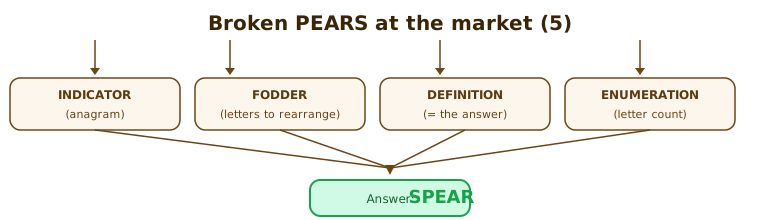
Let us break down one clue in full detail to see how every word earns its place. Consider:
“Mix up pears to make a weapon (5)”
The answer is SPEAR. Here is how every word in the clue functions:
- Definition: “weapon” — this sits at the end of the clue. A spear is a weapon.
- Indicator word: “Mix up” — this signals an anagram. It tells you to rearrange the letters of the word that follows it. Words suggesting disorder, change, or reconstruction are typical anagram indicators.
- Fodder: “pears” — these five letters (P, E, A, R, S) are the raw material for the anagram. Notice that the number of fodder letters matches the answer length in the parentheses — always a useful check for anagram clues.
- Linking words: “to make a” — these words connect the wordplay to the definition and make the clue read as a natural sentence. Linking words have no role in the wordplay mechanics.
- Verification: Rearrange the letters of PEARS — P, E, A, R, S — and you can form SPEAR. The definition “weapon” confirms the answer. Both paths lead to the same word.
Notice how the surface reading sounds like someone mixing up fruit to create something. That misleading surface is deliberate and has nothing to do with the actual answer. The setter's craft lies in making the functional components (definition, indicator, fodder) read like a natural sentence about something completely different.
Every cryptic clue follows this structural pattern. There is always a definition, always wordplay, usually an indicator word (though some types like charades may not need one), and sometimes linking words. Once you learn to parse clues into these functional components, the solving process becomes systematic rather than mysterious.
The 10 clue types you need to know
Cryptic clues fall into about ten main categories. Each type uses a different wordplay mechanism to arrive at the answer. Learning to recognise these types is the foundation of cryptic solving. Here is a brief overview of each one with a worked example, plus a link to the full guide for deeper study.
1. Substitution
A substitution clue replaces a surface-level word with a synonym or standard abbreviation. This is the most fundamental operation in cryptic crosswords — almost every other type uses substitution as a building block. For instance, in the clue “Book about a mountain feature — a card game (6),” the word “book” substitutes to the single letter B (a standard crossword abbreviation). Common substitutions you will see repeatedly include P for “quiet” (from the musical marking piano), R for “king” (from Latin Rex), N for “north,” and E for “east.” Substitution is rarely the sole mechanism in a clue — it contributes building blocks that combine with other operations. Read the full substitution guide.
2. Anagram
An anagram clue tells you to rearrange a set of letters to form the answer. An indicator word signals the rearrangement — look for words suggesting disorder or change, such as “broken,” “wild,” “crazy,” or “new.” Example: “Mix up pears to make a weapon (5).” The indicator “mix up” tells you to rearrange the letters of “pears” (P, E, A, R, S), giving SPEAR, which is a weapon. Always check that the number of letters in the fodder matches the answer length. Read the full anagram guide.
3. Container
A container clue places one set of letters inside another. Indicators like “holding,” “around,” or “involving” signal the operation. Example: “Obvious affair involving part of the psyche (7).” The word “affair” gives EVENT, and “part of the psyche” gives ID (the Freudian term). The indicator “involving” tells you to place ID inside EVENT: EV + ID + ENT = EVIDENT, meaning “obvious.” The definition sits at the start of the clue. Read the full container guide.
4. Deletion
A deletion clue removes one or more letters from a word to reveal the answer. Indicators tell you what to remove: “headless” means drop the first letter, “endlessly” or “almost” means drop the last, and “heartless” means remove the middle. Example: “Almost priced — that's the cost (5).” The indicator “almost” tells you to remove the last letter from PRICED, giving PRICE, which means “cost.” Read the full deletion guide.
5. Reversal
A reversal clue spells a word or component backwards to form the answer. Indicators include “back,” “returned,” “up” (in down clues), or “reflected.” Example: DESSERTS reversed letter by letter gives STRESSED — one of the most famous reversal pairs in English. In a down clue you might see “Puddings going up cause tension (8)” where “going up” is the reversal indicator, “puddings” gives DESSERTS, and “tension” is the definition for STRESSED. Read the full reversal guide.
6. Hidden Word
In a hidden word clue, the answer is spelled out consecutively within the letters of the clue itself. Indicators include “in,” “within,” “partly,” or “some.” Example: “Bargain event held in this ale (4).” The indicator “held in” tells you the answer is hidden inside the surrounding words. Look at the letters spanning “thiS ALE” and you find SALE, which means “bargain event.” Hidden word clues are the most beginner-friendly type because the answer is literally visible inside the clue text. Read the full hidden word guide.
7. Homophone
A homophone clue uses a word that sounds like the answer. Indicators include “we hear,” “reportedly,” “on the radio,” or “sounds like.” Example: “Sounds like nighttime for a chess piece (6).” The indicator “sounds like” tells you the answer sounds like another word. “Nighttime” gives NIGHT, which sounds like KNIGHT — a chess piece. The definition is “chess piece” and the answer is KNIGHT (6 letters). Homophones can be tricky because pronunciation varies by accent, so approach them with flexibility. Read the full homophone guide.
8. Charade / Join
A charade clue builds the answer by placing components side by side, like a game of charades. There is often no explicit indicator — the parts simply sit next to each other in the clue. Example: “Book about a mountain feature — a card game (6).” B (abbreviation for “book”) sits next to RIDGE (“mountain feature”) to give B + RIDGE = BRIDGE, which is a card game. Charades are among the most common clue types and teach you how abbreviations and short synonyms serve as building blocks. Read the full charade guide.
9. Selection
A selection clue picks specific letters — first letters, last letters, or alternating letters — from words in the clue. Indicators include “initially,” “heads of,” “at first,” “finally,” “oddly,” or “regularly.” Example: “Leaders of each and every race — an organ (3).” The indicator “leaders of” tells you to take the first letter of each following word: E(ach), A(nd), R(ace) = EAR. The definition “organ” confirms the answer — an ear is an organ. Read the full selection guide.
10. Translation
A translation clue converts a word into another language — typically French, German, or Latin — to form part of the answer. The most common translations are “the French” giving LE or LA, “the German” giving DER or DAS, and Latin terms like NIL for “nothing.” These foreign-language fragments almost always appear as components in charade or container clues rather than as standalone answers. Once you memorise the dozen or so most common translations, you will spot them quickly. Read the full translation guide.
How to spot indicator words
Indicator words are the signposts that tell you what type of wordplay is being used. Spotting an indicator is often the single fastest way to crack a clue, because it immediately tells you the clue type and therefore what operation to perform. Each type has its own family of indicators:
- Anagram indicators suggest disorder, change, or destruction: “broken,” “mixed,” “wild,” “crazy,” “new,” “ruined,” “dancing,” “drunk.”
- Container indicators suggest placement inside: “holding,” “around,” “containing,” “embracing,” “involving,” “swallowing.”
- Deletion indicators suggest removal: “losing,” “without,” “headless,” “endlessly,” “almost,” “not finished.”
- Reversal indicators suggest backwards movement: “back,” “returned,” “reflected,” “up” (in down clues), “over.”
- Hidden word indicators suggest concealment: “in,” “within,” “partly,” “some,” “held by,” “among.”
- Homophone indicators suggest sound: “we hear,” “reportedly,” “on the radio,” “audibly,” “sounds like,” “say.”
- Selection indicators suggest picking letters: “initially,” “at first,” “finally,” “oddly,” “regularly,” “heads of.”
Over time, indicators will jump out at you before you have even finished reading the clue. That instant recognition is the skill that separates a struggling beginner from a confident solver. You can accelerate the process by studying our indicator words dictionary, which groups hundreds of indicators by clue type.
Your first solving strategy
When you sit down with a cryptic crossword for the first time, follow this step-by-step approach. It will feel slow at first, but with practice each step becomes automatic and eventually you will parse clues almost instantly.
- Read the clue and note the letter count. The number in parentheses at the end of the clue tells you how many letters the answer has. This is your first filter — any candidate answer must be exactly that length. If you see something like (3,4), the answer is two words: three letters then four letters.
- Find the definition. It is almost always at the very beginning or very end of the clue. Read the first word or phrase and the last word or phrase, and ask yourself: could either of these be a synonym or description of a word? One of them will be.
- Scan for indicator words. Look for words that suggest anagrams (disorder words like “broken”), containers (“holding,” “around”), reversals (“back,” “returned”), homophones (“we hear,” “sounds like”), hidden words (“in,” “some”), deletions (“almost,” “headless”), or selections (“initially,” “oddly”). The indicator tells you the clue type.
- Identify the fodder. Once you know the clue type, find the raw material that the wordplay operates on. In an anagram clue, this is the word whose letters get rearranged. In a hidden word clue, it is the span of text concealing the answer. In a charade, it is the individual components that join together.
- Perform the operation. Rearrange, reverse, delete, combine, or extract the letters as instructed by the indicator and the clue type.
- Check against the definition. Does the word you produced match the definition at the start or end of the clue? Does it fit the letter count? If both checks pass, you have your answer. If not, reconsider your parsing — the definition might be at the other end, or you may have identified the wrong clue type.
- Use crossing letters. In a crossword grid, answers intersect with each other. If you have already solved neighbouring clues, the crossing letters narrow down the possibilities enormously. A four-letter answer with _A_E filled in is much easier to find than one with no letters. Crossing letters are your most powerful tool after the clue itself.
Do not expect to solve every clue on your first pass through the grid. Experienced solvers typically read through all the clues quickly, pick off the ones they can see immediately, then return to the harder ones with crossing letters filled in. Each solved clue makes the next one easier. Patience and iteration are fundamental parts of the process, not signs that you are doing it wrong.
Worked example: solving a clue step by step
Let us apply the strategy above to a real clue. Imagine you encounter this in a puzzle:
“Obvious affair involving part of the psyche (7)”
- Letter count: The answer is 7 letters long.
- Find the definition: Check both ends. “Obvious” at the start is an adjective that could describe a seven-letter word. “Part of the psyche” at the end feels more like wordplay than a standalone definition for a seven-letter word. So the definition is likely “obvious.”
- Scan for indicators: “Involving” suggests containment — placing one thing inside another. This looks like a container clue.
- Identify the components: “Affair” is a synonym for EVENT (5 letters). “Part of the psyche” points to ID, the Freudian term (2 letters). EVENT (5) + ID (2) = 7 letters total, matching the count.
- Perform the operation: The indicator “involving” means ID goes inside EVENT. Split EVENT after the second letter: EV + ENT. Insert ID in the middle: EV + ID + ENT = EVIDENT.
- Check: EVIDENT means “obvious” — the definition matches. It has 7 letters — the count matches. Both paths converge on the same answer. Solved.
Notice how the surface reading sounds like a sentence about an emotional situation or a psychological drama. That misdirection is entirely deliberate. The actual clue mechanism has nothing to do with psychology — it is a container operation combining EVENT and ID. Seeing through the surface to the underlying mechanics is the core skill of cryptic solving, and it gets easier with every clue you crack.
Common beginner mistakes
Every new solver makes these errors. Knowing about them in advance will save you hours of frustration and speed up your learning curve:
- Taking the surface reading literally. The surface reading — the story the clue appears to tell — is designed to mislead you. A clue mentioning “flowers in the garden” might have nothing to do with gardens. “Flower” could mean “something that flows,” i.e., a river. “Tender” could mean a small boat, not something gentle. Always consider alternative meanings for every word in the clue.
- Forgetting to check both ends for the definition. Beginners often assume the definition is always at the start of the clue, but it can equally appear at the end. Before committing to an interpretation, try reading the clue with the definition at each end and see which parsing produces a coherent wordplay instruction.
- Ignoring the letter count. If the clue says (7), the answer has exactly seven letters. This simple constraint eliminates most wrong guesses. Always verify the letter count before writing an answer in the grid.
- Not accounting for every word. In a well-constructed cryptic clue, every word has a specific function — it is either part of the definition, an indicator, fodder for a transform, or a legitimate linking word. If your parsing leaves words unaccounted for, you probably have the wrong interpretation. Go back and try splitting the clue differently.
- Trying to solve entirely in your head. Write things down. Jot the letters of a potential anagram on scrap paper and physically rearrange them. Write out the components of a charade. Spell out a word backwards letter by letter. Physical manipulation of letters reveals patterns that mental juggling often misses. Even experienced solvers work with pen and paper.
- Giving up too quickly on a clue. If you cannot solve a clue on first reading, skip it and come back later. Crossing letters from neighbouring solved clues will often crack open the ones you were stuck on. A single confirmed crossing letter can transform an impossible clue into a straightforward one. Cryptic crosswords reward patience and iteration.
Recommended learning path
Not all clue types are equally easy to learn. Here is a suggested order, from the most accessible to the most challenging. You do not need to fully master each type before moving to the next — working through a handful of practice clues for each type and then attempting a real puzzle will accelerate your progress faster than perfecting one type in isolation.
- Hidden word — Start here. The answer is visible inside the clue text, so you learn to spot indicator words without needing any letter manipulation. Once you see how “some” or “within” signals a hidden answer, the concept of indicators clicks into place.
- Anagram — Anagram indicators are among the most distinctive (“broken,” “wild,” “crazy”), and the solving process — rearranging letters — is intuitive. Count the fodder letters to confirm they match the answer length.
- Reversal — Reversals are straightforward once you recognise the indicator. Write the word backwards and check if the result matches the definition.
- Charade / Join — Charades combine two or more short components side by side. They teach you how abbreviations and short synonyms serve as building blocks throughout cryptic crosswords.
- Substitution — Substitution is fundamental but requires familiarity with crossword abbreviation conventions (P = quiet, R = king, etc.). Study common abbreviations alongside this type.
- Container — Containers combine substitution with placement. You need to identify which piece goes inside which, so spatial reasoning becomes important.
- Deletion — Deletions require you to figure out which letter or letters are being removed, and from where (the head, tail, or middle of the word). This demands close reading of the indicator.
- Selection — Selection clues extract specific letters (first, last, or alternating) from multiple words. They require careful, methodical letter-by-letter work.
- Homophone — Homophones can be tricky because pronunciation varies by accent and region. Approach these with flexibility and an open mind about how words might sound.
- Translation — Translation clues require a small foreign-language vocabulary (LE, LA, DER, NIL, etc.). Learn the most common dozen translations and this type becomes manageable.
Practice and tools
Consistent practice is the fastest path to fluency. The gap between understanding clue types in theory and spotting them in real puzzles closes only through repetition. Here are the resources on CrypticHelper to support your learning journey:
Practice packs
Our practice packs contain 10 original cryptic clues per type, arranged from easy to hard, each with a step-by-step solution you can reveal after attempting the clue yourself. Start with the hidden word and anagram packs, then work your way through the rest in the order suggested in the learning path above. Each pack focuses on a single clue type, so you can build confidence with one mechanism before moving to the next.
Solving tools
These tools help you check your work, get unstuck, and build familiarity with crossword conventions:
- Anagram solver — Enter a set of letters and find all valid English words that can be formed from them. Essential for checking anagram clues, especially when the fodder is long or you cannot rearrange the letters mentally.
- Synonym solver — Look up synonyms for a given word. Helps you confirm the definition part of a clue or find the right substitution when you understand the mechanism but cannot think of the answer.
- Pattern matcher — Enter a letter pattern with blanks (e.g., _A_E) and find all matching words. Invaluable when you have crossing letters from the grid and need candidates to test against the wordplay.
- Indicator detector — Paste a cryptic clue and the tool highlights any indicator words it finds, telling you what clue type they signal. A useful training aid while you are still learning to spot indicators by eye.
- Abbreviation dictionary — Browse common crossword abbreviations (R = king, P = quiet, N = north, and many more) that underpin substitution and charade clues. Knowing these conventions is essential for parsing wordplay quickly.
External practice puzzles
Once you are comfortable with individual clue types, try complete puzzles. The Times Quick Cryptic and The Guardian Quiptic are specifically designed for newer solvers and use standard clue types with accessible vocabulary. Many are available free online. Work through one puzzle per day and you will notice a real improvement in your solving speed and confidence within two to three weeks. As you progress, graduate to the main daily cryptics in The Times, The Guardian, or The Telegraph for a fuller challenge.
Frequently asked questions
Are cryptic crosswords harder than regular crosswords?
Cryptic crosswords are different rather than simply harder. Regular crosswords test vocabulary — you either know the synonym or you do not. Cryptic crosswords give you two independent routes to the answer: a straight definition and a wordplay instruction. Once you learn to read the wordplay, cryptic clues are often more solvable because you have two chances instead of one.
How long does it take to learn cryptic crosswords?
Most beginners can solve their first few clues within a single practice session once they understand the two-part structure. Becoming comfortable with all 10 clue types typically takes a few weeks of regular practice. Completing a full cryptic crossword unassisted is a milestone that many solvers reach within two to three months of consistent effort.
What is the easiest type of cryptic clue for beginners?
Hidden word clues are widely considered the easiest starting point. The answer is spelled out in plain sight within the clue text, and the indicator words (such as “in,” “within,” “partly,” or “some”) are easy to spot. Anagram clues are a good second step because the indicator words are distinctive and the solving process — rearranging letters — is intuitive.
Do I need a large vocabulary to solve cryptic crosswords?
A large vocabulary helps, but it is less important than understanding clue mechanics. Cryptic crosswords rely on common abbreviations, short synonyms, and wordplay conventions that you learn through practice. Many answers are everyday words. The real skill is parsing the clue structure, not knowing obscure words.
What does “definition plus wordplay” mean in a cryptic clue?
Every standard cryptic clue contains two parts that independently lead to the same answer. The definition is a synonym or description of the answer, placed at the very beginning or end of the clue. The wordplay is a set of coded instructions — an anagram, a hidden word, a charade, or another device — that spells out the answer through letter manipulation. Both parts point to the same word.
Where can I find cryptic crosswords to practice with?
Start with puzzles labelled “quick cryptic” or “beginner cryptic” — The Times Quick Cryptic and The Guardian Quiptic are excellent starting points. You can also use the practice packs on CrypticHelper, which group clues by type so you can build one skill at a time. Avoid championship-level barred-grid puzzles until you are comfortable with the basics.
Video tutorials for beginners
Sometimes seeing a real solve in action makes the concepts click faster than reading alone. These videos walk through the basics of cryptic crosswords from scratch.