What is a charade clue?
A charade clue is a type of cryptic crossword clue in which the answer is formed by joining two or more separately-derived components in sequence. Like every cryptic clue, a charade clue contains a definition (a synonym for the answer, always at the very beginning or very end of the clue) and wordplay (the instructions for building the answer). The wordplay in a charade clue has two key elements:
- The components — two or more segments of the clue, each of which produces a string of letters. These components are often derived through substitution (replacing a word with a synonym or abbreviation), selection (taking the first or last letter of a word), or other transforms. Each component contributes a piece of the final answer — sometimes a single letter, sometimes a multi-letter fragment, sometimes an entire word.
- The joining mechanism — the components are concatenated in a specific order to produce the answer. The join may be signalled by an explicit indicator word like “with,” “following,” or “next to,” or it may be completely implicit, with the components simply sitting next to each other in the clue text. The solver's job is to identify each component, solve it individually, determine the correct order, and concatenate the results.
The crucial insight about charade clues is that they are inherently multi-step. Unlike a hidden word clue, where you scan the letters of the clue for a substring, or a reversal clue, where you reverse a single word, a charade clue requires you to break the clue into segments, solve each segment independently, and then assemble the results. This assembly step — the join — is what distinguishes charade clues from every other type. In Parseword, the join transform is the operation that concatenates previously solved components into the final answer.
Charade clues tend to produce longer answers because the answer is built from multiple pieces. A seven-letter answer might be formed from three components: a one-letter abbreviation, a four-letter synonym, and a two-letter word. This is why charade clues are so common in cryptic crosswords — they provide an elegant way to clue longer answers that would be difficult to derive through a single transform. The setter breaks the long word into manageable pieces, clues each piece separately, and relies on the solver to put them back together.
How charade clues work
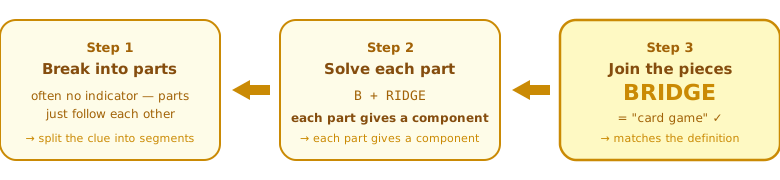
Solving a charade clue follows a consistent five-step process. Unlike hidden word clues where you scan letters or homophone clues where you listen for sounds, charade clues require you to decompose the clue into segments and solve each one before assembling the final answer. The method is systematic once you internalise it.
- Identify the definition. As with every cryptic clue, the definition sits at the very beginning or very end of the clue. It is a synonym or description of the answer. Locate it first so you know what you are building towards. In charade clues, the definition is often a single word or short phrase that seems disconnected from the rest of the clue.
- Break the remaining text into segments. The wordplay portion of a charade clue contains multiple components, each of which will produce a piece of the answer. Look for natural breakpoints — joining indicator words like “with” or “next to” help identify where one component ends and another begins. In implicit charades without indicator words, you must find the breakpoints by testing different divisions of the clue text.
- Solve each segment. Each component is a mini clue in its own right. It might be solved through substitution (replacing a word with a synonym or abbreviation), selection (taking initial or final letters), or another transform. Solve each segment independently to produce its letter contribution. For example, “pop-group” might yield BAND through substitution, while “A” is simply the letter A.
- Join in the correct order. Concatenate the solved components in the order indicated by the clue. If an order indicator like “following” or “before” is present, use it to determine which piece comes first. If no indicator is present, the components are typically joined in reading order — left to right as they appear in the clue.
- Verify against the definition. Confirm that the concatenated result matches the definition at the start or end of the clue. The definition is always at one extreme, never in the middle. If your assembled answer does not match the definition, reconsider your component breakdowns or their order. Also check the enumeration (the number in parentheses) to confirm the letter count is correct.
This five-step method applies to every charade clue, whether it has two components or five, whether it uses explicit indicators or is completely implicit. The difficulty of a charade clue comes from two factors: how many components are involved (more components means more mini-clues to solve) and whether the join is explicit or implicit (implicit charades are harder to recognise). The core principle remains the same: break the clue apart, solve each piece, join the pieces, and verify.
Charade clue indicator words — complete list
Charade indicator words signal that two or more components should be placed next to each other. Unlike homophone indicators, which all reference sound, or anagram indicators, which all reference disorder, charade indicators reference proximity, sequence, or attachment. They tell the solver that the pieces should be concatenated rather than nested, rearranged, or otherwise manipulated. The following list organises charade indicators into three meaningful groups based on the type of joining they describe. Learning these groups helps you recognise charade clues faster and determine component order more accurately.
Joining — references adjacency or attachment
Sequence — references order or position
Implicit (no indicator) — components sit side by side
Many charade clues have no explicit indicator at all. The components simply appear next to each other in the clue text, and the solver must recognise that they should be concatenated. This is one of the most distinctive features of charade clues — no other clue type can operate without any indicator word. Implicit charades are common and often the hardest charade clues to identify, because there is no signpost telling you that joining is involved.
This list is not exhaustive. Cryptic crossword setters are inventive, and any word that plausibly references adjacency, sequence, or attachment can serve as a charade indicator. The key insight is positional reference: the indicator tells the solver to place one component next to another, rather than inside it (which would be a container clue) or in reversed order (which would be a reversal clue). Some words can serve as charade indicators in one context and container indicators in another — for example, “in” usually signals a container, but “with” almost always signals a charade. Context and the structure of the rest of the clue will help you determine which interpretation is correct. For a full searchable dictionary of indicator words across all transform types, see our indicator words dictionary.
Worked charade clue examples
The best way to internalise the charade solving process is to see it applied to real clues. Below are five fully worked examples, including four verified from the Parseword archive. Every example follows the same five-step structure so you can see the method in action across different levels of complexity.
Example 1 — three-part charade Easy
“A pop-group on leave (7)”
- Definition: “leave” (at the end) — the answer means to leave or desert.
- Break into segments: “A” + “pop-group” + “on” — three components that sit next to each other.
- Solve each segment: “A” = the letter A. “pop-group” = BAND (substitution — a band is a pop group). “on” = ON (literal).
- Join: A + BAND + ON = ABANDON.
- Verify: ABANDON means “leave” or “desert.” Seven letters match the enumeration (7). The clue works.
- Answer: ABANDON
This is a classic charade clue with no explicit joining indicator. The three components — a single letter, a substitution, and a literal word — simply sit next to each other. The surface reading suggests someone leaving a musical group, which misdirects from the cryptic reading where each word contributes a piece of the answer. Notice how two of the three components involve substitution (the letter A for the word “a,” and BAND for “pop-group”) before the join step assembles the final answer.
Example 2 — multi-transform charade (Puzzle #46) Hard
Puzzle #46: CAPRICORN
- Components: The answer is built from four pieces derived through selection, substitution, deletion, and then join.
- Derivation: C + APRICO + RN — each component comes from a different transform applied to clue words.
- Join: C + APRICO + RN = CAPRICORN.
- Verify: CAPRICORN is a zodiac sign, matching the definition. Nine letters match the enumeration.
- Answer: CAPRICORN
This puzzle demonstrates how charade clues combine with multiple other transform types. Before the join step, the solver must apply selection to extract C, manipulate letters to get APRICO, and use deletion to produce RN. Only then does the join operation concatenate the three pieces into the nine-letter answer. This multi-transform pattern is typical of harder Parseword puzzles, where the join is the final step that assembles components produced by earlier operations.
Example 3 — four-part charade (Puzzle #43) Medium
Puzzle #43: GRADIENT
- Components: Four pieces derived through substitution and selection.
- Derivation: G (selection — initial letter) + RAD (substitution — a synonym) + I (selection) + ENT (substitution).
- Join: G + RAD + I + ENT = GRADIENT.
- Verify: GRADIENT means a slope or rate of change, matching the definition. Eight letters match.
- Answer: GRADIENT
Four-part charades like GRADIENT show the power of the join mechanism. Each individual component is simple to derive — a single letter from selection or a short fragment from substitution — but the solver must correctly identify all four components and concatenate them in the right order. This is why charade clues scale in difficulty with the number of components: more pieces means more mini-clues to solve and more opportunities to get the breakdown wrong.
Example 4 — join as final step (Puzzle #45) Medium
Puzzle #45: KILOBYTE
- Structure: The answer KILOBYTE is assembled as the final step after other transforms produce the individual components.
- Join: The components are concatenated in sequence to form KILOBYTE.
- Verify: KILOBYTE is a unit of digital storage, matching the definition. Eight letters match the enumeration.
- Answer: KILOBYTE
KILOBYTE illustrates a pattern that is extremely common in Parseword: the join operation is the final step in a multi-step puzzle. The solver first applies various transforms — substitution, selection, deletion — to produce letter fragments, and then concatenates them all at the end. This “join as final step” pattern is the most frequent way charade clues appear in Parseword, and recognising it helps you plan your solving strategy: solve the parts first, then assemble.
Example 5 — substitution + join (Puzzle #41) Medium
Puzzle #41: SWEARWORD
- Structure: The answer SWEARWORD is formed by joining components that were derived through substitution.
- Pattern: Substitution produces the individual fragments, and then join concatenates them into the nine-letter answer.
- Verify: SWEARWORD is a profane expression, matching the definition. Nine letters match the enumeration.
- Answer: SWEARWORD
The combination of substitution and join is the single most common multi-transform pattern in Parseword. SWEARWORD demonstrates this perfectly: each clue word is replaced by a synonym or abbreviation (substitution), and then the results are placed side by side (join) to form the answer. When you encounter a Parseword puzzle, substitution followed by join should be your first hypothesis for how the clue works. Puzzle #41 is an excellent example to study in the archive because the substitution-then-join pattern is clearly visible in each step.
Notice how each example follows the same five-step structure: identify the definition, break the clue into components, solve each component, join in order, and verify. The examples progress from a simple three-part charade with literal components (ABANDON) to complex multi-transform puzzles where several different operations precede the join step (CAPRICORN, SWEARWORD). This progression mirrors the difficulty curve you will encounter in practice: start by mastering simple charades, then build confidence with multi-transform combinations.
How to recognise charade clues
Recognising a charade clue quickly is a valuable skill, especially because charades are the most common multi-step clue type in both newspaper cryptics and Parseword. Here are five key signals to watch for when scanning a clue:
- The answer is longer than any single component can produce. This is the most reliable signal for a charade clue. If the enumeration says (7) or (8) and you cannot see how any single word or abbreviation in the clue could produce that many letters, the answer is almost certainly built from multiple joined components. Charades are the primary mechanism for cluing long answers in cryptic crosswords.
- The clue contains multiple meaningful segments. A charade clue typically reads as a sequence of short, self-contained segments, each of which could produce a word or abbreviation. If you can mentally divide the wordplay into two or three chunks, each of which has an independent meaning, you are likely looking at a charade.
- Joining words like “with,” “following,” “and,” or “next to” appear between segments. These explicit charade indicators make identification easy. When you see one of these words separating two meaningful clue segments, the clue is almost certainly a charade. However, remember that many charades have no indicator at all — so the absence of a joining word does not rule out a charade parse.
- No other clue type seems to fit. If you have checked for anagram indicators, hidden word indicators, reversal indicators, and homophone indicators and found none, consider a charade parse. Charades are the “ default” multi-step clue type — when nothing else seems to work, try breaking the clue into components and joining them.
- The clue seems to describe multiple small things rather than one big concept. In the surface reading, a charade clue often describes a scene or situation made up of several small elements. This is because the setter needs each element to produce a piece of the answer. If the clue feels like a list of small items rather than a description of one thing, suspect a charade.
With practice, spotting charade clues becomes almost instinctive. The length mismatch between the enumeration and any single component is the strongest signal, followed by the presence of joining indicator words. Once you recognise a charade, the solving process is methodical: break, solve, join, verify.
Charade clue variations
Charade clues come in five main variations, each with its own characteristics and level of difficulty. Understanding these variations prepares you for the full range of charade clues you will encounter in cryptic crosswords and in Parseword.
Two-part charade
The simplest and most common form: two components are joined to form the answer. FOOT + BALL = FOOTBALL, or SUN + RISE = SUNRISE. Two-part charades are the easiest to solve because there are only two components to identify and only one join point. They are often used for compound words where the two halves are real English words in their own right. This variation is the best starting point for beginners learning to recognise charade clues.
Multi-part charade
Three or more components are joined: A + BAND + ON = ABANDON, or G + RAD + I + ENT = GRADIENT. Multi-part charades are more complex because the solver must identify more breakpoints and solve more individual components. Each additional component adds another mini-clue to solve, and the number of possible breakdowns increases. Multi-part charades are very common in Parseword puzzles, where answers of seven or more letters are typical.
Implicit charade (no indicator)
No joining indicator word is present — the components simply sit next to each other in the clue text. This is one of the most distinctive features of charade clues and makes them the only clue type that can operate without any indicator word at all. The solver must recognise that the clue breaks naturally into segments, each producing a piece of the answer. Implicit charades are among the hardest charade clues to identify because there is no signpost telling you that concatenation is involved. The ABANDON example above is an implicit charade — there is no word like “with” or “joining” between the components.
Charade with substitution
Almost every charade clue involves substitution as a preceding step. Before the components can be joined, each one is solved through substitution (replacing a clue word with a synonym or abbreviation), selection (taking initial or final letters), or another transform. The join is the final assembly step that concatenates the results. The combination of substitution and join is the single most common multi-transform pattern in Parseword. SWEARWORD from Puzzle #41 is a perfect example: each word is substituted, then the results are joined.
Charade with other transforms
In complex clues, charades combine with transforms beyond substitution. A charade might include a reversed component (a reversal within a join), a container element, or a deletion result. CAPRICORN from Puzzle #46 combines selection, substitution, deletion, and join in a single clue. These complex charades are the most challenging type because the solver must apply multiple different transforms before the join step assembles the final answer. They are common in harder Parseword puzzles and in advanced newspaper cryptics.
Order and direction in charade clues
Getting the order of components right is critical in charade clues. Unlike anagrams, where the letters can be rearranged in any order, charade components must be concatenated in a specific sequence. The wrong order produces the wrong answer — or no valid word at all. Direction indicator words tell you which component comes first and which comes second, and understanding them precisely is essential for accurate solving.
“Following” and “after” mean the subject comes AFTER the other component. If the clue says “A following B,” the order is B then A, producing BA. Think of it this way: if A follows B, then B is in front and A comes behind. Similarly, “A after B” means B first, then A. These words can be counterintuitive because your eye reads A first, but the indicator places A second in the concatenation.
“Before” and “preceding” mean the subject comes FIRST. “A before B” produces AB — A is in front, B follows. “A preceding B” works the same way: A goes first because it precedes B. These indicators are more intuitive because the subject is first both in the clue text and in the answer.
“On,” “over,” and “under” in down clues have a spatial dimension. In a down clue, “A on B” typically means A is on top of B, so A comes first (reading top to bottom). “A under B” means A is beneath B, so B comes first. In across clues, these words behave more like standard joining indicators without a strong directional implication, though context usually clarifies the intended order.
When no indicator is present (implicit charade), the components are almost always joined in reading order — left to right as they appear in the clue. The setter arranges the clue text so that the components appear in the same sequence they should be concatenated. This is the simplest case for order: just join the pieces in the order you encounter them.
A practical tip: if you have solved all the individual components but the concatenated result is not a word, try reversing the order of two adjacent components. You may have misread a direction indicator, or the clue may use a direction word you did not recognise. Swapping two pieces and checking if the result is a valid word is a fast troubleshooting technique.
Tips for solving charade clues
Even after you understand the mechanics, a few practical techniques make charade solving faster and more reliable.
- When an answer seems too long to come from any single transform, suspect a charade. A seven-letter or eight-letter answer is hard to produce from a single substitution, selection, or reversal. If the enumeration is large relative to the clue length, the answer is almost certainly built from multiple joined components. This length mismatch is your strongest signal.
- Solve the individual parts first, then join. Do not try to see the whole answer at once. Focus on each component independently — use substitution, selection, or other techniques to derive the letters for each segment. Once you have all the pieces, concatenating them is straightforward. This divide-and-conquer approach is especially effective for multi-part charades with four or more components.
- Pay attention to order indicators. “Following” and “after” reverse the expected order — the word that follows comes second, not first. Read direction words carefully and think about which piece goes first in the concatenated result. Getting the order wrong is the most common mistake with charade clues.
- Think synonyms for each component. Charade clues in Parseword almost always use substitution for each part. When you see a clue word in the wordplay section, think about what synonym, abbreviation, or single letter it could represent. “Pop-group” = BAND, “doctor” = DR, “sailor” = AB, “king” = R — these substitutions are the building blocks of charade clues.
- Look for short, common words and abbreviations. Charade components are often very short: single letters (A, I, O), two-letter abbreviations (DR, AB, RE), or common three-letter words (THE, AND, FOR). If you can identify these short pieces in the answer word, you can work backwards to determine how the charade breaks down.
- Work backwards from the answer when possible. If crossing letters give you part of the answer, try breaking the partial answer into components and matching them against the clue words. This reverse-engineering approach is especially useful when the forward solve is not yielding results.
Common mistakes with charade clues
Even experienced solvers occasionally fall into these traps when working with charade clues. Being aware of them helps you avoid wasted time and frustration.
- Getting the order wrong. “A following B” means the answer is BA, not AB. Direction indicators like “following,” “after,” “before,” and “preceding” determine which component comes first in the concatenation. Misreading these indicators is the single most common error with charade clues, and it produces a string of letters that is not a valid word. If your concatenated result does not form a word, try swapping the order of two adjacent components.
- Trying to treat a charade clue as a single transform. If you try to derive the entire answer from a single operation (one substitution, one anagram, one hidden word), you will never solve a charade clue. The whole point of a charade is that the answer is built from multiple parts. When a single-transform approach does not produce a result, step back and ask: can I break this clue into two or more segments that each produce a piece of the answer?
- Missing implicit charades. Not every join has a connecting word like “with” or “and.” Many charade clues — arguably the majority — have no explicit indicator at all. If you are only looking for joining indicator words, you will miss all implicit charades. Train yourself to consider a charade parse even when no indicator is present, especially when the answer length suggests multiple components.
- Incorrectly placing the boundary between components. If you break the clue in the wrong place, each component will produce the wrong letters and the join will fail. Try multiple different breakdowns of the clue text until you find one where each segment solves cleanly. This trial-and-error process is normal for charade clues, especially multi-part ones.
- Forgetting that substitution usually precedes join. In most charade clues, the clue words are not used literally. They need to be substituted — replaced with synonyms, abbreviations, or single letters — before joining. If you try to join the literal clue words, the result will almost never be the answer. Always solve each component through substitution or another transform first.
Practice charade clues
The best way to build fluency with charade clues is to practise breaking clues into components and joining the results. Below are practice opportunities that let you apply everything you have learned in this guide.
Archive puzzles featuring join
Four puzzles in the Parseword archive prominently use the join transform. Working through these puzzles gives you hands-on experience with charade clues at different difficulty levels. Each puzzle combines join with other transforms like substitution and selection, showing how charade clues work in real multi-step contexts.
- Puzzle #41: SWEARWORD — substitution + join. A clear example of the most common multi-transform pattern.
- Puzzle #43: GRADIENT — selection + substitution + join. Four components joined from a mix of transforms.
- Puzzle #45: KILOBYTE — join as the final assembly step after other transforms produce the components.
- Puzzle #46: CAPRICORN — selection + substitution + deletion + join. The most complex example, combining four transform types.
Component-splitting drill
For each long word below, try breaking it into two or more components where each component is a real English word or common abbreviation. This builds the decomposition skill that is essential for solving charade clues — you need to see how a long word can be split into joinable parts.
- FOOTBALL → (Answer: FOOT + BALL)
- SUNRISE → (Answer: SUN + RISE)
- UNDERSTAND → (Answer: UNDER + STAND)
- BUTTERFLY → (Answer: BUTTER + FLY)
- HANDSHAKE → (Answer: HAND + SHAKE)
- BLACKBOARD → (Answer: BLACK + BOARD)
Parseword practice
Parseword puzzles regularly feature charade/join as a transform step. In Learn mode, the join indicator is underlined in orange, making it easy to identify. Try solving today's puzzle with a focus on finding components that need to be joined — look for the orange underline and think about how the pieces concatenate. Try today's hints.
For more structured practice with all cryptic clue types including charades, explore Parseword's Learn mode, which highlights indicator words with colour-coded underlines. The visual feedback trains you to spot charade indicators faster when solving newspaper cryptics where no such aid is provided.
Charade clue video tutorials
Visual learners can supplement this written guide with video tutorials from established cryptic crossword channels. Watching an experienced solver work through charade clues step by step reinforces the component-assembly technique and helps you internalise the joining patterns faster than reading alone.
Danny Vibes explains charade clue techniques — how components join side by side to build the answer.
Lovatts Crosswords tutorial covering charade joins and other cryptic crossword techniques for beginners.
Minute Cryptic demonstrates multi-step solving including charade clue component assembly.
Charade clues in Parseword
In Parseword, charade/join is one of the most frequent transforms — it appears in the majority of multi-step puzzles. The join transform is the operation that concatenates two or more previously-derived components into the final answer. When the game offers a “Join” option, it means the remaining letter fragments should be placed side by side in sequence to form a complete word.
Parseword's step-by-step approach makes the relationship between substitution and join particularly clear. In a typical puzzle, you first apply substitution to replace clue words with synonyms or abbreviations, producing short letter fragments. Then the join step concatenates those fragments into the answer. This two-phase pattern — substitute, then join — is the backbone of most Parseword puzzles and mirrors how charade clues work in traditional cryptic crosswords.
In Learn mode, charade/join indicators are highlighted with an orange underline, visually distinguishing them from other transform types (substitution uses blue, selection uses green, and so on). This colour coding makes it easy to see when a join step is expected, even before you start solving the individual components. Puzzles #41, #43, #45, and #46 in the archive are excellent examples to study — each one uses join as a key step, and the Learn mode walk-through shows exactly how the components are assembled.
Because join is so frequent, developing fluency with charade clues has an outsized impact on your Parseword performance. Once you can quickly identify which pieces need to be joined and in what order, the solve time for multi-step puzzles drops dramatically. The join step itself is the simplest operation in Parseword — just concatenation — but identifying the right components and their correct order is the skill that separates fast solvers from slow ones.
Charade clue FAQ
What makes charade clues different from other cryptic clue types?
Charade clues are the only cryptic clue type where the answer is built by placing multiple components side by side in sequence. Other clue types operate on a single word or phrase — anagrams rearrange letters, hidden words extract a substring, containers nest one component inside another, and reversals flip the order of letters. Charade clues concatenate two or more separately-derived pieces left to right to form the complete answer. This makes charades inherently multi-step: you solve each component independently, then join them together. The name comes from the parlor game of charades, where a word is acted out in parts. For a comprehensive overview of all cryptic clue types and how they compare, see our cryptic crossword guide.
Can a charade clue have no indicator word at all?
Yes, and this is one of the most distinctive features of charade clues. Many charades are implicit — the components simply sit next to each other in the clue text with no joining word like “with” or “following” between them. The solver must recognise that the clue breaks naturally into segments, each of which produces a piece of the answer. Implicit charades are among the hardest clues to identify because there is no signpost telling you that joining is involved. The clue reads like a normal sentence, and only when you notice that the answer is longer than any single component can produce do you suspect a charade parse.
How do order indicators like “following” and “before” work in charade clues?
Order indicators determine which component comes first in the final answer. The word “following” means the subject comes AFTER the other component — so “A following B” produces BA, not AB. The word “before” means the subject comes FIRST — “A before B” produces AB. The word “after” works like “following” — “A after B” produces BA. These direction words are critical because getting the order wrong means you will never arrive at the correct answer, even if you have solved each individual component correctly. Always read the indicator carefully and think about which piece goes first in the concatenated result.
How do charade clues work in Parseword?
In Parseword, charade/join is one of the most frequent transforms — it appears in the majority of multi-step puzzles. After you apply substitution, selection, or other transforms to reduce individual words to their letter components, the game offers a “Join” operation to concatenate the remaining pieces into the answer. The join indicator is highlighted with an orange underline in Learn mode, making it easy to spot. Puzzles #41, #43, #45, and #46 in the archive all use join as a step, often as the final operation that assembles the answer from previously derived components. Studying these puzzles in Learn mode is the best way to see how charade/join works in practice.