What is an anagram clue?
An anagram clue is a type of cryptic crossword clue in which the solver must rearrange a set of letters to form the answer. Every anagram clue contains three essential components:
- The definition — a word or phrase that means the same thing as the answer, always located at the very beginning or the very end of the clue.
- The fodder — the letters that need to be rearranged. The fodder can be a single word or spread across multiple words. Crucially, the number of letters in the fodder always matches the answer length exactly.
- The anagram indicator — a word or phrase that signals the letters should be rearranged. The indicator is not part of the fodder. It functions as an instruction to the solver, not as material to be manipulated.
For example, in the clue “Mixed spice creates long stories (5)”, the word “Mixed” is the anagram indicator, “spice” is the fodder (five letters), and “long stories” is the definition. Rearranging the letters S-P-I-C-E gives you EPICS, which means “long stories.” The anagram indicator told you what to do; the fodder gave you the raw material; the definition confirmed your answer.
The fairness of anagram clues is built into their structure. The answer letters are always present in the clue — nothing is hidden, abbreviated, or implied. This makes anagram clues fundamentally transparent once you know how to read them, which is why they are the most beginner-friendly clue type in cryptic crosswords.
How anagram clues work
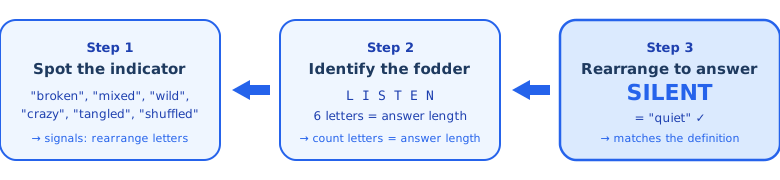
Solving an anagram clue follows a consistent step-by-step process. Once this process becomes second nature, anagram clues are often the fastest to solve in any cryptic crossword grid.
- Spot the anagram indicator. Scan the clue for a word suggesting disorder, change, damage, madness, or movement. Words like “broken,” “confused,” “wild,” and “reformed” are classic anagram indicators.
- Identify the fodder. Look at the words directly adjacent to the indicator. The fodder is the group of letters that the indicator acts upon. It can be a single word or span two or more words.
- Count the letters. The number of letters in the fodder must match the answer length shown in parentheses at the end of the clue. If the count does not match, you have either included the indicator in the fodder by mistake or missed part of a multi-word fodder.
- Rearrange the letters. Write the fodder letters down and try different combinations. A helpful technique is to write them in a circle rather than a line — this breaks your mind's attachment to the original word order and makes new patterns visible.
- Verify against the definition. Once you find a valid word, check that it matches the definition at the start or end of the clue. You can often rearrange letters into several valid words, but only one will fit the definition.
This five-step method applies to every anagram clue, from simple five-letter single-word anagrams to complex multi-word anagrams with nine or more letters. The difficulty scales with the number of letters (more letters means more possible arrangements) and with how well the setter has disguised the fodder within the surface reading.
Anagram clue indicator words — complete list
An anagram indicator is any word that suggests letters are not in their proper order. Setters draw from a vast pool of indicator words, but they cluster around a handful of themes. The following list organises over seventy of the most common anagram indicator words by thematic category. Memorising even a fraction of these will dramatically improve your ability to spot anagram clues quickly.
Disorder and chaos
Damage and destruction
Change and modification
Madness and intoxication
Movement and wandering
Cooking and craft
Strangeness and novelty
Miscellaneous
This list is not exhaustive. Cryptic crossword setters are endlessly inventive, and any word that plausibly suggests rearrangement can serve as an anagram indicator. The key insight is thematic: if a word implies that something is not in its normal state — broken, moved, changed, gone wrong — it could be signalling an anagram. Over time, you will develop an instinct for spotting new anagram indicator words even when you have never encountered them before. For a full searchable dictionary of indicator words across all transform types, see our indicator words dictionary.
Worked anagram clue examples
The best way to internalise the anagram solving process is to see it applied to real clues. Below are five fully worked anagram examples, progressing from straightforward to more complex. Every example has been verified: the fodder letters and the answer letters are exactly the same set.
Example 1 Easy
“Mixed spice creates long stories (5)”
- Anagram indicator: “Mixed” — a classic disorder indicator.
- Fodder: “spice” — five letters: S, P, I, C, E.
- Rearrange: S-P-I-C-E becomes E-P-I-C-S.
- Definition: “long stories” — EPICS are long narrative tales.
- Answer: EPICS
Example 2 Easy
“Broken note produces musical sound (4)”
- Anagram indicator: “Broken” — a damage indicator.
- Fodder: “note” — four letters: N, O, T, E.
- Rearrange: N-O-T-E becomes T-O-N-E.
- Definition: “musical sound” — a TONE is a musical sound.
- Answer: TONE
Example 3 Medium
“Changing planes in Italy (6)”
- Anagram indicator: “Changing” — a modification indicator.
- Fodder: “planes” — six letters: P, L, A, N, E, S.
- Rearrange: P-L-A-N-E-S becomes N-A-P-L-E-S.
- Definition: “in Italy” — NAPLES is a city in Italy. (Strictly, “in Italy” functions as the definition by identifying a place within Italy.)
- Answer: NAPLES
Example 4 Medium
“Damaged edict was mentioned (5)”
- Anagram indicator: “Damaged” — a destruction indicator.
- Fodder: “edict” — five letters: E, D, I, C, T.
- Rearrange: E-D-I-C-T becomes C-I-T-E-D.
- Definition: “was mentioned” — CITED means mentioned or referred to.
- Answer: CITED
Example 5 Harder
“Wrecked car tire becomes unpredictable (7)”
- Anagram indicator: “Wrecked” — a damage indicator.
- Fodder: “car tire” — two words, seven letters total: C, A, R, T, I, R, E. This is a multi-word anagram.
- Rearrange: C-A-R-T-I-R-E becomes E-R-R-A-T-I-C.
- Definition: “unpredictable” — ERRATIC means unpredictable or inconsistent.
- Answer: ERRATIC
Notice how the difficulty increases with the number of letters and with multi-word fodder. In Example 5, the solver must recognise that “car tire” is a two-word anagram fodder — the letters from both words are pooled together and rearranged as a single group. This is a common trap for beginners, who sometimes try to anagram each word separately.
How to recognise anagram clues
Recognising an anagram clue quickly is one of the most valuable skills in cryptic crossword solving. Here are the key signals to watch for:
- An indicator word suggesting disorder or change appears near a group of letters. This is the primary signal. If you see a word like “confused,” “wild,” “reformed,” or “cooked” adjacent to a word or phrase, suspect an anagram.
- The number of letters in the suspected fodder matches the answer length. Check the enumeration in parentheses at the end of the clue. If the word next to the anagram indicator has exactly that many letters, you are almost certainly looking at an anagram clue.
- The indicator is NOT part of the fodder. The anagram indicator word is an instruction, not raw material. A common beginner mistake is to include the indicator letters in the rearrangement, which produces the wrong letter count and a dead end.
- The fodder letters and the answer letters are the same set, just reordered. If you write out both sets and sort them alphabetically, they will match perfectly. This is the ultimate confirmation that you have solved the anagram correctly.
- The surface reading often makes the fodder look like a natural part of the sentence. Setters deliberately choose fodder words that contribute to a plausible surface reading. The word “spice” in “Mixed spice” reads naturally as a cooking reference, masking the fact that it is anagram fodder.
With practice, spotting anagram clues becomes almost automatic. Many experienced solvers scan an entire cryptic crossword grid for anagram clues first, because they are often the fastest to solve and provide helpful crossing letters for harder clue types.
Anagram clue variations
Not all anagram clues follow the same simple pattern. Setters use several variations to increase complexity and improve the surface reading. Understanding these variations prepares you for the full range of anagram clues you will encounter.
Single-word anagram
The simplest form. The fodder is a single word, and the anagram indicator tells you to rearrange it. Example: “Mixed spice” rearranges SPICE into EPICS. Most beginner-level anagram clues are single-word anagrams with five to seven letters.
Multi-word anagram
The fodder spans two or more consecutive words. The solver must pool all the letters together and rearrange them as a single group. Example: “Wrecked car tire” rearranges CARTIRE (seven letters) into ERRATIC. Multi-word anagrams are harder to spot because the fodder does not look like a single unit. Counting letters is your best friend here — if one word next to the indicator has fewer letters than the answer requires, check whether the neighbouring word supplies the remaining letters.
Partial anagram (combined with other transforms)
In more complex clues, an anagram provides only part of the answer. The anagram result is then combined with other components through a join (charade) or placed inside or around another component via a container operation. For example, a clue might anagram four letters to get a component, then join it with a single-letter abbreviation to form a five-letter answer. Recognising partial anagrams requires comfort with multiple transform types working together.
Anagram with linking words
Some anagram clues include a linking word between the wordplay and the definition, such as “gives,” “produces,” “makes,” or “creates.” These linking words are neither part of the fodder nor part of the definition — they serve a grammatical role, connecting the two halves of the clue into a natural sentence. In “Mixed spice creates long stories,” the word “creates” is the linking word.
Tips for solving anagram clues
Even after you understand the mechanics, a few practical techniques can make anagram solving faster and more reliable.
- Count the letters first. Before you attempt any rearrangement, verify that the fodder letter count matches the answer length. This single check eliminates many false starts and confirms you have identified the correct fodder.
- Write the letters in a circle. This classic technique breaks your visual attachment to the original word. When you see SPICE written in a line, your brain reads it as “spice” and resists seeing other patterns. Writing S, P, I, C, E around a circle makes EPICS, PICES, and other combinations visible.
- Look for common letter patterns. English words frequently start with TH, ST, CH, SH, or end with -ING, -TION, -ED, -ER. Scan the fodder letters for these patterns and use them as anchors to build the answer around.
- Use crossing letters. If you have already solved some intersecting clues, use those confirmed letters to constrain the anagram. Knowing that the third letter is A dramatically reduces the number of valid rearrangements.
- Scan for anagram clues first. Many experienced solvers work through a cryptic crossword by scanning for anagram clues first, because they are often the quickest to solve. The crossing letters they provide then make other clue types easier.
- Use Parseword Learn mode. In Parseword, the anagram indicator is underlined with a coloured highlight in Learn mode, making it much easier to spot. This is an excellent way to train your eye for indicator words before tackling newspaper cryptics where no such visual aid exists.
Common mistakes with anagram clues
Even experienced solvers occasionally fall into these traps when working with anagram clues. Being aware of them helps you avoid wasted time and frustration.
- Including the indicator in the fodder. The anagram indicator is an instruction, not raw material. If the clue says “Mixed spice,” only the letters of “spice” are rearranged — “mixed” tells you what to do with them. Including “mixed” in the fodder gives you ten letters instead of five, which cannot produce a five-letter answer.
- Forgetting to check the definition. You can often rearrange fodder letters into multiple valid English words. SPICE yields both EPICS and CIPES (not a word, but larger fodders produce more real words). Always verify your answer against the definition to avoid choosing the wrong word.
- Overlooking multi-word fodder. When the answer is longer than any single word near the indicator, the fodder likely spans two or more words. Beginners sometimes give up when no single adjacent word matches the letter count, not realising that they need to combine neighbouring words.
- Confusing the indicator with the definition. Some anagram indicator words can also serve as definitions in other contexts. The word “novel,” for instance, can be an anagram indicator (meaning “new” or “unusual”) or a definition (meaning a book). Context and letter-count checks help you determine which role the word is playing.
- Forcing a partial match. If you rearrange the letters and get something close to a word but not quite right, you have probably misidentified the fodder. Every letter must be accounted for — anagram answers use all the fodder letters, no more and no fewer.
Practice these anagram clues
Test your anagram-solving skills with these practice clues. Each clue has been verified — the fodder letters and the answer letters are the same set. Try to identify the anagram indicator, the fodder, and the definition before reading the answer.
Clue 1: “Strange thing at night (5)”
Hint: The anagram indicator is “Strange.” The fodder is “night.”
Answer: NIGHT rearranges to THING. The definition is “thing” — wait, actually “Strange” is the indicator, “thing” is the fodder (T, H, I, N, G), and “at night” is the definition. THING rearranges to NIGHT.
Clue 2: “Confused lemon produces melon (5)”
Hint: The anagram indicator is “Confused.” The fodder is “lemon.”
Answer: L-E-M-O-N rearranges to MELON. The definition is “produces melon” — in this case the definition and the answer overlap neatly. (In a published crossword the setter would typically use a different synonym for the definition, such as “fruit.”)
Clue 3: “Shattered pots on top (4)”
Hint: The anagram indicator is “Shattered.” The fodder is a four-letter word.
Answer: Wait — “pots” has four letters (P, O, T, S), and “Shattered” is the indicator. P-O-T-S rearranges to STOP, TOPS, OPTS, or POST. The definition is “on top” — which means TOPS is the answer (or “stop” if we read “on top” differently). Here the answer is TOPS — “on top” means being at the highest point, which is what TOPS means.
For more practice with anagram clues in an interactive setting, try Parseword puzzle #45 which features an anagram transform. Parseword's Learn mode highlights the anagram indicator, making it a perfect training tool.
Anagram clues in Parseword
In Parseword, anagram transforms are one of the most common operations you will encounter. When you tap a word group and see “Anagram” as a transform option, the game is telling you that those letters should be rearranged. The anagram indicator word will have a coloured underline in Learn mode, visually separating it from the fodder and the definition.
This visual feedback makes Parseword an ideal training ground for developing your anagram-spotting skills. After practising with the coloured indicators, you will find yourself recognising anagram indicator words in newspaper cryptic crosswords where no visual aid is provided. The transition from Parseword's guided experience to unassisted solving is one of the most satisfying progressions in learning cryptic crosswords.
Try writing the fodder letters in a circle on scratch paper, or mentally shuffle them by looking for common letter pairs. With practice, you will find that most five- and six-letter anagram clues resolve within seconds once you identify the fodder correctly.
Video tutorials for anagram clues
Visual learners can supplement this written guide with video tutorials from established cryptic crossword channels. Watching an experienced solver work through anagram clues step by step reinforces the indicator recognition and letter-rearranging techniques faster than reading alone.
Beginner-friendly tutorial focused on recognising and solving anagram clues in cryptic crosswords.
Comprehensive beginner tutorial from The New Yorker covering all major cryptic clue types including anagram clues.
Cracking The Cryptic's beginner guide demonstrating how to approach anagram clues and other cryptic techniques.
Related clue types
Anagram clues often interact with other transform types in complex clues. Understanding these related types will help you solve clues where an anagram is just one component of a multi-step operation.
Frequently asked questions about anagram clues
What is an anagram indicator in a cryptic crossword?
An anagram indicator is a word within a cryptic clue that signals the solver to rearrange nearby letters (the fodder) to form the answer. Anagram indicator words suggest disorder, change, destruction, madness, or movement. Common examples include “mixed,” “broken,” “crazy,” “ruined,” and “dancing.” The indicator itself is never part of the rearranged letters — it tells you what to do, not what to do it with. For a comprehensive list, see our indicator words dictionary.
How many anagram indicator words are there?
There are hundreds of valid anagram indicator words. This page lists over seventy of the most common ones, organised into eight thematic categories. However, any word that plausibly implies rearrangement can serve as an anagram indicator. Setters are endlessly creative, and you will encounter new anagram indicator words throughout your solving career. The key is to recognise the underlying theme: if a word suggests something is not in its normal, ordered state, it could be an anagram indicator.
Can an anagram span multiple words?
Yes. In a multi-word anagram, the fodder comes from two or more consecutive words in the clue. All the letters from these words are pooled together and rearranged as a single group. For example, “car tire” provides seven letters (C, A, R, T, I, R, E) that rearrange into ERRATIC. The total letter count of the combined fodder always matches the answer length. Multi- word anagram clues are harder to spot because the fodder does not look like a single unit, but counting letters will always reveal the structure.
How do I practise solving anagram clues?
Start by memorising the most common anagram indicator words from the list above so you can spot them quickly when scanning a crossword grid. Next, practise with simple single-word anagram clues where the fodder is a single obvious word. Parseword's Learn mode highlights anagram indicators with a coloured underline, making it an excellent training environment. You can also try our indicator detector tool to paste any cryptic clue and see which indicator words it contains. Finally, when solving newspaper cryptics, scan for anagram clues first — they are usually the fastest to crack and give you crossing letters for harder clue types.