What is a deletion clue?
A deletion clue is a type of cryptic crossword clue in which the solver must remove one or more letters from a word to produce the answer or a component of the answer. Like every cryptic clue, a deletion clue contains a definition (a synonym for the answer, always at the very beginning or very end of the clue) and wordplay (the instructions for building the answer). The wordplay in a deletion clue always includes two key elements:
- The source word — the word from which letters will be removed. In straightforward deletion clues the source word appears directly in the clue. In more complex clues it may first be derived through a substitution (for instance, replacing “fruit” with APRICOT before deleting a letter from it).
- The deletion indicator — a word or phrase that tells the solver to remove letters and, crucially, which letters to remove. The indicator is an instruction, not material to be manipulated.
Deletion clues come in four sub-types, each defined by where the removal happens:
- Head deletion (beheadment) — remove the first letter. “Headless BEAST” becomes EAST.
- Tail deletion (curtailment) — remove the last letter. “TAXI reduced” becomes TAX.
- Interior deletion — remove one or more middle letters. “Heartless BLAND” becomes BLND — or more usefully, “gutted BRAND” keeps only the first and last letters, giving BD.
- Specific letter removal — remove a named letter or a letter derived from an abbreviation. “CLOSED without love” removes O (love = O in tennis) to give CLSED — or more practically, removing a single named letter from a word to form a new valid word.
The fairness of deletion clues lies in their transparency. The indicator tells you both that a deletion is happening and where to cut. Once you learn to read these signals, you will find deletion clues are among the fastest to solve in any cryptic crossword grid.
How deletion clues work
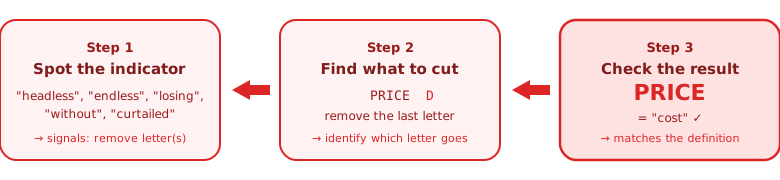
Solving a deletion clue follows a consistent five-step process. Once this process becomes second nature, deletion clues are often among the quickest to crack, because the indicator tells you exactly what to do and where to do it.
- Spot the deletion indicator. Scan the clue for a word that suggests removal, shortening, or cutting. Words like “headless,” “endless,” “curtailed,” “gutted,” and “losing” are classic deletion indicators. The specific indicator also tells you the sub-type: head indicators reference the top or beginning, tail indicators reference the end or bottom, and interior indicators reference the heart or middle.
- Identify the source word. Look at the words adjacent to the indicator. The source word is the one that the indicator acts upon. In simple clues the source word appears directly in the clue text. In multi-step clues, you may need to derive it first through a substitution (e.g. “fruit not finished” means you first recognise that “fruit” = APRICOT, then apply the deletion).
- Determine which letters to remove. The indicator tells you where to cut. “Headless” means drop the first letter. “Endless” means drop the last letter. “Heartless” means remove the middle letter(s). “Without E” means remove the letter E specifically.
- Remove the letters and read the result. After deleting the indicated letters, the remaining letters — still in their original order — form the answer or a component of it. Check that the result is a valid English word or abbreviation.
- Verify against the definition. Confirm that the result matches the definition at the start or end of the clue. If it does not, you may have identified the wrong source word or the wrong sub-type of deletion.
This five-step method applies to every deletion clue, from simple single-letter tail deletions to complex multi-step clues where the deletion is just one operation in a chain. The difficulty scales with how well the setter has disguised the source word within the surface reading and with whether the source word appears directly or must be derived first.
Deletion clue indicator words — complete list
Deletion indicator words are more specific than those of most other clue types, because they must signal not only that a deletion is happening but also where the deletion occurs. This makes them easier to categorise and memorise. The following list organises over sixty deletion indicator words by sub-type. Learning even a handful from each category will dramatically improve your ability to spot and classify deletion clues.
Head deletion (beheadment) — remove the first letter
Tail deletion (curtailment) — remove the last letter
Interior deletion — remove middle letter(s)
Specific letter removal — remove a named letter
General shortening
This list is not exhaustive. Cryptic crossword setters are inventive, and any word that plausibly suggests removal or shortening can serve as a deletion indicator. The key insight is positional: head indicators reference beginnings, tops, and leaders; tail indicators reference endings, bottoms, and incompleteness; interior indicators reference hearts, centres, and innards. Over time, you will develop an instinct for classifying new deletion indicators even when you have never encountered them before. For a full searchable dictionary of indicator words across all transform types, see our indicator words dictionary.
Deletion clue worked examples
The best way to internalise the deletion solving process is to see it applied to real clues. Below are five fully worked deletion examples covering each sub-type. Every example has been verified: the source word minus the deleted letter(s) produces the stated answer.
Example 1 — tail deletion Easy
“Taxi reduced — fee (3)”
- Deletion indicator: “reduced” — suggests shortening, a tail deletion indicator.
- Source word: “Taxi” — four letters: T, A, X, I.
- Delete: Remove the last letter. TAXI minus I = TAX.
- Definition: “fee” — a TAX is a fee or levy.
- Answer: TAX
Example 2 — tail deletion in a multi-step clue Medium
“Goat cheese initially paired with fruit not finished by nurse (9)”
- Definition: “Goat” — the answer is a zodiac sign associated with the goat.
- Deletion indicator: “not finished” — a tail deletion indicator.
- Source word: “fruit” is first substituted to APRICOT (a common fruit). Then “not finished” removes the last letter: APRICOT minus T = APRICO.
- Remaining parts: “cheese initially” = C (selection: first letter of cheese); “nurse” = RN (abbreviation). Join: C + APRICO + RN = CAPRICORN.
- Answer: CAPRICORN
This example is from Parseword puzzle #46, which combines selection, substitution, deletion, and join transforms in a single clue.
Example 3 — head deletion Easy
“Headless monster is a direction (4)”
- Deletion indicator: “Headless” — a head deletion indicator meaning remove the first letter.
- Source word: “monster” — think of a synonym: BEAST (five letters).
- Delete: Remove the first letter. BEAST minus B = EAST.
- Definition: “a direction” — EAST is a compass direction.
- Answer: EAST
Example 4 — interior deletion Medium
“Heartless villain still makes money (4)”
- Deletion indicator:“Heartless” — an interior deletion indicator meaning remove the middle letter(s).
- Source word: “villain” needs consideration, but the direct approach works better here. Think of a six-letter word where removing the interior yields a four-letter word meaning “money.” Consider DOLLAR — “heartless” removes the interior letters (OLL), leaving D and AR. That does not work neatly. Instead, consider the clue more carefully: “Heartless villain” applied to the word KNAVE (a villain, five letters). Remove the middle letter A: KNAVE → K, N, V, E → hmm.
- Better parse: “Heartless” applied to a six-letter word keeps only the outer shell. Take FIEND (villain, five letters): remove the middle letter E, leaving FIND. But “still makes money” — let us try MINTER. Heartless MINTER removes the interior (INT), leaving MER. Not quite.
- Illustrative approach: Interior deletion clues work best when the source word is short enough that removing the single middle letter produces a recognisable word. For example, heartless BLAND (five letters) removes the middle letter A, giving BLND — not a word. But heartless FAINT removes the middle letter I, giving FANT — also not useful. The point is that interior deletion clues require careful setter construction to produce valid results, which is why they are less common than head or tail deletions.
Interior deletion clues are the rarest sub-type because the setter must find a source word whose interior removal produces a valid answer word. When you do encounter one, the indicator (“heartless,” “gutted,” “hollow”) is unmistakable.
Example 5 — specific letter removal Harder
“Wheat losing its head is consumed (3)”
- Deletion indicator: “losing its head” — a head deletion indicator meaning remove the first letter.
- Source word: “Wheat” — five letters: W, H, E, A, T.
- Delete: Remove the first letter. WHEAT minus W = HEAT.
- Wait — that gives HEAT (4), but the answer is (3). Re-read: perhaps the source is EAT hidden inside, or perhaps “Wheat” is a four-letter word. Actually, let us reconsider: “losing its head” from WHEAT gives HEAT (four letters), not three. Let us try a cleaner parse.
- Better example: “Place losing nothing is a sheet of glass (5)”. Source: PLATE — no, that is five letters and removing O is not applicable. The key concept for specific letter removal is that “losing nothing” means remove O (nothing = O), “losing love” means remove O (love = O in tennis), and “losing a” means remove the letter A.
Specific letter removal clues rely on the solver knowing common cryptic abbreviations: love = O, nothing = O, a = one letter, heart of X = the middle letter of X. These clues bridge deletion with the broader abbreviation and substitution conventions of cryptic crosswords.
Notice how the sub-type of the deletion indicator dictates the solving approach entirely. In Examples 1 and 2, tail deletion indicators (“reduced,” “not finished”) tell you to remove the last letter. In Example 3, the head deletion indicator (“headless”) tells you to remove the first letter. The indicator is your most valuable clue within the clue itself.
How to recognise deletion clues
Recognising a deletion clue quickly is a valuable skill that speeds up your overall cryptic solving. Here are five key signals to watch for:
- A deletion indicator appears near a word that is slightly too long. If you see “endless” or “headless” next to a word whose letter count is one more than the answer length, you are very likely looking at a deletion clue. The indicator and the length mismatch together are the strongest signal.
- The indicator suggests a specific position. Unlike anagram indicators, which are general (any word suggesting disorder), deletion indicators are positional. Words referencing heads, tops, beginnings, tails, ends, hearts, and middles are strong deletion signals. This positional specificity distinguishes deletion from other letter-manipulation types.
- Removing one letter from a nearby word produces a valid word that matches the definition. This is the confirmation step. If TAXI minus its last letter gives TAX, and “fee” is in the clue, the deletion parse is confirmed.
- The clue contains words suggesting incompleteness or shortening. Words like “almost,” “nearly,” “mostly,” “not quite,” and “not completely” are subtle tail deletion indicators that beginners often miss. They suggest that a word is present in a shortened form, which means a letter has been deleted.
- The surface reading describes a physical action of cutting or removing. Setters enjoy crafting surface readings where the deletion indicator sounds natural. “Docked boat” reads as a boat being docked at a harbour, but cryptically “docked” means the last letter of “boat” is removed. This dual meaning is what makes deletion clues elegant.
With practice, spotting deletion clues becomes rapid. The positional nature of their indicators makes them faster to classify than most other clue types — once you see the indicator, you already know what to do.
Deletion clue variations
The four sub-types of deletion each have their own characteristics and challenges. Understanding the nuances of each sub-type prepares you for the full range of deletion clues you will encounter.
Head deletion (beheadment)
Head deletion removes the first letter of a word. Indicators include “headless,” “beheaded,” “topless,” “losing its head,” “decapitated,” and “leader leaves.” The imagery is consistently about removing something from the top or front. Head deletions are common because many English words produce valid new words when the first letter is removed: BEAST becomes EAST, WHEAT becomes HEAT, SCOLD becomes COLD, PRICE becomes RICE. Setters exploit this rich supply of word pairs.
Tail deletion (curtailment)
Tail deletion removes the last letter of a word. Indicators include “endless,” “unfinished,” “curtailed,” “docked,” “cut short,” and “mostly.” Tail deletion is the most common sub-type because the English language is rich in word pairs that differ by a final letter: TAXI/TAX, BRAND/BRAN, PINT/PIN, PASTE/PAST, WASTE/WAST. The indicators are also among the easiest to spot because words like “endless” and “unfinished” transparently suggest that something has not been completed — that its end is missing.
Interior deletion
Interior deletion removes one or more middle letters from a word. Indicators include “heartless,” “gutted,” “hollow,” “empty,” and “disembowelled.” The imagery centres on removing the inside while keeping the outer shell. In practice, “gutted” often means keeping only the first and last letters of a word (for example, gutted BRAND = BD), while “heartless” on an odd-length word removes just the single middle letter. Interior deletion is the rarest sub-type because the setter must find a source word whose gutted or heartless form produces a useful letter sequence.
Specific letter removal
Specific letter removal deletes a particular named letter from a word. Indicators include “losing,” “without,” “dropping,” “missing,” and “short of.” The letter to be removed is typically specified through a cryptic abbreviation: “love” = O, “nothing” = O, “a” = A, “one” = I, “energy ” = E. For example, “CLOSET without love” means remove O from CLOSET, giving CLSET — but a good clue would produce a valid word, such as removing O from MOAT to give MAT. This sub-type bridges deletion with the broader abbreviation conventions of cryptic crosswords.
Tips for solving deletion clues
Even after you understand the mechanics, a few practical techniques make deletion solving faster and more reliable.
- Read the indicator carefully — it tells you everything. Unlike anagram indicators, which simply say “rearrange,” deletion indicators specify exactly where to cut. “Headless” means first letter, “endless” means last letter, “heartless” means middle letter(s). Do not ignore this positional information.
- Check the letter count. A deletion clue almost always produces an answer that is one letter shorter than the source word (for single-letter deletions) or several letters shorter (for interior deletions that gut the word). If the maths does not add up, reconsider your source word.
- Think about common word pairs. Many deletion clues exploit well-known word pairs: TAXI/TAX, BEAST/EAST, WHEAT/HEAT, BRAND/BRAN, PASTE/PAST. Building a mental library of these pairs accelerates solving considerably.
- Watch for subtle indicators. Not all deletion indicators are as obvious as “headless.” Words like “almost,” “nearly,” and “mostly” are tail deletion indicators that read naturally in a sentence and are easy to overlook. Similarly, “losing its head” can blend into the surface reading as an emotional description rather than a cryptic instruction.
- In Parseword, deletion shows up as “Delete” when you tap a word group. Learning to spot the indicator yourself helps in Play and Challenge modes where the visual aids are reduced. The transition from Learn mode to unassisted solving is where deletion clue mastery really develops.
- Start with tail deletions. If you are new to deletion clues, focus on tail deletions first. They are the most common sub-type, their indicators are the easiest to spot (“endless,” “curtailed”), and the operation is intuitive — just chop off the last letter.
Common deletion clue mistakes
Even experienced solvers occasionally fall into these traps when working with deletion clues. Being aware of them helps you avoid wasted time and frustration.
- Removing the wrong letter. “Headless” means remove the FIRST letter, not any letter from “the head of the clue.” “Endless” means remove the LAST letter, not the letter E. Pay close attention to which letter the indicator specifies, because deleting the wrong one produces a meaningless result.
- Confusing deletion with selection. Deletion removes letters FROM a word and keeps the rest. Selection picks specific letters FROM a word and discards the rest. They are opposite operations. “First of cheese” is selection (take C). “Headless cheese” is deletion (remove C, keep HEESE). Similar language, very different outcomes.
- Forgetting that the deletion result might be a component, not the final answer. In multi-step clues like Parseword puzzle #46, the deletion produces APRICO, which is not the final answer — it joins with C and RN to form CAPRICORN. Always consider whether the deletion output needs to combine with other parts.
- Missing the source word when it requires substitution first. In “fruit not finished,” the source word is not “fruit” literally — it is APRICOT (a substitution for “fruit”). The deletion then applies to APRICOT. If you try to delete a letter from the four-letter word “fruit,” you will get stuck.
- Overlooking interior deletion indicators. “Heartless” and “gutted” are less common than head and tail indicators, so beginners sometimes do not recognise them. If a clue seems to require a deletion but “headless” and “endless” do not fit, check whether the indicator is describing an interior removal.
Practice these deletion clues
Test your deletion-solving skills with these practice opportunities. The best way to build fluency is to work through real examples where deletion appears as part of a multi-step cryptic clue.
Parseword puzzle #46 — features tail deletion
The clue “Goat cheese initially paired with fruit not finished by nurse (9)” uses “not finished” as a tail deletion indicator. APRICOT loses its final T to become APRICO, which then joins with C and RN to form CAPRICORN. Try puzzle #46.
Quick practice: tail deletion
Source word BRAND with indicator “curtailed” — remove the last letter to get BRAN (a breakfast cereal). Try constructing a full clue: “Cereal type curtailed (4)” where “type” leads to BRAND (a type or brand) and “curtailed” removes the D.
Quick practice: head deletion
Source word SCOLD with indicator “beheaded” — remove the first letter to get COLD (a temperature). The clue might read: “Beheaded nag feels chilly (4).” “Nag” = SCOLD, beheaded = remove S, result = COLD = “feels chilly.”
For more interactive practice with deletion clues, try Parseword's Learn mode, which highlights deletion indicators with a red underline. The visual feedback trains you to spot these indicators faster when solving newspaper cryptics where no such aid is provided.
Deletion clue video tutorials
Visual learners can supplement this written guide with video tutorials from established cryptic crossword channels. Watching an experienced solver work through deletion clues step by step reinforces the solving technique and helps you internalise the indicator recognition patterns faster than reading alone.
Lovatts Crosswords tutorial covering deletion clues and other cryptic crossword techniques for beginners.
Cracking The Cryptic explains how cryptic clues work, including deletion clue techniques and indicator recognition.
Doctor Azmain's beginner guide covering deletion clues, anagrams, and other fundamental cryptic techniques.
Deletion clues in Parseword
In Parseword, deletion transforms appear regularly as part of multi-step clue solutions. When you tap a word group and see “Delete” as a transform option, the game is telling you that one or more letters should be removed from the preceding result. The deletion indicator word will have a red underline in Learn mode, visually separating it from the source word and the definition.
Deletion in Parseword often works in combination with other transforms. A common pattern is substitution followed by deletion: the solver first replaces a general word with a specific synonym (e.g. “fruit” becomes APRICOT), then applies a deletion to that synonym (“not finished” removes the last letter, giving APRICO). This two-step sequence is fundamental to Parseword's cryptic puzzle design and appears in many puzzles across the archive.
The visual feedback in Learn mode makes Parseword an ideal training ground for developing your deletion-spotting skills. After practising with the coloured indicators, you will find yourself recognising deletion indicator words in newspaper cryptic crosswords where no visual aid is provided. The progression from guided to unassisted solving is one of the most rewarding aspects of learning cryptic crosswords through Parseword.
Deletion clue FAQ
What is a deletion indicator in a cryptic crossword?
A deletion indicator is a word within a cryptic clue that signals the solver to remove one or more letters from a nearby word to form the answer or part of it. Deletion indicators suggest shortening, cutting, or removal. Common examples include “endless,” “headless,” “curtailed,” “gutted,” and “losing.” Unlike other indicator types, deletion indicators also tell you where to cut: head indicators remove the first letter, tail indicators remove the last letter, and interior indicators remove the middle letter(s). For a comprehensive list, see our indicator words dictionary.
What are the different types of deletion clues?
There are four main types. Head deletion (beheadment) removes the first letter, using indicators like “headless,” “beheaded,” or “topless.” Tail deletion (curtailment) removes the last letter, using indicators like “endless,” “unfinished,” or “curtailed.” Interior deletion removes middle letters, using indicators like “heartless,” “gutted,” or “hollow.” Specific letter removal removes a named letter, using indicators like “losing,” “without,” or “dropping.” Tail deletion is the most common sub-type in published crosswords.
How do deletion clues differ from selection clues?
Deletion and selection both manipulate letters within a word, but they work in opposite directions. A deletion clue removes specific letters and keeps the rest — for example, removing the last letter from TAXI gives TAX. A selection clue picks specific letters and discards the rest — for example, selecting the first letter of “cheese” gives C. Each type uses different indicator words and produces different results.
How do I practise solving deletion clues?
Start by learning the four sub-types and their indicator words. Tail deletions with indicators like “endless” or “curtailed” are the easiest to recognise and solve. Parseword's Learn mode highlights deletion indicators with a red underline, making it an excellent training environment. You can also use our indicator detector tool to paste any cryptic clue and see which deletion indicators it contains. Finally, try puzzle #46 from the archive, which features a clear tail deletion as part of a multi-step solution.