What is a reversal clue?
A reversal clue is a type of cryptic crossword clue in which the solver must spell a word or group of letters backwards to produce the answer or a component of the answer. Like every cryptic clue, a reversal clue contains a definition (a synonym for the answer, always at the very beginning or very end of the clue) and wordplay (the instructions for building the answer). The wordplay in a reversal clue always includes two key elements:
- The source word — the word that must be spelled backwards. In simple reversal clues the source word appears directly in the clue text. In more complex clues it may first be derived through a substitution (for instance, replacing “animal” with DOG before reversing it to GOD).
- The reversal indicator — a word or phrase that tells the solver to reverse the source word. The indicator is an instruction, not material to be manipulated. Crucially, the specific indicator used depends on the direction of the clue in the crossword grid.
The direction-dependent nature of reversal indicators is a unique feature of this clue type. In a crossword grid, across entries read from left to right. When the setter wants you to reverse an across entry, they use horizontal indicators — words that suggest going backwards, returning, or moving westward. Down entries read from top to bottom. When the setter wants you to reverse a down entry, they use vertical indicators — words that suggest rising, climbing, or going upward. This distinction exists because “going up” only makes logical sense as a reversal instruction when the answer is written vertically. Saying a word is “rising” in an across clue would be misleading, so setters avoid it.
The result of a reversal can be the complete answer or just one component that combines with other parts. When REWARD reverses to DRAWER, the reversal produces the entire answer. But when GET reverses to TEG, that three-letter fragment might be joined with other components to build a longer word like STRATEGY. The enumeration (the number in parentheses at the end of the clue) and the definition help you determine whether the reversal is the whole story or just one step in a multi-part construction.
How reversal clues work
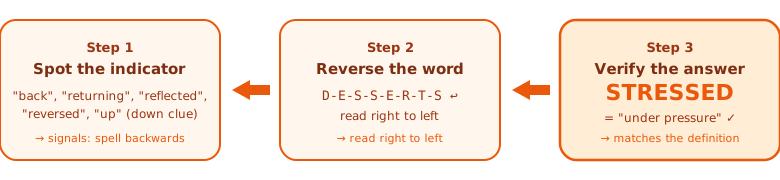
Solving a reversal clue follows a consistent five-step process. Once this method becomes second nature, you will find that reversal clues are among the quickest to crack, because the operation itself — spelling a word backwards — is straightforward once you know which word to target.
- Spot the reversal indicator. Scan the clue for a word that suggests reversal, returning, or backward motion. In across clues, look for horizontal indicators like “back,” “returned,” “reflected,” “going west,” or “retreating.” In down clues, look for vertical indicators like “rising,” “climbing,” “going up,” “lifted,” or “raised.” Some indicators work in either direction: “turned,” “inverted,” “switched.”
- Identify the source word. Look at the words adjacent to the reversal indicator. The source word is the one that the indicator acts upon. In simple clues the source word appears directly in the clue text (e.g. “reward” in “returned reward”). In multi-step clues, you may need to derive it first through a substitution (e.g. “animal going back” means you first recognise that “animal” could be DOG, then reverse it).
- Reverse the letters. Spell the source word backwards, letter by letter. REWARD becomes D-R-A-W-E-R. DOG becomes G-O-D. STAR becomes R-A-T-S. This is the mechanical step and it is straightforward, but double-check your letter order because a single transposition error ruins the result.
- Check whether the result is a valid word or useful component. After reversing, confirm that the result is a real English word or a recognisable abbreviation. If it is not, you may have identified the wrong source word or the clue may not be a reversal after all. If the reversed result is shorter than the enumeration, it is likely a component that needs to combine with other parts.
- Verify against the definition. Confirm that the reversed result (or the full answer after combining components) matches the definition at the start or end of the clue. “Returned reward is furniture” — DRAWER is indeed furniture. If the definition does not match, reconsider your source word or check whether a different word in the clue should be reversed.
This five-step method applies to every reversal clue, from simple full reversals where one word produces the entire answer to complex multi-step clues where the reversal is just one operation in a chain. The difficulty scales primarily with how cleverly the setter has disguised the source word within the surface reading and whether the source word appears directly or must be derived first through substitution.
Reversal clue indicator words — complete list
Reversal indicator words are unique among cryptic clue types because they split into direction-dependent categories. In a traditional crossword grid, the setter chooses the indicator based on whether the clue is across or down. The following list organises reversal indicators into three groups: across and general indicators (for horizontal clues or clues with no grid), down-only indicators (exclusively for vertical clues), and general indicators that work in either direction. Learning these categories will sharpen your ability to spot and classify reversal clues, and to understand why a particular indicator was chosen.
Across and general — horizontal reversal indicators
Down clues only — vertical reversal indicators
General — works in either direction
This list is not exhaustive. Cryptic crossword setters are inventive, and any word that plausibly suggests backward motion, return, or inversion can serve as a reversal indicator. The key insight is directional: across indicators reference horizontal backward movement (returning, reflecting, going west), down indicators reference vertical upward movement (rising, climbing, going up), and general indicators reference inversion without specifying a direction (turned, switched, upset). Over time, you will develop an instinct for classifying new reversal indicators even when you have not encountered them before. For a full searchable dictionary of indicator words across all transform types, see our indicator words dictionary.
Worked reversal clue examples
The best way to internalise the reversal solving process is to see it applied to real clues. Below are five fully worked reversal examples covering full reversals, partial reversals, and different difficulty levels. Every example has been verified: the source word spelled backwards produces the stated answer.
Example 1 — full reversal Easy
“Returned reward is furniture (6)”
- Reversal indicator: “Returned” — a horizontal reversal indicator suggesting something has come back.
- Source word: “reward” — six letters: R, E, W, A, R, D.
- Reverse: Spell REWARD backwards: D-R-A-W-E-R = DRAWER.
- Definition: “furniture” — a DRAWER is a piece of furniture (or a component of one).
- Answer: DRAWER
This is one of the most classic reversal clues. The REWARD/DRAWER pair appears frequently in cryptic crosswords because both words are common and the six-letter length makes for a satisfying solve.
Example 2 — full reversal Easy
“Dog going back is deity (3)”
- Reversal indicator: “going back” — a straightforward horizontal reversal indicator.
- Source word: “Dog” — three letters: D, O, G.
- Reverse: Spell DOG backwards: G-O-D = GOD.
- Definition: “deity” — a GOD is a deity.
- Answer: GOD
Short words that form valid words when reversed are the bread and butter of reversal clues. The DOG/GOD pair is perhaps the best-known reversible pair in the English language.
Example 3 — partial reversal (component) Medium
“Get back in errant — plan of action (8)”
- Reversal indicator: “back” — signals that something should be reversed.
- Source word: “Get” — three letters: G, E, T.
- Reverse: Spell GET backwards: T-E-G = TEG.
- Remaining parts: “errant” serves as an anagram indicator for nearby letters, or the remaining components build the rest of the answer. The full answer STRATEGY contains TEG as a reversed component within a larger construction: S-T-R-A + TEG + Y.
- Answer: STRATEGY
This example is from Parseword puzzle #42, which uses a reversal of GET to TEG as one component in building the eight-letter answer STRATEGY. Partial reversals like this are common in longer answers.
Example 4 — full reversal Easy
“Reflected evil is to exist (4)”
- Reversal indicator:“Reflected” — suggests mirror-image reversal, a horizontal indicator.
- Source word: “evil” — four letters: E, V, I, L.
- Reverse: Spell EVIL backwards: L-I-V-E = LIVE.
- Definition: “to exist” — to LIVE is to exist.
- Answer: LIVE
The EVIL/LIVE pair is a favourite among setters because both words are common and the surface reading of “reflected evil” has a naturally dramatic quality that disguises the cryptic instruction within a vivid image.
Example 5 — full reversal with vertical indicator Medium
“Tipped over, star becomes rodents (4)”
- Reversal indicator: “Tipped over” — suggests inversion or overturning, an indicator that works in either direction.
- Source word: “star” — four letters: S, T, A, R.
- Reverse: Spell STAR backwards: R-A-T-S = RATS.
- Definition: “rodents” — RATS are rodents.
- Answer: RATS
Note the direction of the reversal: STAR is the source word and RATS is the answer, not the other way around. The definition (“rodents”) confirms RATS as the answer. The indicator “tipped over” signals the reversal of the adjacent source word “star.”
Notice how each example follows the same five-step structure: spot the indicator, identify the source, reverse the letters, check the result, and verify against the definition. With practice, these steps collapse into a rapid, almost instinctive process. The key variable across examples is whether the reversal produces the full answer (Examples 1, 2, 4, and 5) or just a component (Example 3).
How to recognise reversal clues
Recognising a reversal clue quickly is a valuable skill that speeds up your overall cryptic solving. Here are five key signals to watch for when scanning a clue:
- A direction word appears near a short, common word. Reversal clues rely on words that produce valid words when spelled backwards. If you see “back” or “returned” next to a three-to-six-letter word, mentally reverse that word and see if the result is meaningful. Many common English words are reversible (DOG, LIVE, STAR, STOP, REWARD), so the combination of an indicator plus a short word is the strongest signal.
- The indicator matches the clue direction. In grid-based crosswords, check whether the indicator matches the clue's position. “Rising” in an across clue is suspicious — it should only appear in a down clue if it signals reversal. If you see a vertical indicator in a down clue, that is a strong reversal signal. This directional consistency is a hallmark of well-constructed reversal clues.
- You recognise a known reversible word pair. Experienced solvers build a mental library of word pairs like DOG/GOD, LIVE/EVIL, and STAR/RATS. When either word from a known pair appears in a clue alongside a reversal indicator, the solve is nearly instant. Building this library is one of the most effective ways to speed up reversal clue solving.
- The enumeration matches a word in the clue when spelled backwards. If the answer is six letters and “reward” (six letters) appears in the clue, try reversing it. When the letter count of a visible word matches the enumeration exactly, reversal is a prime candidate.
- The surface reading describes backward motion or return. Setters craft surface readings where the reversal indicator sounds natural. “Returned reward” reads as a reward being given back. “Dog going back” reads as a dog retreating. This dual meaning — natural surface and cryptic instruction — is the hallmark of an elegant reversal clue.
With practice, spotting reversal clues becomes rapid. The directional nature of their indicators, combined with the limited supply of reversible English words, means that reversal clues have a distinctive fingerprint once you know what to look for.
Reversal clue variations
Reversal clues come in three main variations, each with its own characteristics and level of difficulty. Understanding these variations prepares you for the full range of reversal clues you will encounter in cryptic crosswords.
Full reversal
In a full reversal, one word is reversed to produce the entire answer. This is the simplest and most common form. REWARD reversed gives DRAWER. DOG reversed gives GOD. EVIL reversed gives LIVE. STAR reversed gives RATS. Full reversals are the easiest to spot because the source word appears directly in the clue, the letter count matches the enumeration exactly, and the reversed result is the complete answer. Beginners should focus on full reversals first, as they offer the most direct path from recognising the indicator to finding the answer.
Partial reversal (component)
In a partial reversal, only part of the answer comes from a reversal. The reversed portion is then combined with other components through join or container techniques. For example, GET reversed gives TEG, which might form one section of the eight-letter answer STRATEGY. Partial reversals are more challenging because the reversed fragment alone does not match the definition — it is just one building block. The solver must identify all the components, assemble them in the right order, and verify the full construction against the definition. Partial reversals are common in Parseword puzzles, where longer answers are built from multiple transforms.
Phrase reversal
In a phrase reversal, multiple words are reversed as a unit. For example, “live on” reversed as a whole phrase gives “no evil” (though the spaces are removed in the crossword grid). Phrase reversals are rare and considerably harder to spot than single-word reversals, because the solver must recognise that a multi-word sequence, when reversed letter by letter, produces a meaningful result. They are uncommon in Parseword, which focuses primarily on single-word transforms, but they do appear occasionally in newspaper cryptics where setters have more space to construct elaborate surface readings.
Common reversible word pairs
One of the most effective ways to get faster at solving reversal clues is to memorise common reversible word pairs — words that form valid English words when spelled backwards. Cryptic crossword setters return to the same pairs repeatedly because both directions must produce recognisable words for the clue to be fair. Below is a list of the most frequently used reversible pairs. In each pair, either word can be the source and the other becomes the answer, depending on which direction the setter chooses.
Some pairs are more useful than others. Three-letter pairs like DOG/GOD, TAR/RAT, and PAT/TAP appear frequently because short words are easy to embed in surface readings and their reversals are immediately recognisable. Longer pairs like DRAWER/REWARD and DESSERTS/STRESSED are crowd favourites that solvers remember easily because of their satisfying symmetry. The RAIL/LIAR pair is notable because both words are common yet the connection is not immediately obvious. The EMIT/TIME pair is particularly versatile because both words have multiple meanings, giving setters extra flexibility in crafting convincing surface readings.
Building a mental library of these pairs is one of the highest- return investments you can make as a cryptic solver. When you see “returned” next to “reward” in a clue, the answer DRAWER should surface in your mind almost instantly. Start with the ten most common pairs (the first two rows above) and expand your list as you encounter new pairs in your solving practice. Over time, you will begin to spot potential reversible words even before you notice the indicator, which is the sign of a truly fluent solver.
Tips for solving reversal clues
Even after you understand the mechanics, a few practical techniques make reversal solving faster and more reliable.
- Build your reversible word pair vocabulary. Keep a mental (or physical) list of common reversible words: DOG/GOD, LIVE/EVIL, STAR/RATS, STOP/POTS, DRAWER/REWARD, TAR/RAT, PAT/TAP, TIP/PIT, LOOP/POOL, MOOD/DOOM. The more pairs you know, the faster you will recognise reversal opportunities. When you encounter a new pair while solving, add it to your list.
- Pay attention to the clue direction in grid crosswords. If you are solving a newspaper cryptic, note whether the clue is across or down before you start. This tells you which reversal indicators to expect. Seeing “climbing” in an across clue should not trigger a reversal parse, but seeing it in a down clue should. This directional awareness eliminates false leads and saves time.
- In Parseword, try the reverse transform whenever you see a reversal indicator. Since Parseword has no grid, all reversal indicators work equally. If a word in the clue has a reversal indicator nearby, tap that word and check whether “Reverse” is offered as a transform option. The visual feedback in Learn mode (blue underline on the indicator) confirms the reversal parse.
- Check the enumeration against visible words. If the answer is four letters long and you can see a four-letter word in the clue, try reversing it. The letter count match between a clue word and the enumeration is a strong hint that a reversal may be in play, especially when an indicator is also present.
- Remember that reversal can produce a component, not just the full answer. If reversing a word gives you a valid word that does not match the definition, do not discard the reversal. The reversed result may be one piece of a larger answer built through join or container operations. Look for other components in the clue that could combine with your reversed fragment.
- Start with the most common indicators. If you are new to reversal clues, focus on recognising the three most common indicators first: “back,” “returned,” and “up” (in down clues). These three alone will cover a large proportion of the reversal clues you encounter. Once they are second nature, expand to the full list.
Common mistakes with reversal clues
Even experienced solvers occasionally fall into these traps when working with reversal clues. Being aware of them helps you avoid wasted time and frustration.
- Missing direction-dependent indicators. In grid crosswords, “rising” and “climbing” only signal reversal in down clues, not across clues. If you see “rising” in an across clue, it likely means something else entirely (perhaps “increasing” in the surface reading). Conversely, “going west” only works as a reversal indicator in across clues. Applying the wrong directional indicator wastes solving time and produces incorrect parses.
- Trying to reverse too many letters. Usually only one word is reversed in a reversal clue, not multiple words or the entire clue. If you find yourself reversing a long phrase and getting gibberish, step back and look for a single source word. The indicator typically acts on the word immediately adjacent to it, not on a distant phrase.
- Forgetting that reversal can produce a component, not the full answer. In multi-step clues, the reversal output (like TEG from GET) is just one building block. If the reversed word does not match the definition, do not abandon the reversal parse — look for other components in the clue that combine with the reversed fragment. Many solvers give up on a reversal too quickly when the answer is actually a combination.
- Reversing the wrong word. The source word is always adjacent to the reversal indicator. If the clue says “returned reward is furniture,” the word to reverse is “reward,” not “furniture.” The definition and the wordplay are separate halves of the clue, and the reversal indicator acts on the wordplay side. Identifying which word the indicator modifies is the most important step in solving any reversal clue.
- Confusing reversal with anagram. Both reversal and anagram rearrange letters, but they are fundamentally different operations. A reversal preserves the original letter order, just read backwards. An anagram scrambles the letters into an entirely new arrangement. “Back” is a reversal indicator. “Broken” is an anagram indicator. The distinction matters because the solving technique is different: reversals have exactly one possible result (the word spelled backwards), while anagrams can have many possible arrangements.
Practice these reversal clues
Test your reversal-solving skills with these practice opportunities. The best way to build fluency is to work through real examples where reversal appears in different contexts, both as a full answer and as one component of a multi-step clue.
Parseword puzzle #42 — features partial reversal
The clue for STRATEGY in puzzle #42 uses a reversal of GET to TEG as one component of the eight-letter answer. This is an excellent example of how reversal works as a building block in a multi-step clue construction. Try solving the full clue to see how the reversed TEG fits into the larger answer. Try puzzle #42.
Quick practice: full reversal
Try this clue: “Returned cooking vessel holds nothing (4).” The source word is a cooking vessel (POTS), and the reversal indicator is “returned.” POTS reversed gives STOP. The definition is “holds nothing” — no, the definition is at the start or end. Parse: “holds nothing” = STOP (as in “stop” can mean halt). Or try it with the pair LOOP/POOL: “Returned ring is swimming place (4).”
Quick practice: direction-dependent indicator
For a down clue, try: “Rising evil is to exist (4).” Here, “rising” is a vertical reversal indicator that only works in a down clue. EVIL reversed gives LIVE. Compare this with the across version using “reflected”: “Reflected evil is to exist (4).” Same answer, different indicator, different direction. In Parseword, both versions work identically.
For more interactive practice with reversal clues, try Parseword's Learn mode, which highlights reversal indicators with a blue underline. The visual feedback trains you to spot these indicators faster when solving newspaper cryptics where no such aid is provided.
Video tutorials for reversal clues
Visual learners can supplement this written guide with video tutorials from established cryptic crossword channels. Watching an experienced solver work through reversal clues step by step reinforces the solving technique and helps you internalise the indicator recognition patterns faster than reading alone.
Dedicated reversal clue tutorial with examples showing how to spot direction-dependent indicators.
Danny Vibes explains hidden word and reversal clue techniques side by side.
Cracking The Cryptic's basics tutorial covering reversal clues and other fundamental techniques.
Reversal clues in Parseword
In Parseword, the reverse transform appears as a clickable option after selecting a word or word group. When you tap a word and see “Reverse” as a transform option, the game is telling you that the selected letters should be spelled backwards. The reversal indicator word will have a blue underline in Learn mode, visually separating it from the source word and the definition.
Because Parseword has no crossword grid, the across-versus-down indicator distinction does not apply. All reversal indicators work equally for every clue. “Back,” “returned,” “rising,” “climbing” — in Parseword, they all mean the same thing: reverse the adjacent word. This simplification makes Parseword an excellent training ground for learning reversal indicators without worrying about grid positioning. Once you are comfortable recognising all the indicators in Parseword, you can add the directional layer when you move to grid-based newspaper cryptics.
Reversal in Parseword often works in combination with other transforms. A common pattern is substitution followed by reversal: the solver first replaces a general word with a specific synonym (e.g. “animal” becomes DOG), then reverses that synonym (DOG becomes GOD). Another common pattern is reversal followed by join: the reversed fragment combines with other components to build the full answer (TEG joins with other parts to form STRATEGY). These multi-step sequences are fundamental to Parseword's cryptic puzzle design and appear regularly across the puzzle archive.
Reversal clue FAQ
What is the difference between across and down reversal indicators?
In traditional crossword grids, across clues read from left to right and down clues read from top to bottom. Reversal indicators reflect this directional difference. Across reversal indicators use horizontal imagery: “back,” “returned,” “reflected,” “going west,” and “retreating.” Down reversal indicators use vertical imagery: “rising,” “climbing,” “going up,” “lifted,” and “raised.” A setter will not use “rising” in an across clue because rising implies upward motion, which does not map to horizontal reversal. This directional precision is unique to reversal clues among all cryptic clue types. For a comprehensive reference, see our indicator words dictionary.
Can reversal produce the whole answer or just a component?
Both are possible. In a full reversal, the entire answer comes from reversing a single word — for example, REWARD reversed gives DRAWER, which is the complete six-letter answer. In a partial reversal, the reversed word is just one component that combines with other parts to build the full answer — for example, GET reversed gives TEG, which then joins with other components to form STRATEGY. The enumeration (the number in parentheses) helps you determine which case applies: if the source word has the same number of letters as the enumeration, it is likely a full reversal. If it is shorter, the reversal is probably a component.
How do reversal clues work in Parseword (no grid)?
Parseword has no crossword grid, so the across-versus-down indicator distinction does not apply. All reversal indicators — whether horizontal (“back,” “returned”), vertical (“rising,” “climbing”), or general (“turned,” “inverted”) — work equally for every clue. When you select a word in Parseword, the Reverse transform appears as a clickable option if a reversal is appropriate. In Learn mode, the reversal indicator is highlighted with a blue underline. This makes Parseword an excellent environment for learning to recognise the full range of reversal indicators before adding the directional complexity of grid-based puzzles.
What are the most common reversible word pairs?
The most frequently used reversible pairs in published cryptic crosswords include DOG/GOD, LIVE/EVIL, STAR/RATS, STOP/POTS, DRAWER/REWARD, TAR/RAT, PAT/TAP, TIP/PIT, LOOP/POOL, MOOD/DOOM, PART/TRAP, SNAP/PANS, FLOW/WOLF, SPIT/TIPS, and STEW/WETS. Both directions must produce valid English words for a pair to work in a cryptic clue. Memorising even ten of these pairs gives you a significant speed advantage, because you can instantly recognise the source word and produce the answer without needing to spell out the reversal letter by letter.