What is a substitution clue?
A substitution clue is a type of cryptic crossword clue in which one or more words in the clue are replaced with a synonym, abbreviation, or conventional shorthand to produce part or all of the answer. Like every cryptic clue, a substitution clue contains a definition (a synonym for the answer, always at the very beginning or very end of the clue) and wordplay (the instructions for building the answer). The wordplay in a substitution clue has one key operation:
- The replacement — a word in the clue text is swapped for a shorter form. The clue might say “affair” and the solver replaces it with EVENT. The clue might say “advertisement” and the solver replaces it with AD. The clue might say “nurse” and the solver replaces it with RN. The replacement draws on a vast vocabulary of synonyms, abbreviations, and conventions shared between setter and solver.
- No indicator word — unlike every other cryptic clue type, substitution typically has no explicit indicator signalling that a swap should occur. The solver must recognise from context and from familiarity with the abbreviation conventions that a particular word should be replaced. This is why substitution is both the simplest operation to understand conceptually and the hardest to master in practice — the difficulty lies entirely in vocabulary, not in mechanics.
The crucial insight about substitution clues is that they are rarely standalone. In most cryptic puzzles, substitution is the first step in a multi-transform chain. You substitute a word to produce a letter fragment, then join that fragment with others (charade), insert it inside another word (container), reverse it, or rearrange it (anagram). Substitution produces the building blocks; other transforms assemble them. In Parseword, substitution appears in the vast majority of puzzles as the initial operation, confirming its role as the foundational cryptic operation.
Substitution clues draw from an extraordinarily rich vocabulary of abbreviations. The cryptic crossword tradition has accumulated hundreds of standard shorthands from chess notation, musical terminology, chemical symbols, military ranks, Roman numerals, compass directions, sporting conventions, and everyday abbreviations. A single word like “king” might yield K (chess), R (rex, as in the royal cipher), or ER (Elizabeth Regina). The solver must consider which substitution produces a valid answer in combination with the other components of the clue. This ambiguity is intentional — it is part of the puzzle.
How substitution clues work
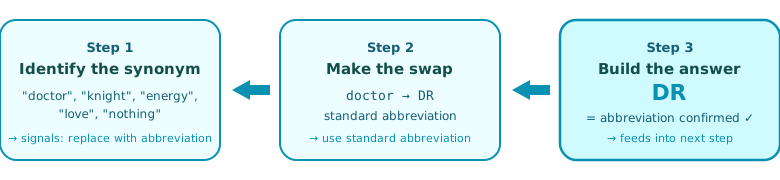
Solving a substitution clue follows a consistent four-step process. Unlike anagram clues where you rearrange letters or container clues where you nest one component inside another, substitution clues require you to recognise which word should be replaced and with what. The method is straightforward once you have internalised the common abbreviation conventions.
- Identify the definition. As with every cryptic clue, the definition sits at the very beginning or very end of the clue. It is a synonym or description of the answer. Locate it first so you know what you are building towards. In substitution-heavy clues, the definition is often a single word or short phrase that seems slightly disconnected from the rest of the clue.
- Spot the word to substitute. Look for words in the wordplay section that have well-known shorter forms. A word like “doctor,” “sailor,” “knight,” “time,” or “love” is almost certainly there to be substituted. These words are oddly specific in context — they feel like they have been chosen for their abbreviation value rather than for the surface meaning of the sentence. That specificity is your signal.
- Apply the replacement. Replace the identified word with its synonym, abbreviation, or conventional shorthand. “Doctor” becomes DR or MO or GP. “Sailor” becomes AB or TAR. “Knight” becomes N or SIR. If the clue involves multiple substitutions (common in charade clues), apply each one independently.
- Verify against the definition. Confirm that the substituted result — either on its own or after further transforms — matches the definition and the enumeration. If the result does not work, consider alternative substitutions. Many words have multiple valid abbreviations (king = K, R, ER, or REX), and trying each one is a normal part of the solving process.
This four-step method applies whether the substitution is the only operation in the clue or the first step in a longer chain. The difficulty of substitution clues comes from two factors: the breadth of the abbreviation vocabulary (there are hundreds of conventions to learn) and the ambiguity of some words (which can have multiple valid substitutions). The mechanics are simple — replace one word with another — but the vocabulary requirement is vast.
Substitution clue abbreviation families
Instead of indicator words (which substitution clues typically lack), the key knowledge for mastering substitution is the vocabulary of standard cryptic abbreviations. These abbreviations are drawn from specific source domains, and learning them by family is far more efficient than memorising individual pairs. Below are the most important abbreviation families, organised by their source. Each family represents a coherent group of conventions that setters draw on regularly. Mastering these families is the single most effective thing you can do to improve your cryptic solving speed.
Chess notation — pieces and moves
Chess notation is one of the richest sources of single-letter abbreviations in cryptic crosswords. “Knight” yields N (not K, which is reserved for king), and “castle” and “rook” both yield R. These conventions are universal across English-language cryptics.
Musical dynamics — volume and expression
Musical terminology provides both single-letter abbreviations (F for loud, P for quiet) and multi-letter ones (the solfege syllables DO, RE, MI, FA, SO, LA, TI). A clue mentioning “loudly” or “softly” in the wordplay is almost certainly signalling a musical substitution.
Chemical symbols — elements and compounds
Chemical symbols are a favourite source for cryptic setters because they produce short, unexpected letter combinations. “Gold” yielding AU and “iron” yielding FE are among the most commonly tested substitutions. These abbreviations come from the Latin names of elements (aurum, argentum, ferrum, cuprum, plumbum, stannum).
Military ranks and roles
Military abbreviations are deeply embedded in the British cryptic tradition. “Sailor” = AB is one of the most frequently tested substitutions in all of cryptic crosswords. “Engineer” = RE (from Royal Engineers) and “gunner” = RA (from Royal Artillery) are also very common. Any word referencing a military role in a cryptic clue is almost certainly there for its abbreviation.
Roman numerals
Roman numerals are a staple of cryptic substitution. Any number word in a clue — “one,” “five,” “ten,” “fifty,” “hundred,” “thousand” — should immediately trigger a Roman numeral substitution check. These are particularly useful because they produce single letters that slot neatly into charade joins.
Compass directions
Compass directions are straightforward but extremely common. Any directional word in a cryptic clue — “northern,” “eastern,” “southerly” — is likely there for its compass abbreviation. Setters also use indirect references: “point” can mean N, S, E, or W (compass points), and “quarter” can similarly refer to any compass direction.
Medical and professional titles
Professional titles provide short, productive abbreviations. “Doctor” is especially versatile: DR is the most common substitution, but MO (Medical Officer) and GP (General Practitioner) also appear. “Nurse” = RN (Registered Nurse) is another high-frequency substitution that appears across many puzzles and difficulty levels.
Sporting and gaming conventions
Sporting conventions are deeply British and occasionally surprising to newcomers. The most important is “love” = O, from tennis scoring where love means zero. “Duck” = O comes from cricket, where scoring zero is called a duck (from the shape of 0 resembling a duck's egg). These conventions appear frequently and are essential to know.
Everyday abbreviations and single-letter conventions
These everyday abbreviations round out the substitution vocabulary. Physics symbols (T for time, E for energy, I for current, R for resistance) overlap with Roman numerals and chess notation, creating the productive ambiguity that setters exploit. “Advertisement” = AD is a particularly common substitution that appears in many puzzles at all difficulty levels.
This list covers the most important abbreviation families, but it is not exhaustive. Cryptic crossword setters draw from an enormous vocabulary, and new abbreviations appear regularly. The key strategy is to learn these families as groups rather than memorising individual pairs — when you see a chess-related word, check the chess family; when you see a musical term, check the music family. Over time, recognition becomes automatic. For a full searchable dictionary of abbreviations, see our abbreviations dictionary.
Common substitution clue pairs
The following table lists the most frequently encountered substitution pairs in cryptic crosswords. These are the abbreviations and synonyms that appear again and again across puzzles of all difficulty levels. If you learn nothing else about substitution, learning these pairs will give you the biggest return on investment for your solving speed. The “source” column indicates which abbreviation family the convention comes from, helping you build mental associations between related pairs.
| Clue word | Substitution | Source |
|---|---|---|
| time | T | Physics |
| knight | N | Chess |
| doctor | DR | Medical |
| sailor | AB | Military |
| love | O | Tennis |
| nothing | O / NIL | General |
| gold | AU | Chemistry |
| iron | FE | Chemistry |
| silver | AG | Chemistry |
| copper | CU | Chemistry |
| king | K / R | Chess / Royal |
| queen | Q / ER | Chess / Royal |
| nurse | RN | Medical |
| advertisement | AD | General |
| loud | F | Music |
| quiet | P | Music |
| engineer | RE | Military |
| soldier | GI | Military |
| one | I / A | Roman / General |
| fifty | L | Roman |
| hundred | C | Roman |
| thousand | M | Roman |
| north | N | Compass |
| south | S | Compass |
| east | E | Compass |
| west | W | Compass |
| right | R | General |
| left | L | General |
| learner | L | General |
| unknown | X / Y | Algebra |
| current | I / AC | Physics |
| energy | E | Physics |
| pig | BOAR / HOG / SOW | Synonym |
| affair | EVENT / DO | Synonym |
| part of the psyche | ID / EGO | Synonym |
This table is a starting point, not a complete list. Hundreds of additional substitution pairs exist across the abbreviation families described above. The pairs listed here are the ones you will encounter most often and should prioritise memorising first. As you solve more cryptic puzzles, your personal abbreviation vocabulary will grow naturally. For the full searchable reference, visit our abbreviations dictionary.
Substitution clue worked examples
The best way to internalise the substitution process is to see it applied to real clues. Below are five fully worked examples, all verified from the Parseword archive. Every example follows the same structure so you can see the method in action across different levels of complexity and different abbreviation families.
Example 1 — synonym substitution (Puzzle #44) Easy
Puzzle #44: “affair” → EVENT
- Identify the word: “affair” appears in the wordplay section of the clue.
- Recognise the substitution type: This is a synonym substitution. The word “affair” does not have a standard abbreviation; instead, it has a direct synonym.
- Apply the replacement: “affair” = EVENT. An affair is an event — a happening, an occurrence, a social gathering. The five-letter synonym replaces the surface word.
- Result: EVENT becomes a component that feeds into subsequent transforms in the puzzle.
- Substitution: “affair” = EVENT
This is the simplest form of substitution: a direct synonym swap. No abbreviation knowledge is needed — just a good vocabulary of English synonyms. The word “affair” could also substitute as DO (as in “a grand affair”), but in this puzzle EVENT is the substitution that makes the rest of the clue work. When multiple synonyms are possible, try each one and see which produces a valid answer in combination with the other transforms.
Example 2 — psychology substitution (Puzzle #44) Easy
Puzzle #44: “part of the psyche” → ID
- Identify the phrase: “part of the psyche” appears in the wordplay. This is a descriptive phrase rather than a single word, but the substitution principle is the same.
- Recognise the substitution type: This is a synonym substitution drawing on Freudian psychology. The “part of the psyche” could be the id, the ego, or the superego.
- Apply the replacement: “part of the psyche” = ID. The id is the primal, instinctual part of the psyche in Freudian theory. It produces a useful two-letter component.
- Result: ID becomes a component for subsequent transforms.
- Substitution: “part of the psyche” = ID
This example shows that substitution can operate on phrases as well as single words. The phrase “part of the psyche” is a descriptive clue for ID — the solver needs general knowledge (Freudian psychology in this case) to recognise the intended synonym. EGO would also be a valid substitution for “part of the psyche,” but ID produces a shorter component that fits the overall puzzle structure. This kind of ambiguity is typical of substitution clues — the solver must test alternatives.
Example 3 — animal synonym (Puzzle #47) Easy
Puzzle #47: “pig” → BOAR
- Identify the word: “pig” appears in the wordplay section.
- Recognise the substitution type: This is a synonym substitution. The word “pig” has several synonyms: HOG, SOW, BOAR, SWINE, and others.
- Apply the replacement: “pig” = BOAR. A boar is an adult male pig, and the four-letter synonym is the one that works in the overall clue structure.
- Result: BOAR becomes a component for the rest of the puzzle.
- Substitution: “pig” = BOAR
Animal synonyms are a rich source of substitution material in cryptic crosswords. A single animal word can yield multiple synonyms of different lengths: “pig” gives HOG (3), BOAR (4), SOW (3), or SWINE (5). The solver tries each possibility until one fits the overall puzzle. Setters love animal words precisely because they offer this variety of lengths. Other productive animal families include: “fish” (BASS, DACE, CHAR, IDE), “deer” (DOE, HART, HIND, ROE), and “bird” (WREN, SWIFT, MARTIN, ROBIN).
Example 4 — everyday abbreviation (Puzzle #47) Easy
Puzzle #47: “advertisement” → AD
- Identify the word:“advertisement” appears in the wordplay section. At thirteen letters, it is suspiciously long for a component — a strong hint that it should be substituted.
- Recognise the substitution type: This is an abbreviation substitution. “Advertisement” has a universally known short form.
- Apply the replacement:“advertisement” = AD. The two-letter abbreviation is the standard short form used in everyday English and is one of the most common substitutions in cryptic crosswords.
- Result: AD becomes a compact two-letter component that feeds into the next transform.
- Substitution: “advertisement” = AD
This example illustrates a key substitution pattern: a long surface word that reduces to a very short abbreviation. When you see an unusually long word in a cryptic clue, ask yourself whether it has a much shorter standard abbreviation. The dramatic length reduction — from thirteen letters to two — is exactly the kind of compression that makes substitution so powerful as a cryptic mechanism. Other examples of this long-to-short pattern include “independent” = I, “Conservative” = C, and “Democrat” = D.
Example 5 — professional title (Puzzle #46) Medium
Puzzle #46: “nurse” → RN
- Identify the word: “nurse” appears in the wordplay section. It feels oddly specific — the surface reading of the clue does not obviously require a medical context.
- Recognise the substitution type: This is a professional title abbreviation. “Nurse” has several possible abbreviations: RN (Registered Nurse), EN (Enrolled Nurse), or SRN (State Registered Nurse).
- Apply the replacement: “nurse” = RN. In this puzzle, the two-letter abbreviation RN is the one that makes the answer work when combined with other components.
- Result: RN becomes a component in the puzzle CAPRICORN: C + APRICO + RN = CAPRICORN.
- Substitution: “nurse” = RN
This example shows substitution as one step in a multi-transform chain. In Puzzle #46, the answer CAPRICORN is assembled from multiple components produced by different transforms: selection, substitution, and deletion, all joined at the end. The substitution of “nurse” = RN provides the final two letters of the nine-letter answer. This is the typical role of substitution in complex puzzles — it produces a letter fragment that feeds into the assembly process. The word “nurse” in the surface reading might suggest caregiving or tending, misdirecting from its true cryptic role as a source of the letters RN.
Notice how each example follows the same four-step structure: identify the word, recognise the substitution type, apply the replacement, and verify the result. The examples progress from simple synonym swaps (affair = EVENT, pig = BOAR) to abbreviation substitutions (advertisement = AD, nurse = RN) and include both single-word substitutions and phrase substitutions (part of the psyche = ID). This range mirrors what you will encounter in practice: substitution operates on vocabulary of all kinds, from everyday synonyms to specialised domain abbreviations.
How to recognise substitution clues
Recognising that a word should be substituted is a critical skill because substitution has no dedicated indicator word. Unlike other clue types where an indicator gives you a clear signal, with substitution you must rely on contextual clues and familiarity with the abbreviation conventions. Here are five key signals to watch for when scanning a clue:
- A word feels oddly specific for the surface meaning. When a clue about cooking mentions a “knight,” or a clue about weather mentions a “sailor,” the word is almost certainly there for its abbreviation value (N and AB respectively). Cryptic setters choose words for their substitution potential, and this often creates a slight mismatch with the surface reading. That mismatch is your signal.
- A word belongs to a known abbreviation family. If you spot a chess piece, musical dynamic, chemical element, military rank, Roman numeral, compass direction, or professional title in the wordplay, it is almost certainly there to be substituted. These abbreviation families are the core vocabulary of substitution, and recognising membership in a family is the fastest path to the correct replacement.
- A word is unusually long relative to its role. Words like “advertisement” (13 letters) or “independent” (11 letters) are too long to be literal components of most crossword answers. Their presence in a clue strongly suggests they should be replaced with a much shorter abbreviation (AD and I respectively). The dramatic length difference between the surface word and its abbreviation is a reliable substitution signal.
- No other clue type indicator is present. If you see no anagram indicator, no reversal indicator, no container indicator, and no homophone indicator, the wordplay is likely operating through substitution (possibly combined with charade joining). Substitution is the “default” operation — when no explicit indicator tells you to do something else, check whether the words can be substituted.
- Common shorthand would make the clue work. If replacing a clue word with I, N, AB, T, DR, O, or another common abbreviation suddenly makes the rest of the clue click into place, the substitution is correct. This trial-and-error approach is perfectly legitimate — experienced solvers mentally test common abbreviations as a matter of routine when parsing a clue.
With practice, spotting substitution opportunities becomes almost automatic. The more abbreviation families you know, the faster you can scan a clue and identify which words are there for their shorthand value. This recognition skill is the foundation of fast cryptic solving, because substitution feeds into every other transform type.
Substitution clue variations
Substitution clues come in three main variations, each drawing on a different type of knowledge. Understanding these variations helps you approach each substitution with the right mental toolkit.
Synonym substitution
The simplest and most intuitive form: a word is replaced with a direct synonym. “Affair” = EVENT, “pig” = BOAR, “blade” = SWORD, “vessel” = POT or ARK or URN. Synonym substitutions require a broad English vocabulary but no specialised abbreviation knowledge. The challenge lies in finding the right synonym — words like “vessel” might mean a ship (ARK, BOAT), a container (POT, URN, VAT), or even a blood vessel (VEIN). Setters exploit this ambiguity to mislead the solver about the intended meaning. Synonym substitutions often produce longer components (3–6 letters) compared to abbreviation substitutions.
Abbreviation substitution
The most distinctive form: a word is replaced with its standard short form from one of the abbreviation families. “Time” = T, “doctor” = DR, “knight” = N, “sailor” = AB, “independent” = I. These substitutions require knowledge of the cryptic abbreviation conventions rather than general vocabulary. They typically produce very short components — often just one or two letters — making them ideal building blocks for charade joins. Abbreviation substitution is the type that most benefits from systematic study of the abbreviation families listed above.
Convention-based substitution
The most surprising form for newcomers: a word is replaced using a crossword-specific convention that is not a standard English abbreviation. “Love” = O (from tennis scoring, where love means zero), “nothing” = O or NIL, “ gold” = AU (from the Latin aurum via chemical symbols), “loud” = F (from the Italian forte via musical dynamics), “flower” = RIVER (because a flower is something that flows). These conventions are the most counter-intuitive substitutions and the ones that most surprise beginners. They require specific cultural knowledge — tennis scoring, Latin-derived chemistry, Italian musical terms — that has been baked into the cryptic crossword tradition over decades. Once you know these conventions, however, they become second nature.
Why learning abbreviations is the key to substitution clue mastery
Of all the skills involved in solving cryptic crosswords, abbreviation knowledge has the highest return on investment. The reason is simple: substitution is the most frequent operation, and abbreviation substitution is the most frequent type of substitution. Every time you learn a new abbreviation convention, you add a tool that will be useful in puzzle after puzzle for the rest of your solving career.
Consider the numbers. A typical Parseword puzzle involves two to five transforms. Substitution appears in the vast majority of these puzzles, often more than once. If a puzzle has four transforms, two or three of them might be substitutions. This means that on any given day, the substitution step is the one you are most likely to encounter and the one where speed matters most. A solver who recognises “sailor” = AB instantly has a massive advantage over one who has to puzzle it out each time.
The good news is that the abbreviation vocabulary, while large, is finite and learnable. There are perhaps 200–300 core abbreviation pairs that cover the vast majority of substitutions in standard cryptic crosswords. Learning them in family groups (chess, music, chemistry, military, Roman numerals, compass, medical, sporting, everyday) makes the task manageable. Most solvers build this vocabulary organically through practice, but deliberate study of the abbreviation families described above accelerates the process enormously.
In Parseword, you can build your abbreviation vocabulary efficiently by using Learn mode. Tapping any word in a puzzle shows its available substitutions, letting you discover new abbreviation conventions in context. Over time, patterns emerge — you start to recognise that any mention of a colour might have a chemical symbol (gold = AU, silver = AG), that any mention of a military role might have a two-letter code (sailor = AB, engineer = RE), and that any mention of a number might have a Roman numeral equivalent. These pattern-recognition skills compound: the more families you know, the faster you can scan a new clue and identify its substitution opportunities.
Tips for solving substitution clues
Even after you understand the mechanics and have begun learning the abbreviation families, a few practical techniques make substitution solving faster and more reliable.
- Start by scanning the clue for abbreviation-family words. Before you try to parse the clue structure, scan it for words that belong to known abbreviation families: chess pieces, musical terms, chemical elements, military ranks, numbers, compass directions, professional titles. These are the words most likely to require substitution, and identifying them first narrows your parsing dramatically.
- If a word seems oddly specific, it is probably there for its abbreviation. Cryptic setters choose words carefully. When “sailor” appears in a clue about gardening, or “knight” appears in a clue about cooking, the word is not contributing to the surface meaning — it is contributing its abbreviation (AB and N respectively) to the wordplay. Train yourself to notice when a word feels out of place in the surface reading.
- Try common single-letter abbreviations first. The most productive substitutions produce single letters: N, T, I, O, R, L, E, S, W, P, F, C, D, M, K, Q. When you are stuck, mentally try replacing each potentially substitutable word with common single-letter abbreviations. The small number of possibilities makes this trial-and-error process fast.
- Remember that substitution is almost always the first step. In multi-transform puzzles, substitution typically comes before joining, containing, reversing, or anagramming. If you are looking at a complex clue, try the substitution pass first: replace each word with its likely abbreviation or synonym, and then see if the remaining transforms become obvious.
- Use Parseword's Learn mode to discover new abbreviations. Tapping any word in Learn mode shows its available substitutions. This is the most efficient way to build your abbreviation vocabulary because you see each convention in the context of a real puzzle, which makes it more memorable than studying a list in isolation.
- When multiple synonyms are possible, try the shortest one first. In most cryptic clues, shorter substitutions are more likely to be correct because they produce compact building blocks that fit neatly into charade joins and other assembly operations. If “vessel” could be POT, URN, ARK, BOAT, or SHIP, try the three-letter options first.
Common mistakes with substitution clues
Even experienced solvers occasionally fall into these traps when working with substitution clues. Being aware of them helps you avoid wasted time and frustration.
- Not knowing the abbreviation conventions. This is the single biggest barrier to solving substitution clues, and unfortunately there is no shortcut: you must learn the abbreviation vocabulary through study and practice. A solver who does not know that “sailor” = AB or “love” = O will be stuck on clues that are straightforward for someone who does. The abbreviation families listed above are your study guide — work through them systematically and you will see rapid improvement.
- Choosing the wrong synonym. A word like “flower” might mean a river (something that flows) rather than a plant. “Lead” might mean the chemical element (PB) or the verb meaning to guide. “Vessel” might mean a ship, a container, or a blood vessel. Cryptic setters love exploiting these double meanings, and choosing the wrong interpretation sends you down a dead end. If your first synonym choice does not work, step back and consider alternative meanings of the word.
- Trying to substitute every word in the clue. Usually only one to three words in a clue need substitution. The remaining words serve other roles: the definition, indicator words for other transforms, or literal components that enter the answer unchanged. Over-substituting leads to confusion because you end up with more fragments than you need and cannot see how they fit together.
- Ignoring convention-based substitutions. Newcomers to cryptics often focus on obvious abbreviations (DR, AB, RN) but overlook the more surprising conventions (love = O, gold = AU, loud = F). These convention-based substitutions are just as common as straightforward abbreviations, and missing them leaves gaps in your solving ability. Make sure to study the sporting, chemical, and musical conventions alongside the more intuitive abbreviation families.
- Not considering multiple possible abbreviations for the same word. “Doctor” could be DR, MO, or GP. “King” could be K, R, or ER. “Nurse” could be RN, EN, or SRN. If your first substitution does not produce a valid answer when combined with the other components, try alternative abbreviations for the same word before giving up on the parse entirely.
Practice substitution clues
The best way to build fluency with substitution is to practise recognising abbreviation families and applying replacements in real puzzle contexts. Below are practice opportunities that let you apply everything you have learned in this guide.
Archive puzzles featuring substitution
Three puzzles in the Parseword archive prominently feature substitution as a key step. Working through these puzzles gives you hands-on experience with different abbreviation families and synonym conventions at different difficulty levels.
- Puzzle #44 — synonym substitutions including “affair” = EVENT and “part of the psyche” = ID. A clear example of how substitution feeds into the rest of the puzzle.
- Puzzle #46: CAPRICORN — professional title substitution: “nurse” = RN. Shows substitution as one step in a multi-transform chain alongside selection and deletion.
- Puzzle #47 — mixed substitutions including “pig” = BOAR (synonym) and “advertisement” = AD (abbreviation). Demonstrates both major substitution types in a single puzzle.
Abbreviation family drill
For each word below, identify the abbreviation family it belongs to and write the standard cryptic substitution. This builds the instant-recognition skill that is essential for fast solving.
- sailor → (Answer: AB — Military)
- gold → (Answer: AU — Chemistry)
- knight → (Answer: N — Chess)
- loud → (Answer: F — Music)
- fifty → (Answer: L — Roman numerals)
- love → (Answer: O — Tennis)
- doctor → (Answer: DR — Medical)
- south → (Answer: S — Compass)
- iron → (Answer: FE — Chemistry)
- time → (Answer: T — Physics)
Parseword practice
Parseword puzzles almost always begin with a substitution step. In Learn mode, tapping any word shows its available substitutions, making it the most efficient way to build your abbreviation vocabulary. Try solving today's puzzle with a focus on identifying which words need to be substituted — pay attention to which abbreviation family each substitution draws from. Try today's hints.
For more structured practice with all cryptic clue types including substitution, explore Parseword's Learn mode, which highlights indicator words with colour-coded underlines and shows available substitutions for every word. The visual feedback trains you to recognise substitution opportunities faster when solving newspaper cryptics where no such aid is provided.
Substitution clue video tutorials
Visual learners can supplement this written guide with video tutorials from established cryptic crossword channels. Watching an experienced solver work through substitution clues step by step reinforces the abbreviation conventions and helps you internalise the recognition patterns faster than reading alone.
Comprehensive guide covering substitution clue abbreviation conventions alongside all other cryptic clue types.
Doctor Azmain's beginner tutorial demonstrating substitution clue techniques and common abbreviations.
Teach Wonderful's beginner guide covering how substitution clues replace words with synonyms and abbreviations.
Substitution clues in Parseword
In Parseword, substitution is almost always the first step in any multi-step puzzle. The game presents you with a cryptic clue and asks you to apply transforms in sequence, and substitution is typically where you begin. The substitution transform replaces a surface word with its shorter synonym or abbreviation, producing the letter fragments that subsequent transforms will assemble.
Parseword's step-by-step approach makes the role of substitution particularly clear. In a typical puzzle, you first apply substitution to replace clue words with synonyms or abbreviations. Then you might join the results (charade), insert one inside another (container), reverse them, or rearrange them (anagram). This multi-phase pattern — substitute first, then assemble — is the backbone of most Parseword puzzles and mirrors how cryptic clue solving works in traditional newspaper crosswords.
In Learn mode, substitution transforms are highlighted with an amber underline using the substitution colour theme. This visual indicator distinguishes substitution from other transform types (join uses orange, selection uses indigo, deletion uses red, and so on). The colour coding makes it easy to see when a substitution step is expected, even before you start working out which word should be replaced and with what. Tapping a word in Learn mode reveals all of its available substitutions, providing instant access to the abbreviation conventions that would otherwise require memorisation.
Because substitution is so frequent, developing a strong abbreviation vocabulary has an outsized impact on your Parseword performance. Once you can instantly recognise that “sailor” = AB, “knight” = N, and “love” = O, the substitution step becomes near-instant, and you can focus your mental energy on the more complex transforms that follow. Puzzles #44, #46, and #47 in the archive are excellent starting points for practising substitution in context, as each one features prominent substitution steps with different abbreviation families.
Substitution clue FAQ
What makes substitution the most fundamental cryptic operation?
Substitution is the most fundamental cryptic operation because almost every cryptic clue begins with it. Before you can apply any other transform — joining, containing, reversing, anagramming — you first need to replace surface words with their shorter synonyms or standard abbreviations. A word like “knight” becomes N, “doctor” becomes DR, “love” becomes O, and “sailor” becomes AB. These substitutions produce the raw letter material that all other transforms then manipulate. Without substitution, there would be no building blocks for charade joins, no letters to insert in container clues, and no fodder for anagram rearrangement. Mastering the abbreviation conventions is the single biggest unlock for cryptic solving speed. For a comprehensive overview of all cryptic clue types and how they compare, see our cryptic crossword guide.
Why do substitution clues usually have no indicator word?
Unlike anagram clues (which need disorder indicators), homophone clues (which need sound indicators), or container clues (which need insertion indicators), substitution clues typically have no explicit indicator word. The context makes the substitution clear: when a setter writes “knight” in the wordplay, the solver is expected to know that knight = N from chess notation. When “love” appears, the solver recognises that love = O from tennis scoring. The entire cryptic crossword tradition relies on a shared vocabulary of abbreviations and synonyms that both setter and solver understand. This implicit nature is what makes substitution unique — and what makes learning the abbreviation conventions so critical.
What are the most important abbreviation families to learn?
The most productive abbreviation families are: Roman numerals (I, V, X, L, C, D, M), compass directions (N, S, E, W), chess pieces (K for king, Q for queen, N for knight, B for bishop, R for rook), musical dynamics (F for forte/loud, P for piano/quiet), chemical symbols (AU for gold, AG for silver, FE for iron, CU for copper), military ranks (AB for sailor, GI for soldier, RE for engineers), medical titles (DR for doctor, RN for nurse, GP for general practitioner), and single-letter conventions (O for love/nothing, T for time, I for one/current). These families cover the vast majority of substitutions you will encounter. For the complete searchable reference, visit our abbreviations dictionary.
How do substitution clues work in Parseword?
In Parseword, substitution is almost always the first step in any multi-step puzzle. The game presents the cryptic clue and asks you to apply transforms in sequence. Substitution replaces a surface word with its shorter synonym or abbreviation — for example, replacing “affair” with EVENT, or “advertisement” with AD. In Learn mode, you can tap any word to see its available substitutions, which is an excellent way to build your abbreviation vocabulary. Substitution feeds into every other transform: after substituting, you might join the results (charade), insert one inside another (container), reverse them, or rearrange them (anagram). Puzzles #44, #46, and #47 in the archive all feature prominent substitution steps that you can study in Learn mode to see the full process.