What is a homophone clue?
A homophone clue is a type of cryptic crossword clue in which the answer sounds the same as another word when spoken aloud, even though the two words are spelled differently. Like every cryptic clue, a homophone clue contains a definition (a synonym for the answer, always at the very beginning or very end of the clue) and wordplay (the instructions for building the answer). The wordplay in a homophone clue has two key elements:
- The auditory indicator — a word or phrase that tells the solver to think about sound rather than spelling. Common auditory indicators include “sounds like,” “we hear,” “reportedly,” “on the radio,” and “aloud.” The indicator is an instruction to listen, not part of the answer itself.
- The homophone source — the word (or a synonym of a word) in the clue that, when pronounced, sounds like the answer. The source word and the answer are homophones: they share the same pronunciation but have different spellings and different meanings. The solver's job is to identify the source, say it aloud (literally or mentally), and recognise what other word shares that pronunciation.
The crucial insight is that homophone clues operate on a completely different axis from most cryptic wordplay. Other clue types manipulate the written form of words — rearranging letters, extracting substrings, reversing sequences, or nesting components. Homophone clues manipulate the spoken form. The letters on the page are misleading by design: the setter chooses words that look completely different from the answer but sound identical. This is what makes homophone clues both distinctive and occasionally tricky — you must override your instinct to analyse the letters and instead focus on how the words sound when spoken.
Homophone clues tend to be among the shorter clue types because the wordplay is compact: one word sounds like another, signalled by an indicator. There is no complex chain of operations, no multi-step derivation. The difficulty comes entirely from recognising the auditory indicator, identifying the right word to “listen to,” and then making the sound connection to a differently-spelled word that matches the definition. For solvers who are comfortable thinking about pronunciation, homophone clues can be among the fastest to solve.
How homophone clues work
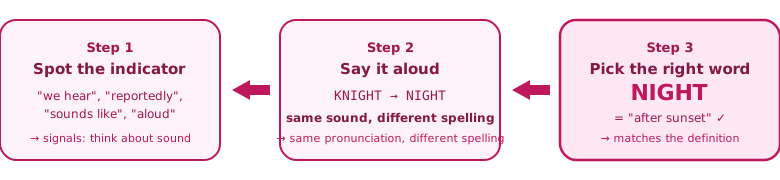
Solving a homophone clue follows a consistent five-step process. Unlike hidden word clues where you scan letters, or anagram clues where you rearrange them, homophone clues require you to switch from visual processing to auditory processing. The method is straightforward once you internalise it.
- Spot the auditory indicator. Scan the clue for a word or phrase that references hearing, speaking, or broadcasting. Look for indicators like “sounds like,” “we hear,” “reportedly,” “on the radio,” “aloud,” “said,” or “by the sound of it.” The auditory indicator is your starting signal — it tells you this is a homophone clue before you do anything else.
- Identify the word to “listen to.” The auditory indicator typically sits next to the homophone source word. Look at the words adjacent to the indicator and determine which one you should pronounce. This is the word whose sound will lead you to the answer.
- Think about what it sounds like. Say the source word aloud or in your head. Now think: what other English word sounds exactly the same but is spelled differently? This is the core of homophone solving — you are searching your mental pronunciation dictionary for a match.
- Find the differently-spelled word. The word that sounds like the source but has a different spelling is your candidate answer. Sometimes there may be more than one homophone (English has many homophones), so you may need to consider multiple options.
- Verify against the definition. Confirm that the differently-spelled word matches the definition at the start or end of the clue. The definition is always at one extreme of the clue, never in the middle. If your candidate homophone does not match the definition, consider whether a different homophone pair is in play, or whether the clue is an indirect homophone requiring a synonym step first.
This five-step method applies to every direct homophone clue. For indirect homophones, where you must first find a synonym before making the sound connection, there is an additional step between steps two and three: derive a synonym of the source word, then find the homophone of that synonym. The core principle remains the same: the auditory indicator tells you to think about sound, and the answer is a word that shares its pronunciation with another word in (or derived from) the clue.
Homophone clue indicator words — complete list
Homophone indicator words all share a common theme: they reference sound, hearing, speaking, or broadcasting. Unlike hidden word indicators that suggest containment, or reversal indicators that suggest direction, homophone indicators suggest that you should listen to a word rather than read it. The following list organises homophone indicators into four meaningful groups based on the type of auditory reference they make. Learning these groups helps you recognise homophone clues faster, because you can associate each indicator with the general concept of “think about how this sounds.”
Hearing — references the act of listening
Speaking — references the act of saying words
Broadcasting — references audio transmission
General — other auditory signals
This list is not exhaustive. Cryptic crossword setters are inventive, and any word that plausibly references sound, hearing, or speaking can serve as a homophone indicator. The key insight is auditory reference: the indicator always points to sound, telling the solver to listen rather than to read. Over time, you will develop an instinct for recognising new homophone indicators even when you have not encountered them before. The word “reportedly” deserves special mention because it is one of the most common and most elegant homophone indicators — it sounds natural in almost any surface reading, which makes it a favourite of setters. For a full searchable dictionary of indicator words across all transform types, see our indicator words dictionary.
Worked homophone clue examples
The best way to internalise the homophone solving process is to see it applied to real clues. Below are five fully worked homophone examples using verified homophone pairs where both spellings are real English words. Every example follows the same five-step structure so you can see the method in action.
Example 1 — direct homophone Easy
“Meat we hear is encounter (4)”
- Auditory indicator: “we hear” — tells us to think about sound.
- Homophone source: “Meat” — the word we need to listen to.
- Sound match: What sounds like MEAT? → MEET. Same pronunciation, different spelling.
- Definition: “encounter” — at the end of the clue. MEET means to encounter.
- Verify: MEET sounds like MEAT, and MEET means “encounter.” The clue works.
- Answer: MEET (sounds like MEAT)
This is a textbook homophone clue. The indicator “we hear” is short and natural-sounding, the surface reading is plausible, and the homophone pair MEAT/MEET is one of the most common in English. Notice how the clue reads as if describing food at a gathering, but the actual instruction is purely about sound: the word for “meat” when heard sounds like the word for “encounter.”
Example 2 — direct homophone Easy
“Dark time, we hear, is warrior (6)”
- Auditory indicator: “we hear” — signals a homophone.
- Homophone source: “Dark time” — a description of NIGHT.
- Sound match: What sounds like NIGHT? → KNIGHT. Same pronunciation, different spelling.
- Definition: “warrior” — at the end of the clue. A KNIGHT is a warrior.
- Verify: KNIGHT sounds like NIGHT, and KNIGHT means “warrior.” The clue works.
- Answer: KNIGHT (sounds like NIGHT)
This example shows how the homophone source does not have to be a single word. “Dark time” is a two-word description of NIGHT, which sounds like KNIGHT. The solver must first interpret “dark time” as NIGHT, then hear the homophone KNIGHT. This adds a small layer of indirection while remaining a direct homophone because the sound-alike word is derived straightforwardly from the clue surface.
Example 3 — direct homophone with “heard” Easy
“Boy heard is post (4)”
- Auditory indicator: “heard” — tells us to think about how a word sounds.
- Homophone source: “Boy” — a synonym for MALE.
- Sound match: What sounds like MALE? → MAIL. Same pronunciation, different spelling.
- Definition: “post” — at the end of the clue. MAIL means post.
- Verify: MAIL sounds like MALE, and MAIL means “post.” The clue works.
- Answer: MAIL (sounds like MALE)
Here “boy” is a synonym for MALE, not the literal word in the clue that sounds like the answer. The solver must interpret “boy” as MALE, then hear the homophone MAIL. The indicator “heard” is a concise, common auditory indicator that appears frequently in published cryptic crosswords.
Example 4 — homophone with “reportedly” Medium
“Navigate, reportedly, is bargain event (4)”
- Auditory indicator:“reportedly” — a classic homophone indicator.
- Homophone source: “Navigate” — a synonym for SAIL.
- Sound match: What sounds like SAIL? → SALE. Same pronunciation, different spelling.
- Definition: “bargain event” — at the end of the clue. A SALE is a bargain event.
- Verify: SALE sounds like SAIL, and SALE means “bargain event.” The clue works.
- Answer: SALE (sounds like SAIL)
The indicator “reportedly” is elegant because it sounds completely natural in the surface reading. A reader might initially parse the clue as “reportedly, X is Y,” treating “reportedly” as a narrative word. But in the cryptic reading, “reportedly” is an instruction: the word for “navigate” (SAIL), when reported or spoken, sounds like SALE. This misdirection between surface and cryptic readings is what makes “reportedly” a setter favourite.
Example 5 — homophone with “by the sound of it” Medium
“Correct, by the sound of it, is to compose (5)”
- Auditory indicator: “by the sound of it” — a longer but unmistakable homophone signal.
- Homophone source: “Correct” — a synonym for RIGHT.
- Sound match: What sounds like RIGHT? → WRITE. Same pronunciation, different spelling.
- Definition: “to compose” — at the end of the clue. WRITE means to compose.
- Verify: WRITE sounds like RIGHT, and WRITE means “to compose.” The clue works.
- Answer: WRITE (sounds like RIGHT)
The longer indicator “by the sound of it” is harder to miss than a single-word indicator like “heard,” making this clue slightly easier to identify as a homophone despite the medium difficulty of the homophone pair itself. The WRITE/RIGHT pair is interesting because the silent W in WRITE is what makes the two words sound identical despite looking very different on the page — a perfect illustration of why homophone clues require auditory rather than visual thinking.
Notice how each example follows the same five-step structure: spot the auditory indicator, identify the homophone source, find the sound match, check the definition, and verify. With practice, these steps collapse into a rapid, almost instinctive process. The key skill is the auditory leap — the moment where you shift from reading the word to hearing it and recognising its sound-alike partner.
How to recognise homophone clues
Recognising a homophone clue quickly is a valuable skill that saves you from trying letter-based techniques on a clue that is fundamentally about sound. Here are five key signals to watch for when scanning a clue:
- An auditory indicator appears in the clue. This is the most reliable signal. Words like “sounds like,” “we hear,” “reportedly,” “on the radio,” “said,” “aloud,” or “by the sound of it” should immediately make you consider a homophone parse. No other clue type uses these auditory words, so their presence is almost a guarantee that you are looking at a homophone clue.
- The clue seems to reference communication or broadcasting. Words like “broadcast,” “on the air,” “on the telephone,” or “in conversation” suggest audio transmission, which is the domain of homophone clues. These words may read naturally in the surface meaning of the clue, but in the cryptic reading they are instructions to think about how a word sounds when spoken or transmitted.
- The clue is shorter than expected for the answer length. Homophone clues tend to be compact because the wordplay is simple: one word sounds like another. There is no need for the extra text that hidden word clues require (to embed the answer) or the multiple components that container clues need. If a clue seems unusually short and contains an auditory word, homophone is a strong candidate.
- You can think of two words that sound the same but are spelled differently. If you read the clue and immediately notice that one word has a well-known homophone partner, you are likely looking at a homophone clue. Pairs like MEAT/MEET, KNIGHT/NIGHT, SALE/SAIL, and WRITE/RIGHT are so common in cryptic crosswords that experienced solvers recognise them on sight.
- Letter-based techniques do not seem to work. If a clue contains an indicator-like word but scanning for hidden words, anagrams, or containers produces no result, step back and ask: could this be about sound? Homophone clues are the type most often missed by solvers who are focused exclusively on letter manipulation. When other parses fail, try saying the words aloud.
With practice, spotting homophone clues becomes almost instant. The auditory indicator is distinctive — no other clue type uses words about hearing, speaking, or broadcasting — and once you tune your recognition to these words, homophone clues stand out clearly from the rest of the puzzle.
Common homophone pairs in cryptic crosswords
Cryptic crossword setters return to certain homophone pairs again and again because they offer clean, unambiguous sound matches that work across most English dialects. Familiarising yourself with these common pairs gives you a significant advantage: when you spot an auditory indicator, you can quickly check whether any word in the clue belongs to a known homophone pair. Below are twenty-five of the most frequently used homophone pairs in cryptic crosswords. For each pair, both spellings are real English words with distinct meanings.
This list covers the pairs you are most likely to encounter, but English has hundreds of homophones. Some pairs are obvious (SEA/SEE), while others are surprising (KNIGHT/NIGHT, with its silent K). Setters particularly favour pairs where the two words look very different on the page, because the visual mismatch makes the clue harder to solve. A pair like FLOUR/FLOWER, where the two words share only the letters F-L-O, is more deceptive than SEA/SEE, where the spellings are obviously related. Building a mental library of homophone pairs is one of the most effective ways to improve your homophone solving speed.
Some pairs have three or more homophones. THERE, THEIR, and THEY'RE all sound the same. WRITE, RIGHT, RITE, and WRIGHT are a four-way set. In cryptic clues, the setter will use the definition to disambiguate which spelling is the answer, but knowing these extended sets helps you consider all possibilities when solving.
Homophone clue variations
Homophone clues come in three main variations, each with its own characteristics and level of difficulty. Understanding these variations prepares you for the full range of homophone clues you will encounter in cryptic crosswords and in Parseword.
Direct homophone
In a direct homophone, a word that appears explicitly in the clue (or is directly described by the clue) sounds like the answer. This is the most common and most straightforward form. “Meat we hear is encounter” is a direct homophone: the word MEAT is right there in the clue, and it sounds like the answer MEET. Direct homophones are the easiest to solve because the sound-alike word is immediately available — you do not need to derive a synonym first. The solving process is: read the source word, say it aloud, recognise the homophone, and confirm against the definition.
Indirect homophone
In an indirect homophone, you first find a synonym of a word in the clue, and then the homophone of that synonym is the answer. This adds an extra derivation step. For example, a clue involving “money” might require you to think: money = CENT, which sounds like SCENT. Indirect homophones are harder because you must make two mental leaps — first from the clue word to its synonym, then from the synonym to its homophone. The auditory indicator still signals that sound is involved, but the word you need to “listen to” is not written in the clue; it must be derived. Setters use indirect homophones to increase difficulty, and they appear more frequently in advanced cryptic crosswords.
Partial homophone
In a partial homophone, only part of the answer is derived through a homophone, with the rest coming from other wordplay techniques. For example, the answer might be built from a homophone of one word combined with an abbreviation or letter selection from another. Partial homophones are relatively rare and tend to appear in more complex clues that combine multiple transform types. They are the most challenging homophone variation because the solver must recognise that only part of the clue uses the homophone mechanism and the rest uses a different technique entirely. The auditory indicator in a partial homophone typically modifies only one specific element of the wordplay, not the entire clue.
The homophone clue dialect challenge
Homophone clues carry a unique complication that no other cryptic clue type faces: pronunciation varies between dialects. A homophone pair that works perfectly in one accent may not work at all in another, and this can cause genuine confusion for solvers whose pronunciation differs from the setter's.
Cryptic crosswords originated in Britain, and most setters use Received Pronunciation (RP) — the standard British English accent associated with southern England — as their baseline. This means that homophone pairs in British cryptics are designed to sound identical in RP, even if they do not in other dialects. Understanding a few key differences between RP and other accents can help international solvers crack homophone clues that might otherwise seem wrong.
The “r” distinction: In RP and many southern British accents, the letter R is not pronounced after vowels (this is called “non-rhotic” speech). This means “caught” and “court” can sound identical, as can “source” and “sauce,” and “poor” and “paw.” In American English and many other dialects (which are “rhotic” — they pronounce the R), these pairs sound quite different. If a homophone clue seems wrong, consider whether the pair might work in a non-rhotic accent.
Vowel mergers: Different dialects merge different vowel sounds. In some British accents, “pa” and “par” are homophones. In many Australian accents, “beer” and “bare” can sound similar. These vowel mergers create homophone pairs that only work in specific regional accents, and setters occasionally use them. Most published cryptics stick to pairs that work in RP, but regional newspapers may use locally valid homophones.
How setters handle dialect: Responsible setters favour homophone pairs that are unambiguous across the widest range of accents. Pairs like MEAT/MEET, KNIGHT/NIGHT, MAIL/MALE, and WRITE/RIGHT work in essentially every English dialect because the sound identity is maintained regardless of accent. Pairs that rely on specific accent features (like the caught/court merger or the poor/paw merger) are used less frequently and are sometimes criticised by solvers who find them unfair. The best homophone clues use universally recognised pairs where the sound match is beyond dispute.
Tip for international solvers: When a homophone clue does not seem to work in your accent, try saying the words with a standard British (RP) accent. Think about whether post-vocalic R is being dropped, whether certain vowel sounds are being merged, or whether syllable stress patterns differ. Over time, you will build a mental model of how RP pronunciation differs from your own, and homophone clues will become much less confusing.
Tips for solving homophone clues
Even after you understand the mechanics, a few practical techniques make homophone solving faster and more reliable.
- Say the words out loud. Homophone clues are designed to be heard, not read. If you are solving silently, you are fighting against the clue's design. Say the words aloud, or at least mouth them silently, and listen for the sound match. Many solvers report that a clue they were stuck on suddenly becomes obvious the moment they say the words out loud.
- Think in British English pronunciation when stuck. If a homophone clue does not seem to work in your accent, try a British English pronunciation. Remember that RP drops post-vocalic R and merges certain vowel sounds. A pair that sounds different in your dialect may be identical in the dialect the setter intended.
- Build your homophone pair vocabulary. The common pairs listed in this guide appear repeatedly in cryptic crosswords. Memorising them gives you an immediate advantage: when you see MEAT in a clue with an auditory indicator, you instantly know to consider MEET. Over time, you will accumulate dozens of pairs and can match them almost without thinking.
- Try synonyms if the direct word does not produce a homophone. If the word next to the auditory indicator does not have an obvious homophone, consider whether it might be an indirect homophone. Think of synonyms for the word and say each synonym aloud. One of the synonyms may have a homophone that matches the definition.
- Check both directions around the indicator. The auditory indicator can sit between the definition and the homophone source on either side. If looking at the words to the right of the indicator does not produce a match, try the words to the left. The definition is always at one extreme of the clue, so the homophone source is on the opposite side of the indicator from the definition.
- Consider multiple homophones for the same sound. Some sounds have three or more valid spellings (WRITE, RIGHT, RITE, WRIGHT). When you identify the sound, think through all possible spellings and use the definition and enumeration to determine which one is the answer.
Common mistakes with homophone clues
Even experienced solvers occasionally fall into these traps when working with homophone clues. Being aware of them helps you avoid wasted time and frustration.
- Reading the letters instead of listening to the sounds. The most common mistake with homophone clues is treating them like any other clue type and analysing the letters. Homophone clues are fundamentally about pronunciation. If you find yourself trying to rearrange letters or scan for substrings in a clue that contains “sounds like” or “we hear,” you are using the wrong technique. Stop reading and start listening.
- Forgetting dialect differences. A homophone pair that does not work in your accent may be perfectly valid in RP. “Caught” and “court,” “source” and “sauce,” “paw” and “poor” — these pairs all rely on specific accent features. If a homophone clue seems broken, try a British pronunciation before giving up.
- Assuming the homophone must be a direct word from the clue. In indirect homophones, you first need to find a synonym, then find the homophone of that synonym. If you only look for homophones of the literal words in the clue, you will miss indirect homophones entirely. When a direct parse does not work, think about synonyms.
- Getting the direction wrong. In the clue “Meat we hear is encounter,” the answer is MEET (which sounds like MEAT), not MEAT (which sounds like MEET). Both words sound the same, but the answer is the one that matches the definition. Always verify that your answer matches the definition, not just that it sounds like another word.
- Confusing homophone indicators with other indicators. The word “vocal” might look like a descriptive adjective, and “broadcast” might seem to reference media. In the surface reading, these words serve one purpose; in the cryptic reading, they are homophone indicators. Train yourself to recognise auditory words as potential indicators, even when they read naturally in the clue's surface meaning.
Practice homophone clues
The best way to build fluency with homophone clues is to practise thinking about sound. Below are practice opportunities that let you apply everything you have learned in this guide.
Homophone pair drill
For each word below, think of a word that sounds the same but is spelled differently. Try to find each pair before checking the answer. This builds the auditory vocabulary that makes homophone clues fast to solve.
- STEAK → (Answer: STAKE)
- THROWN → (Answer: THRONE)
- PEACE → (Answer: PIECE)
- RAIN → (Answer: REIGN)
- BARE → (Answer: BEAR)
- FLOUR → (Answer: FLOWER)
Spot the auditory indicator
Read each clue and identify the auditory indicator word before attempting to solve. Recognising the indicator is the first and most important step. Once you can spot auditory indicators instantly, you know immediately that you are dealing with a homophone clue and can switch to auditory thinking mode. Practise scanning clues for words about hearing, speaking, and broadcasting.
Parseword practice
Parseword puzzles regularly feature homophone clues. In Learn mode, the homophone indicator is underlined in pink, making it easy to identify. Try solving today's puzzle with a focus on spotting auditory indicators first — say the words aloud and listen for the sound match. Try today's hints.
For more structured practice with all cryptic clue types including homophones, explore Parseword's Learn mode, which highlights indicator words with colour-coded underlines. The visual feedback trains you to spot homophone indicators faster when solving newspaper cryptics where no such aid is provided.
Video tutorials for homophone clues
Visual learners can supplement this written guide with video tutorials from established cryptic crossword channels. Watching an experienced solver work through homophone clues step by step reinforces the auditory thinking technique and helps you internalise the indicator recognition patterns faster than reading alone.
Danny Vibes explains homophone clue techniques — how to spot auditory indicators and think about sound rather than spelling.
Comprehensive guide covering homophone clues alongside all other cryptic crossword clue types.
Doctor Azmain's beginner tutorial covering homophone clues and other fundamental cryptic techniques.
Homophone clues in Parseword
In Parseword, homophone clues appear when the game offers a “sounds like” transform option. The auditory indicator is highlighted with a pink underline in Learn mode, visually separating it from the homophone source and the definition. This colour coding makes homophone clues easy to identify even before you start thinking about pronunciation.
Parseword's step-by-step approach to clue solving makes homophone clues particularly intuitive. The solver identifies the word that should be “heard,” and the game shows the sound-alike transformation: the source word becomes its homophone partner. Because the operation is about pronunciation rather than letter manipulation, homophone clues in Parseword help train the auditory thinking skill that is unique to this clue type. When you see the pink indicator underline, stop reading the letters and start saying the words aloud — the answer often becomes obvious when you hear it rather than see it.
Indirect homophone clues in Parseword require an additional transform step: first finding the synonym, then applying the sound-alike transformation. The game breaks this into two distinct operations, helping players understand the two-step process that indirect homophones require. This multi-step interaction is valuable preparation for solving indirect homophones in newspaper cryptics, where the synonym and homophone steps must be combined mentally without visual guidance.
Homophone clue FAQ
What makes homophone clues different from other cryptic clue types?
Homophone clues are the only cryptic clue type that operates on sound rather than letters. Every other clue type — anagrams, hidden words, containers, reversals — manipulates the written letters of words. Homophone clues ask you to think about pronunciation instead: the answer sounds like another word when spoken aloud. This means you need to shift from visual processing to auditory processing, saying words out loud or in your head rather than scanning letters on the page. An auditory indicator word like “sounds like,” “we hear,” or “reportedly” signals this shift from reading to listening. For a comprehensive overview of all cryptic clue types and how they compare, see our cryptic crossword guide.
Why do some homophone clues only work in certain accents?
English pronunciation varies significantly across dialects. A word pair that sounds identical in Received Pronunciation (standard British English) may sound quite different in American English, Australian English, or regional British dialects. For example, “caught” and “court” are perfect homophones in many British accents but distinct in most American accents. Since cryptic crosswords originated in Britain, setters typically use British pronunciation as the standard. International solvers should be aware that some homophone pairs may not sound identical in their own accent, and thinking in terms of British pronunciation can help when a homophone clue seems not to work. See the dialect challenge section above for detailed guidance on navigating accent differences.
What is the difference between a direct and indirect homophone clue?
In a direct homophone clue, a word that appears explicitly in the clue sounds like the answer. For example, “Meat we hear is encounter” — the word MEAT is right there in the clue, and it sounds like the answer MEET. In an indirect homophone clue, you first find a synonym of a clue word, and then the homophone of that synonym is the answer. For example, “money reportedly” might require you to think: money = CENT, which sounds like SCENT. Indirect homophones are harder because they add an extra derivation step before the sound-matching step. The auditory indicator works the same way in both types — the difference is whether the word you need to “listen to” appears directly in the clue or must be derived from a synonym.
How do homophone clues work in Parseword?
In Parseword, homophone clues appear when the game offers a “sounds like” transform option. The auditory indicator word is highlighted with a pink underline in Learn mode, making it easy to identify. The solver selects the word that needs to be heard differently, and Parseword shows the sound-alike transformation. Because the operation requires thinking about pronunciation rather than letter manipulation, homophone clues in Parseword help train the auditory thinking skill that is unique to this clue type. Indirect homophones add a synonym step before the sound-alike transformation, teaching players how the two operations combine in a hands-on, interactive way.