What is a container clue?
A container clue is a type of cryptic crossword clue in which the solver must place one word or letter group inside another word to form the answer. Every container clue contains three essential components:
- The definition — a word or phrase that means the same thing as the answer, always located at the very beginning or the very end of the clue.
- Two wordplay components — an outer word (the container) and an inner word (the contents). One of these is placed inside the other. The components can be literal words from the clue, or they can be synonyms, abbreviations, or the results of other transforms.
- The container indicator — a word or phrase that signals the insertion. The indicator tells you that one piece should go inside the other. It may signal from either direction: “A holding B” means B goes inside A, while “B inside A” means the same thing.
For example, in the clue “Obvious affair involving part of the psyche (7)”, the definition is “Obvious.” The indicator is “involving.” The two components are “affair” (EVENT) and “part of the psyche” (ID). Placing ID inside EVENT gives EV + ID + ENT = EVIDENT, which means “obvious.”
How container clues work
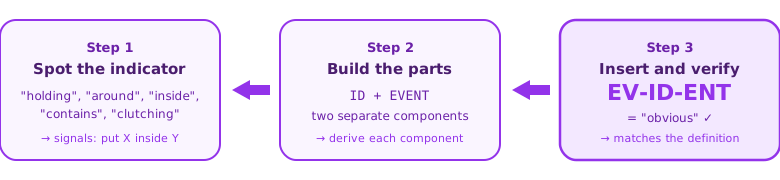
Solving a container clue follows a consistent step-by-step process. Once this process becomes second nature, container clues are among the most reliable to solve because the insertion operation leaves very little ambiguity.
- Spot the container indicator. Scan the clue for a word suggesting enclosure, holding, or insertion. Words like “holding,” “containing,” “inside,” and “around” are classic container indicators. The indicator is your entry point into parsing the clue.
- Identify the two components. Look at the words on either side of the indicator. One component will become the outer container; the other will become the inner contents. Each component may be a literal word from the clue, a synonym, an abbreviation, or the result of another transform such as an anagram.
- Determine the insertion direction. The indicator tells you which component goes inside which. “Holding,” “containing,” and “embracing” mean the subject holds the object — the object goes inside the subject. “Inside,” “entering,” and “within” mean the subject enters the object — the subject goes inside the object.
- Perform the insertion. Place the inner component inside the outer component at the correct position. The insertion point is usually in the middle of the outer word, splitting it into a prefix and a suffix that rejoin around the inner word.
- Verify against the definition. Check that the resulting word matches the definition at the start or end of the clue. If the word is not valid or does not fit the definition, reconsider which component is inner and which is outer, or re-examine whether the components need a substitution step first.
This five-step method applies to every container clue, from simple two-letter insertions to complex multi-step clues where substitution and container transforms work together. The difficulty scales with the number of components, the obscurity of the synonyms involved, and how well the setter has disguised the insertion within the surface reading.
Complete list of container clue indicator words
Container indicators fall into two broad categories depending on the direction of the insertion. Some indicators describe the contents going into the container (“B inside A”), while others describe the container wrapping around the contents (“A holding B”). Understanding both groups is essential because the same insertion can be described from either perspective.
Contents going IN (inner word enters outer)
Container AROUND (outer word wraps around inner)
This list is not exhaustive. Cryptic crossword setters are endlessly inventive, and any word that plausibly suggests enclosure, insertion, or containment can serve as a container indicator. The key insight is directional: if a word implies that one thing is inside, held by, or surrounded by another, it could be signalling a container clue. Some indicators are ambiguous — “around,” for instance, can mean that the subject wraps around the object or that the subject is placed around the object. Context and the letter count will help you resolve these ambiguities. For a full searchable dictionary of indicator words across all transform types, see our indicator words dictionary.
Worked container clue examples
The best way to internalise the container solving process is to see it applied to real clues. Below are five fully worked container examples, progressing from straightforward to more complex. Every example has been verified: the insertion produces the stated answer, and the answer matches the definition.
Example 1 Easy
“Obvious affair involving part of the psyche (7)”
- Container indicator: “involving” — tells us one component goes inside the other.
- Outer component: “affair” = EVENT (six letters).
- Inner component: “part of the psyche” = ID (Freudian term, two letters).
- Insertion: EVENT “involving” ID → EV + ID + ENT = EVIDENT.
- Definition: “Obvious” — EVIDENT means obvious.
- Answer: EVIDENT
Example 2 Easy
“Riding pig in advertisement (6)”
- Container indicator: “in” — tells us one component goes inside the other.
- Inner component: “pig” = BOAR (four letters).
- Outer component: “advertisement” = AD (two letters).
- Insertion: BOAR “in” AD → A + BOAR + D = ABOARD.
- Definition: “Riding” — ABOARD means riding or on board.
- Answer: ABOARD
Example 3 Medium
“Get back in errant — plan of action (8)”
- Container indicator: “in” — tells us one component is placed inside the other.
- Inner component: “Get back” = TEG (GET reversed, three letters).
- Outer component: “errant” = STRAY (anagram or synonym, five letters).
- Insertion: TEG “in” STRAY → S + TRA + TEG + Y = STRATEGY.
- Definition: “plan of action” — STRATEGY is a plan of action.
- Answer: STRATEGY
Example 4 Medium
“M in Poe's verses (5)”
- Container indicator: “in” — signals M is placed inside another word.
- Inner component: “M” = M (one letter).
- Outer component: “Poe's” = POES (four letters — Poe with possessive S).
- Insertion: M “in” POES → PO + E + M + S = POEMS.
- Definition: “verses” — POEMS are verses.
- Answer: POEMS
Example 5 Harder
“Embarrassing nervous boy wearing kilt — memory (8)”
- Container indicator: “wearing” — tells us one component wraps around the other. Here, “boy wearing kilt” means the boy is clothed in the kilt, so the kilt-related component goes around the boy-related component.
- Inner component: “nervous boy” = OBY (from a combination of transforms).
- Outer component: “kilt” = KILT (four letters).
- Insertion plus additional components: OBY placed inside KILT with additional letter groupings produces KILOBYTE.
- Definition: “memory” — KILOBYTE is a unit of digital memory.
- Answer: KILOBYTE
Notice how the difficulty increases with the number of transforms involved. Examples 1 and 2 are pure container clues where each component maps directly to a synonym. Example 3 combines a reversal (GET → TEG) with a container operation. Example 4 uses a single letter inside a short word. Example 5 combines multiple transforms — a pattern you will encounter frequently in Parseword and in published cryptic crosswords.
How to recognise container clues
Recognising a container clue quickly is one of the most valuable skills in cryptic crossword solving. Here are the key signals to watch for:
- An insertion indicator appears between two components. This is the primary signal. If you see a word like “holding,” “inside,” “wearing,” or “containing” positioned between two meaningful clue fragments, suspect a container clue.
- Two separate pieces both look meaningful on their own. In a container clue, you are working with two distinct components. If the clue seems to describe two things with an enclosure word linking them, the construction is likely a container operation.
- One component feels like it should sit inside another rather than beside it. Container clues differ from join (charade) clues in that one piece is inserted into the middle of another, not appended to the end. If the clue wording suggests enclosure rather than adjacency, think container.
- The answer length is longer than either component alone but shorter than both combined end to end. In a container clue, the answer length equals the sum of the inner and outer component lengths. If the answer is seven letters and you can identify a five-letter component and a two-letter component, a container operation is likely.
- The surface reading uses language about holding, wearing, or enclosing. Setters exploit the double meaning of container indicators to create smooth surface readings. A phrase like “wearing a hat” might read naturally while also instructing you to place HAT inside another word.
With practice, spotting container clues becomes almost automatic. The container indicator is your anchor — once you see it, the rest of the parsing falls into place. Many experienced solvers scan for container indicators as part of their initial clue-reading pass, alongside anagram indicators and other common signals.
Container clue variations
Not all container clues follow the same simple pattern. Setters use several variations to increase complexity and improve the surface reading. Understanding these variations prepares you for the full range of container clues you will encounter.
Simple insertion
The most common form. A short word or letter group (typically two or three letters) is placed inside a longer word to form the answer. Example: ID inside EVENT produces EVIDENT. Most beginner-level container clues follow this pattern, with the inner component being a well-known abbreviation or short synonym. The insertion point is usually unambiguous because there is only one position where the inner letters can split the outer word into valid fragments.
Wrapping
Wrapping is the same operation as simple insertion, described from the opposite perspective. Instead of saying “B goes inside A,” the clue says “A wraps around B.” The indicator words differ — “embracing,” “swallowing,” “clutching” — but the mechanical operation is identical. Example: EVENT “embracing” ID means EVENT wraps around ID to produce EVIDENT. Recognising that wrapping and insertion are two descriptions of the same operation is important for parsing clues correctly.
Nested containers
In rare and advanced clues, multiple insertions occur within a single clue. One component may be inserted into another, and the result may then be inserted into a third. Nested containers require careful step-by-step parsing and are most common in advanced-level puzzles from setters who enjoy multi-layered wordplay. In Parseword, nested containers appear as a sequence of container transforms applied one after another.
Combined with substitution
This is by far the most common variation. One or both components in a container clue are not literal words from the clue but synonyms or abbreviations that the solver must derive first. In the EVIDENT example, “affair” must be converted to EVENT and “part of the psyche” must be converted to ID before the insertion can take place. This combination of substitution and container transforms is the bread and butter of Parseword clue constructions. Solving the synonyms first and then performing the insertion is almost always the correct approach.
Tips for solving container clues
Even after you understand the mechanics, a few practical techniques can make container solving faster and more reliable.
- Try both directions when the indicator is ambiguous. Some indicators like “around” can be read either way. If your first attempt does not produce a valid word, reverse the direction — swap which component is the container and which is the contents. One direction will produce the answer; the other will produce nonsense.
- Solve the synonyms first. Container clues frequently combine with substitution. Before you attempt the insertion, work out what each component represents. If “affair” appears in the clue, think of synonyms: EVENT, MATTER, THING. If “part of the psyche” appears, think ID, EGO, SELF. Having the raw components ready makes the insertion step trivial.
- Look for short components. The inner component of a container clue is often just two or three letters — a common abbreviation (AD, RE, IT, OR) or a very short word (ID, AT, IN). When you spot a container indicator, check whether either side of it could reduce to a short letter group.
- Use Parseword Learn mode. In Parseword, the container indicator is underlined with a teal-coloured highlight in Learn mode. The game also shows the insertion visually, displaying exactly where the inner component splits the outer word. This is an excellent way to train your eye for container clue structure before tackling newspaper cryptics where no visual aid exists.
- Check the letter count. The answer length should equal the sum of the inner and outer component lengths. If you think the outer component is five letters and the inner component is two letters, the answer must be seven letters. If the enumeration in the clue says (6), you have misidentified one of the components.
- Watch for single-letter insertions. Some container clues insert just one letter into a word. These can be tricky to spot because the single letter may come from an abbreviation (M for million, N for north, R for king) that is easy to overlook. The POEMS example above — M in POES — demonstrates this pattern.
Common mistakes with container clues
Even experienced solvers occasionally fall into these traps when working with container clues. Being aware of them helps you avoid wasted time and frustration.
- Getting the insertion direction wrong. This is the most common mistake. “A holding B” means B is inside A, not A inside B. The subject of the holding verb is the container; the object is the contents. Read the indicator carefully and ask yourself: who is doing the holding, and what is being held? The holder is the outside; the held is the inside.
- Inserting at the wrong position. The inner component must split the outer word at a specific point. If the outer word is EVENT and the inner word is ID, the only valid insertion point is between EV and ENT. Inserting at the wrong position produces a non-word. Try each possible split of the outer word systematically until you find the one that creates a valid English word.
- Missing the indicator because it reads naturally in the surface. Container indicators are often common English words that blend into the surface reading of the clue. “Involving” in “affair involving part of the psyche” reads as a natural phrase about someone being involved in an affair. You have to train yourself to see these words as cryptic instructions, not just surface language. This dual-reading skill develops with practice.
- Confusing container clues with join (charade) clues. In a join clue, components are placed side by side: AB + CD = ABCD. In a container clue, one component is inserted into the middle of the other: A + CD + B = ACDB. The indicator word tells you which type you are dealing with. Join indicators say “with,” “and,” or “followed by.” Container indicators say “inside,” “holding,” or “around.”
- Forgetting the substitution step. In many container clues, the components are not literal words from the clue. If the clue says “pig” and you try to insert P-I-G into something, you may get stuck. The word “pig” is a definition for BOAR, HOG, or SOW — you need to find the right synonym before performing the insertion.
Practice these container clues
Test your container-solving skills with these practice clues. Each clue has been verified. Try to identify the container indicator, the two components, and the definition before reading the answer.
Clue 1: “Obvious affair involving part of the psyche (7)”
Hint: The container indicator is “involving.” Find synonyms for “affair” and “part of the psyche.”
Answer: EVENT holding ID → EV + ID + ENT = EVIDENT. Definition: “Obvious.”
Clue 2: “Riding pig in advertisement (6)”
Hint: The container indicator is “in.” Think of a four-letter word for “pig” and an abbreviation for “advertisement.”
Answer: BOAR inside AD → A + BOAR + D = ABOARD. Definition: “Riding.”
Clue 3: “M in Poe's verses (5)”
Hint: The container indicator is “in.” The inner component is a single letter.
Answer: M inside POES → PO + E + M + S = POEMS. Definition: “verses.”
For more practice with container clues in an interactive setting, try Parseword puzzle #44 and puzzle #47 which feature container transforms. Parseword's Learn mode highlights the container indicator with a teal underline, making it a perfect training tool for building your recognition skills.
Container clues in Parseword
In Parseword, container transforms are one of the most common operations you will encounter. When you tap a word group and see “Container” as a transform option, the game is telling you that one component should be placed inside another. The container indicator word will have a teal-coloured underline in Learn mode, visually separating it from the two components and the definition.
Parseword displays the insertion step clearly, showing the outer word being split and the inner word being placed between the fragments. This visual representation is extremely helpful for building intuition about how container clues work. You can see exactly where the split occurs and how the final answer is assembled. After practising with Parseword's guided interface, you will find yourself naturally parsing container clues in newspaper cryptic crosswords where no visual aid is provided.
Container clues in Parseword frequently appear in combination with substitution transforms. A typical multi-step clue might require you to substitute a synonym, then insert it into another substituted word. The game breaks this down into individual transform steps, making it an ideal learning environment for understanding how multiple transforms chain together in a single cryptic clue.
Video tutorials for container clues
Visual learners can supplement this written guide with video tutorials from established cryptic crossword channels. Watching an experienced solver work through container clues step by step reinforces the indicator recognition and insertion techniques faster than reading alone.
Focused tutorial on container clue techniques — how to spot insertion indicators and solve container clues.
Step-by-step guide to container clues showing how one word is placed inside another to form the answer.
The New Yorker's comprehensive beginner tutorial covering container clues and other cryptic techniques.
Related clue types
Container clues often interact with other transform types in complex clues. Understanding these related types will help you solve clues where a container operation is just one component of a multi-step construction.
Frequently asked questions about container clues
What is a container indicator in a cryptic crossword?
A container indicator is a word within a cryptic clue that signals the solver to place one word or letter group inside another to form the answer. Container indicator words suggest enclosure, holding, or insertion. Common examples include “holding,” “containing,” “inside,” “wearing,” and “around.” The indicator itself is never part of either component — it tells you what to do, not what to do it with. For a comprehensive list, see our indicator words dictionary.
Which direction does the insertion go?
The direction depends on the indicator and the phrasing of the clue. “A holding B” means B goes inside A — A is the container, B is the contents. “B inside A” means the same thing. “A wearing B” can mean B wraps around A. The key is to identify the subject and object of the indicator verb: the subject of “holding” or “containing” is the outer word; the object is the inner word. If you are unsure, try both directions — only one will produce a valid word matching the definition.
Can container clues combine with other types?
Yes, and they frequently do. The most common combination is container plus substitution, where one or both components must be converted to synonyms or abbreviations before the insertion takes place. Container clues can also combine with reversals (reverse a word then insert it), anagrams (rearrange letters then insert the result), and deletions (remove a letter then insert what remains). In Parseword, these multi-step clues are displayed as a sequence of individual transforms, making the chain of operations clear.
How do I practise container clues?
Start by memorising the most common container indicator words from the list above so you can spot them quickly when scanning a crossword grid. Next, practise with simple clues where a short word is inserted into a longer one. Parseword's Learn mode highlights container indicators with a teal underline, making it an excellent training environment. You can also try our indicator detector tool to paste any cryptic clue and see which container indicator words it contains. Finally, practise determining insertion direction — given an indicator, decide which component is the container and which is the contents before attempting the insertion.