What is a hidden word clue?
A hidden word clue is a type of cryptic crossword clue in which the answer appears as a consecutive sequence of letters embedded within the clue text itself, usually spanning two or more words. Like every cryptic clue, a hidden word clue contains a definition (a synonym for the answer, always at the very beginning or very end of the clue) and wordplay (the instructions for building the answer). The wordplay in a hidden word clue has two key elements:
- The containment indicator — a word or phrase that tells the solver to look inside the surrounding text for the answer. Common containment indicators include “in,” “part of,” “hidden in,” “some,” and “held by.” The indicator is an instruction, not part of the answer itself.
- The carrier text — the words in the clue that contain the hidden answer within their letters. The answer spans across the boundaries between two or more words in this carrier text. The carrier text is chosen by the setter so that the answer's letters form a natural-sounding phrase on the surface, disguising the embedded word.
The crucial insight is that the answer is always a continuous substring of the clue's letters when spaces are removed. It does not skip letters, it does not rearrange them, and it does not require any derivation. The letters appear in exact order, one after another, bridging the gap between two or more printed words. This is what distinguishes hidden word clues from every other cryptic clue type: the answer is literally in the text, not encoded, not abbreviated, not scrambled — just hidden across word boundaries where the solver might not think to look.
Hidden word clues tend to have longer surface text than other clue types of comparable answer length. This is because the setter needs enough surrounding letters to disguise the embedded answer within a natural-sounding phrase. A five-letter hidden answer typically spans two words, so the carrier text alone might be ten or more letters, plus the definition and indicator. This “extra length” is itself a recognition signal: if a clue seems to have more words than necessary for the answer length, consider whether it might be a hidden word clue.
How hidden word clues work
Solving a hidden word clue follows a consistent five-step process. Unlike most other cryptic clue types, where the difficulty lies in the wordplay itself, hidden word clues are mechanically simple once you know the method. The challenge is entirely in spotting the indicator and then scanning carefully across word boundaries.
- Spot the containment indicator. Scan the clue for a word or phrase that suggests the answer is inside, part of, or hidden within the surrounding text. Look for indicators like “in,” “part of,” “some,” “hidden in,” “held by,” “found in,” “buried in,” or “concealed in.” The indicator is your starting signal — it tells you the clue type before you do anything else.
- Understand that the answer is literally in the text. Once you have identified the containment indicator, shift your mindset. You are not looking for a synonym, an abbreviation, or an anagram. You are looking for the actual answer spelled out consecutively in the printed letters of the clue. The answer is already there — you just need to find it.
- Scan across word boundaries. Mentally strip the spaces from the carrier text (the words near the indicator, on the opposite side from the definition). Slide a window of N letters across the resulting string, where N is the answer length given in the enumeration. At each position, check whether the N-letter window forms a valid English word.
- Find the consecutive letters spelling a word. When your scanning window lands on a valid word, you have found the hidden answer. Note exactly where it starts and ends within the carrier text. The answer should bridge at least one word boundary — if it sits entirely within a single word, double-check your parse, because hidden word answers almost always span two or more words.
- Verify against the definition. Confirm that the word you found matches the definition at the start or end of the clue. The definition is always at one extreme of the clue, never in the middle. If your candidate answer does not match any reasonable definition, continue scanning for alternative positions or reconsider whether the clue is truly a hidden word type.
This five-step method applies to every hidden word clue, from the simplest two-word spans to longer answers that bridge three or more words. The difficulty scales primarily with how cleverly the setter has disguised the hidden word within a smooth, natural-sounding surface reading. An elegant hidden word clue reads like a perfectly normal English sentence, and the solver must resist being drawn into the surface meaning and instead focus on the raw letter sequence.
Hidden word clue indicator words — complete list
Hidden word clue indicator words all share a common theme: they suggest that something is inside, part of, or contained within something else. Unlike reversal indicators, which are direction-dependent, hidden word indicators work the same way regardless of whether the clue is across or down in a crossword grid. The following list organises hidden word indicators into four meaningful groups based on the type of containment they suggest. Learning these groups helps you recognise hidden word clues faster, because you can associate each indicator with the general concept of “look inside the text.”
Containment — the answer is inside the text
Partial or fragment — the answer is part of the text
Holding or possession — the text holds the answer
Other — general signals to look in the text
This list is not exhaustive. Cryptic crossword setters are inventive, and any word that plausibly suggests that something is inside, part of, or contained within something else can serve as a hidden word indicator. The key insight is containment: the indicator always points inward, telling the solver to look within the text rather than to transform it. Over time, you will develop an instinct for recognising new hidden word indicators even when you have not encountered them before. The word “from” deserves special mention because it can signal a hidden word (“word from these letters”) or a different clue type entirely depending on context. When “from” appears between two groups of words with enough letters to contain the answer, treat it as a potential hidden word signal. For a full searchable dictionary of indicator words across all transform types, see our indicator words dictionary.
Worked examples
The best way to master hidden word clues is to see the solving process applied to real clues. Below are five fully worked hidden word examples covering different answer lengths, indicator types, and difficulty levels. Every example has been verified: the answer appears as a consecutive letter sequence spanning word boundaries in the clue text.
Example 1 — simple hidden word Easy
“Scottish snack offered in disco nearby (5)”
- Containment indicator: “in” — tells us the answer is hidden inside the surrounding words.
- Definition: “Scottish snack” — at the start of the clue.
- Carrier text: “disco nearby” — the words after the indicator.
- Scan: Strip spaces from “disco nearby” to get DISCONEARBY. Slide a five-letter window: DISCO, ISCON, SCONE, CONEA, ONEAR ... SCONE is a valid word.
- Verify: SCONE is a Scottish snack. The answer spans diSCO NEarby.
- Answer: SCONE
This is a textbook hidden word clue. The indicator “in” is short and natural-sounding, the surface reading is plausible (“offered in disco nearby” reads like a normal phrase), and the answer spans exactly two words. Notice how the word boundaries disguise SCONE: the SC comes from the end of “disco” and the ONE comes from the start of “nearby.”
Example 2 — simple hidden word Easy
“Hero buried in each amplifier (5)”
- Containment indicator: “buried in” — a vivid indicator suggesting the answer is buried inside the text.
- Definition: “Hero” — at the start of the clue.
- Carrier text: “each amplifier” — the words surrounding the hidden answer.
- Scan: Strip spaces: EACHAMPLIFIER. Slide a five-letter window: EACHA, ACHAM, CHAMP, HAMPL ... CHAMP is a valid word.
- Verify: CHAMP means hero or champion. The answer spans eaCH AMPlifier.
- Answer: CHAMP
The indicator “buried in” is more evocative than plain “in,” making the surface reading slightly more misleading. A solver might initially read “hero buried in” as a narrative about a hero being buried, rather than as an instruction to find the hero inside the text. This is the hallmark of a well-crafted hidden word clue.
Example 3 — hidden word with “some” Easy
“Regret some rueful action (3)”
- Containment indicator: “some” — signals that part of the following text contains the answer.
- Definition: “Regret” — at the start of the clue.
- Carrier text: “rueful action”
- Scan: Strip spaces: RUEFULACTION. Slide a three-letter window: RUE, UEF, EFU, FUL, ULA, LAC, ACT, CTI, TIO, ION. RUE is a valid word at position one.
- Verify: RUE means to regret. The answer is in RUEful action — it sits at the very start of the carrier text.
- Answer: RUE
This example shows that the hidden word does not always bridge word boundaries in an obvious way. Here, RUE is the first three letters of “rueful” — the word boundary is at the start of the carrier text rather than in the middle. The indicator “some” is particularly versatile and appears frequently in hidden word clues because it sounds natural in almost any surface reading.
Example 4 — longer hidden word spanning three words Medium
“Courage found in the art I display (5)”
- Containment indicator: “found in” — signals containment.
- Definition: “Courage” — at the start of the clue.
- Carrier text: “the art I display”
- Scan: Strip spaces: THEARTIDISPLAY. Slide a five-letter window: THEAR, HEART, EARTI, ARTID ... HEART is a valid word at position two.
- Verify: HEART can mean courage (as in “take heart” or “have the heart to do something”). The answer spans tHE ART Idisplay — bridging three words.
- Answer: HEART
When the hidden word spans three or more words, it becomes harder to spot visually because the answer is distributed across more boundaries. The scanning technique is especially useful here: by stripping all spaces and methodically sliding a window, you find HEART at position two even though it is split across “the,” “art,” and “I.”
Example 5 — reversed hidden word Medium
“Animal returned in tableware (3)”
- Combined indicator: “returned in” — the word “returned” signals reversal and “in” signals containment. Together they tell us the answer is hidden backwards inside the text.
- Definition: “Animal” — at the start of the clue.
- Carrier text: “tableware”
- Scan backwards: We need a three-letter animal hidden in reverse within TABLEWARE. Read the letters and look for reversed animal names: TAB — reversed is BAT. And indeed, BAT is hidden reversed at the very start:TABleware read backwards gives BAT.
- Verify: A BAT is an animal. The answer is hidden in reverse in TABleware.
- Answer: BAT
Reversed hidden words add an extra layer of difficulty because you must scan in both directions. The indicator typically combines a reversal word (“returned,” “back,” “reflected”) with a containment word (“in,” “within,” “among”). When you see this combination, try scanning the carrier text backwards for the answer.
Notice how each example follows the same five-step structure: spot the indicator, identify the definition, find the carrier text, scan for the hidden word, and verify against the definition. With practice, these steps collapse into a rapid, almost instinctive process. The key variable across examples is the answer length (which affects how many word boundaries it spans) and whether the answer reads forward or backward.
How to recognise hidden word clues
Recognising a hidden word clue quickly is a valuable skill that speeds up your overall cryptic solving. Every hidden word clue shares the same structural fingerprint, and here are five key signals to watch for:
- A containment indicator appears in the clue. This is the most reliable signal. Words like “in,” “part of,” “some,” “hidden in,” “found in,” “buried in,” “held by,” or “among” should immediately make you consider a hidden word parse. Not every “in” signals a hidden word (it can also indicate a container clue), but when combined with other signals below, it becomes a strong indicator.
- The clue text seems longer than necessary for the answer length. Hidden word clues need extra letters around the answer to disguise it. If the clue has more words than you would expect for the enumeration, the setter may be padding the text to hide the answer within it. A five-letter answer with a ten-word clue is suspicious — there are a lot of extra letters, and some of them might be carrying the hidden answer.
- You can see the answer when you strip spaces from part of the clue. This is the definitive test. If you mentally remove spaces from the words around the indicator and can spot the answer as a consecutive substring, you have found a hidden word clue. Train yourself to do this automatically whenever you see a containment indicator.
- The surface reading feels slightly forced or wordy. Setters must engineer the answer letters across word boundaries while maintaining a plausible surface reading. This constraint sometimes produces phrases that are grammatically correct but slightly unusual. If a clue reads naturally but feels like it uses an odd word choice, the setter may have chosen that specific word because its letters contribute to the hidden answer.
- The indicator divides the clue into a short definition and a longer phrase. In a typical hidden word clue, the definition is short (one or two words) and the carrier text is longer (three or more words). The containment indicator sits between them. This asymmetric structure — short definition, indicator, long carrier — is a hallmark of hidden word clues and distinguishes them from other clue types where the wordplay and definition are more balanced in length.
With practice, spotting hidden word clues becomes almost instant. The combination of a containment indicator, extra-long clue text, and an asymmetric definition-carrier structure creates a distinctive fingerprint that experienced solvers recognise at a glance. Because hidden word clues are the easiest to solve once identified, learning to recognise them quickly gives you guaranteed points in every cryptic puzzle.
Hidden word clue variations
Hidden word clues come in three main variations, each with its own characteristics and level of difficulty. Understanding these variations prepares you for the full range of hidden word clues you will encounter in cryptic crosswords and in Parseword.
Simple hidden word
In a simple hidden word, the answer reads forward across two words in the carrier text. This is the most common and most straightforward form. The answer spans exactly one word boundary: some letters come from the end of one word and the remaining letters come from the start of the next word. SCONE is hidden in diSCO NEarby, with SC from “disco” and ONE from “nearby.” CHAMP is hidden in eaCH AMPlifier, with CH from “each” and AMP from “amplifier.” Simple hidden words are the best starting point for beginners because the scanning technique is at its most effective when the answer bridges just one gap.
Long hidden word
In a long hidden word, the answer spans three or more words in the carrier text. This happens when the answer is longer or when the carrier words are short. HEART is hidden in tHE ART Idisplay, bridging three words. Long hidden words are harder to spot visually because the answer is spread across more boundaries, but the scanning technique handles them identically — strip the spaces and slide the window. The extra word boundaries actually make the answer more fragmented and therefore better disguised, which is why setters use short carrier words when they want to increase difficulty.
Reversed hidden word
In a reversed hidden word, the answer is hidden backwards in the carrier text. This variation combines the hidden word technique with a reversal, and the indicator reflects both operations: it includes a containment word (“in,” “within”) and a reversal word (“going back,” “returned,” “reflected”). Typical combined indicators include “going back in,” “returned within,” “reflected in,” and “recalled from.” To solve a reversed hidden word, scan the carrier text backwards for the answer, or equivalently, look for the answer's letters in reverse order reading forward. BAT is hidden in reverse in TABleware — reading TAB backwards gives BAT. Reversed hidden words are slightly harder than standard hidden words because you must consider both directions, but they follow the same fundamental technique: the answer is a consecutive substring, just read in the opposite direction.
The scanning technique for hidden word clues
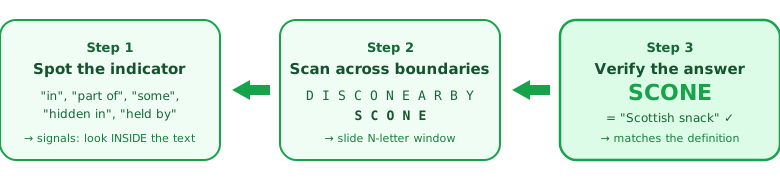
The scanning technique is the single most important tool for solving hidden word clues. It transforms hidden word solving from guesswork into a systematic, repeatable process. Once you master this technique, hidden word clues become almost mechanical to solve. Here is the step-by-step method:
- Write out the carrier text without spaces. Take the words around the containment indicator (on the opposite side from the definition) and concatenate them into a single string of letters. For “disco nearby,” you get DISCONEARBY.
- Note the answer length from the enumeration. The number in parentheses at the end of the clue tells you exactly how many letters the answer has. For (5), you are looking for a five-letter word.
- Slide a window of N letters across the string. Starting at position one, look at the first N letters. Then move one position to the right and look at the next N letters. Continue until you reach the end of the string. Each window position gives you a candidate letter sequence.
- Check each window for a valid word. At each position, ask: is this a real English word? Most positions will produce gibberish, but one position will yield a recognisable word. That is your answer.
- Confirm against the definition. Verify that the word you found matches the definition at the start or end of the clue. If it does, you have solved the clue.
Demonstration: scanning “disco nearby” for a 5-letter word
The window at position three produces SCONE, which matches the definition “Scottish snack.” The technique is exhaustive and reliable: you will never miss the answer as long as you check every window position. In practice, experienced solvers do not need to check every position — they develop an eye for spotting familiar letter combinations and can jump directly to the answer. But for beginners, the systematic approach guarantees success.
For reversed hidden words, apply the same technique but read each window backwards. Alternatively, reverse the entire carrier string first and then scan forward as normal. Either approach works; use whichever feels more natural. The scanning technique is what makes hidden word clues the easiest cryptic type — you have a mechanical procedure that always produces the right answer when the clue is indeed a hidden word.
Tips for solving hidden word clues
Even after you understand the mechanics of the hidden word clue type, a few practical techniques make solving faster and more reliable.
- When you see a containment indicator, scan immediately. Do not overthink it. The moment you spot “in,” “part of,” “some,” or “hidden in,” strip the spaces from the surrounding text and start scanning. Hidden word clues reward speed and directness, not deliberation. The answer is there — you just need to find it.
- Write out the carrier text on paper. If you are solving on paper, write the carrier letters in a straight line without spaces. This visual aid makes the hidden word jump out far more readily than trying to scan across word boundaries in your head. Many experienced solvers use this technique even after years of practice.
- Check both directions for reversed hidden words. If a containment indicator appears alongside a reversal word (“going back in,” “returned within”), remember to scan backwards. A solver who only scans forward will miss reversed hidden words entirely. Make bidirectional scanning a habit whenever you encounter a compound indicator.
- Use the enumeration to narrow your scan. The answer length tells you exactly how wide your scanning window should be. A three-letter answer means you are looking for a very short word, which narrows the possibilities dramatically. A seven-letter answer means the hidden word spans a larger chunk of text. Match your scanning window to the enumeration and you eliminate most of the search space.
- Hidden word clues are great confidence builders. If you are new to cryptic crosswords, start by looking specifically for hidden word clues in every puzzle. They are the easiest to solve once identified, and every successful solve builds the confidence you need to tackle harder clue types. Many experienced solvers still begin each puzzle by scanning for hidden word clues to bank easy wins before moving to more complex types.
- Remember that “in” can signal multiple clue types. The word “in” appears in hidden word clues, container clues, and even some charade clues. If scanning for a hidden word does not produce a valid result, do not assume the clue is unsolvable — it may simply be a different clue type that also uses “in” as an indicator. Flexibility in parsing is essential for cryptic solving.
Common mistakes with hidden word clues
Even experienced solvers occasionally fall into these traps when working with hidden word clues. Being aware of them helps you avoid wasted time and frustration.
- Looking only within single words instead of across boundaries. The most common beginner mistake is searching for the answer entirely within one word. Hidden word answers almost always span at least two words — that is what makes them “hidden.” If the answer sat neatly inside a single word, it would be too obvious. Always scan across word boundaries.
- Confusing hidden word indicators with container indicators. Both hidden word and container clues use words like “in,” “inside,” and “within.” The difference is that in a hidden word clue, the answer is a substring of the literal clue text, while in a container clue, one derived component is placed inside another derived component. If you scan the text and cannot find the answer as a consecutive substring, the clue is probably a container rather than a hidden word.
- Giving up too quickly on scanning. The answer might not be in the first place you look. Hidden words can start at any position in the carrier text, including positions that begin with what look like the “wrong” letters. Use the systematic scanning technique and check every window position before concluding that the clue is not a hidden word.
- Forgetting to check for reversed hidden words. If a clue has both a containment indicator and a reversal word, the answer may be hidden backwards. Solvers who only scan forward will miss these completely. Whenever you see a compound indicator like “returned in” or “going back within,” remember to scan in both directions.
- Misidentifying which end holds the definition. In every cryptic clue, the definition is always at the very start or very end — never in the middle. If you assume the wrong end is the definition, you will look for the hidden word in the wrong part of the clue. If scanning one side does not produce a match, try the other end as the definition and scan the remaining text.
Practice these hidden word clues
The best way to build fluency with hidden word clues is to practise the scanning technique on real examples. Below are practice opportunities that let you apply everything you have learned in this guide.
Scanning drill: find the hidden word
Practise the scanning technique on these carrier texts. Strip spaces, slide a window of the given length, and find the hidden word. Try to find each answer before reading the solution.
- Carrier: “disco nearby” — find a 5-letter word. (Answer: diSCO NEarby = SCONE)
- Carrier: “each amplifier” — find a 5-letter word. (Answer: eaCH AMPlifier = CHAMP)
- Carrier: “the art I display” — find a 5-letter word. (Answer: tHE ART Idisplay = HEART)
Practice with the scanning technique
Apply the step-by-step scanning technique from this guide to any clue you suspect is a hidden word. Write the carrier text without spaces, note the answer length, and slide your window across the letters. The systematic approach guarantees you will find the answer if it is there. Start with published easy cryptic puzzles (many newspapers label their easier cryptic as “Quick Cryptic”), which tend to include one or two hidden word clues per puzzle.
Parseword practice
Parseword puzzles regularly feature hidden word clues. In Learn mode, the hidden word indicator is underlined in green, making it easy to identify. Try solving today's puzzle with a focus on spotting hidden word indicators first — they are often the fastest clues to solve and give you momentum for the rest of the puzzle. Try today's hints.
For more structured practice with all cryptic clue types including hidden words, explore Parseword's Learn mode, which highlights indicator words with colour-coded underlines. The visual feedback trains you to spot hidden word indicators faster when solving newspaper cryptics where no such aid is provided.
Video tutorials for hidden word clues
Visual learners can supplement this written guide with video tutorials from established cryptic crossword channels. Watching an experienced solver work through hidden word clues step by step reinforces the scanning technique and helps you internalise the indicator recognition patterns faster than reading alone.
A comprehensive beginner tutorial covering all major cryptic clue types including hidden word clues, anagrams, and containers.
Detailed walkthrough of cryptic clue types with real examples, demonstrating how to identify and solve hidden word clues in published crosswords.
Step-by-step cryptic solving demonstration showing indicator recognition, definition identification, and the scanning technique for hidden word clues in action.
Hidden word clues in Parseword
In Parseword, hidden word clues appear as an extraction operation where the solver selects the range of carrier words and the game identifies the consecutive substring that forms the answer. The hidden word indicator is highlighted with a green underline in Learn mode, visually separating it from the carrier text and the definition. This colour coding makes hidden word clues easy to identify even before you start scanning.
Parseword's step-by-step approach to clue solving makes hidden word clues particularly intuitive. The solver taps the carrier words, and the game shows the hidden substring being extracted. Because the operation is purely about finding a substring (no rearranging, no abbreviation, no general knowledge), hidden word clues in Parseword are often the first clue type that new players master. This early success builds confidence for tackling more complex transforms like anagrams, substitutions, and containers.
Reversed hidden word clues in Parseword combine the hidden word extraction with a reversal transform. The solver first selects the carrier text, then applies a reverse operation to the extracted substring. The combined indicator (such as “going back in”) is highlighted to show that both containment and reversal are in play. This multi-step interaction helps players understand how hidden word and reversal techniques combine, which is valuable preparation for solving reversed hidden words in newspaper cryptics.
Clue types related to hidden word clues
Hidden word clues share characteristics with several other clue types. Understanding these relationships helps you distinguish between similar-looking clues and choose the right solving approach when a clue could be parsed in multiple ways.
Hidden word clue FAQ
What makes hidden word clues the easiest cryptic clue type?
Hidden word clues are considered the easiest because the answer is literally spelled out inside the clue text. Unlike anagram clues where you must rearrange letters, or substitution clues where you need general knowledge, hidden word clues require only one skill: scanning across word boundaries for a consecutive sequence of letters that forms the answer. The answer is right there in front of you — you just need to find where it starts and where it ends. This makes hidden word clues the ideal starting point for anyone learning to solve cryptic crosswords. The scanning technique described in this guide transforms the solving process into a mechanical procedure: strip spaces, slide a window, check each position. There is no ambiguity and no need for creative leaps. For a comprehensive overview of all cryptic clue types and how they compare in difficulty, see our cryptic crossword guide.
How do I tell the difference between a hidden word clue and a container clue?
Both hidden word and container clues use indicators like “in” and “inside,” which can cause confusion. The key difference is where the answer comes from. In a hidden word clue, the answer is a consecutive substring of the actual clue text — you find it by scanning the printed letters across word boundaries. In a container clue, one component is placed inside another component, and both components are derived through wordplay (abbreviations, synonyms, or other transforms). If the indicator points you to look at the literal letters of the clue surface, it is a hidden word clue. If the indicator tells you to insert one derived element into another, it is a container clue. When in doubt, try the hidden word parse first because it is faster: scan the carrier text for the answer. If no valid word appears, switch to a container parse.
What is a reversed hidden word clue?
A reversed hidden word clue combines the hidden word technique with a reversal. The answer is still embedded inside the clue text as a consecutive sequence of letters, but it reads backwards rather than forwards. These clues use a combined indicator that signals both containment and reversal, such as “going back in,” “reflected in,” “returned within,” or “recalled from.” To solve one, scan the clue text for a letter sequence that, when reversed, produces a word matching the definition. Reversed hidden word clues are slightly harder than standard hidden word clues because you must read the embedded letters in the opposite direction, but the fundamental technique is the same: find a consecutive substring in the text. For more on reversal techniques, see our reversal clues guide.
How do hidden word clues work in Parseword?
In Parseword, hidden word clues appear as an extraction operation. The solver selects the range of carrier words, and the game identifies the consecutive substring that forms the answer. In Learn mode, the hidden word indicator is highlighted with a green underline, making it easy to identify. Because Parseword breaks clue solving into individual transforms, hidden word clues are presented as a single extraction step, making them an excellent starting point for new players learning the mechanics of the app. Reversed hidden words in Parseword add a reversal step after the extraction, teaching players how the two techniques combine in a hands-on, interactive way.